

High-Speed Laser Printer Paper Specifications: Surface Resistivity, Bendtsen Smoothness & 200°C Fuser Stability
Meeting production laser printer paper specifications for 90 to 120 ppm xerographic presses requires controlling three physical boundaries. Keep surface resistivity between 1.0 x 10^10 and 8.0 x 10^10 ohm/sq (ASTM D257-14(2021)e1) and Bendtsen roughness at 100 to 150 mL/min (ISO 8791-2:2013). Lock sheet moisture within 4.0% to 4.5% (ISO 287:2017) to stop 200 C fuser blistering and duplex curl.
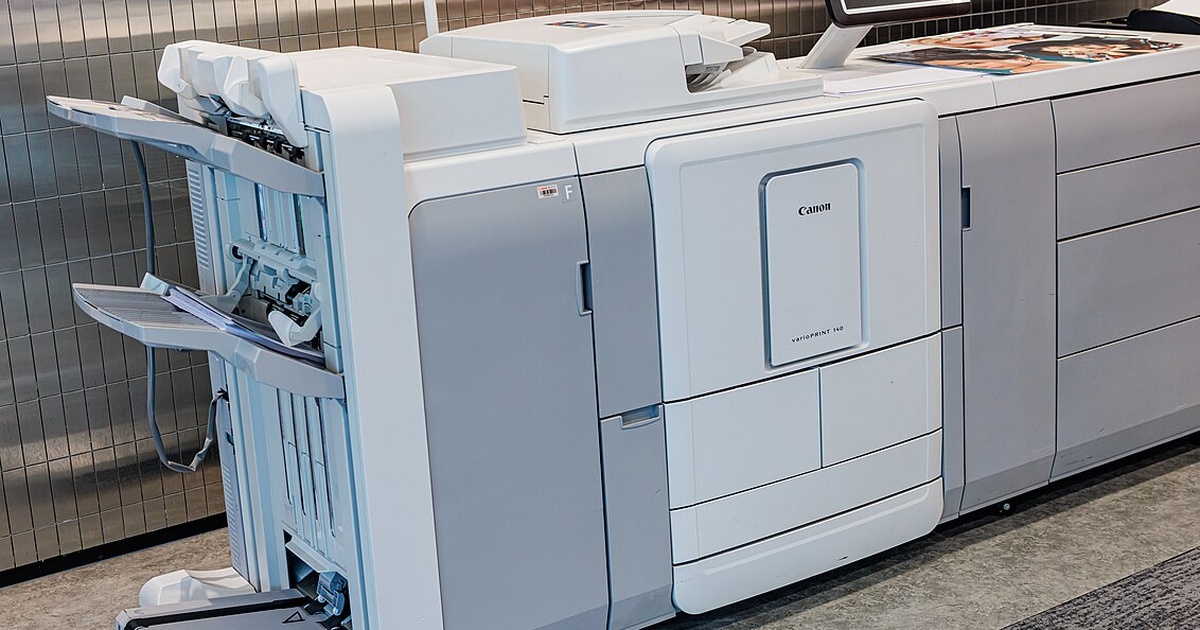
| Laser Engine Parameter | Target Mill Specification | Governing Test Standard | Press Failure Mode Outside Window |
|---|---|---|---|
| Surface Electrical Resistivity | 1.0 x 10^10 - 8.0 x 10^10 ohm/sq (log10 = 10.0 - 10.9) |
ASTM D257-14(2021)e1 / IEC 62631-3-2:2023 | Double feeds (> 10^12) or mottled transfer (< 5 x 10^8) |
| Bendtsen Surface Roughness | 100 - 150 mL/min (80 - 120 mL/min color laser) |
ISO 8791-2:2013 | Unfused toner speckle in solid halftone areas |
| Absolute Sheet Moisture | 4.0% - 4.5% by oven-dry mass |
ISO 287:2017 | Steam blisters at 200 C (> 5.0%) or static jams (< 3.5%) |
Surface Water Absorption (Cobb60) |
20.0 - 24.0 g/m2 (AKD + styrene-acrylate size) |
ISO 535:2023 | Fuser roll linting or poor polyester toner anchoring |
| Bendtsen Air Permeance (Porosity) | 3.5 - 6.5 um/(Pa*s) z-direction venting |
ISO 5636-3:2013 | Internal delamination under heavy duplex CMYK toner |
| Post-Fuser Duplex Axis Curl | <= 3.0 mm diagonal or CD curl at 200 C |
ISO 187:2022 / Press Run Test | Delivery stacker jams and booklet trimmer misregistration |
Commercial print shops, bank statement centers, and corporate reprographics departments run production laser presses at 90 to 120 pages per minute (ppm). Standard office paper that feeds cleanly in a 25 ppm desktop printer frequently fails inside high-speed xerographic engines such as Xerox Iridesse, Canon varioPRINT, Ricoh Pro, and Konica Minolta AccurioPress. At 200 degrees Celsius fuser nip temperatures and millisecond electrostatic transfer windows, minor shifts in electrical conductivity, surface topography, or moisture trigger costly downtime.
Prepared by Dr. Wei Chen and the physical testing team at the GUANHE Paper Mill and QC Lab, this engineering guide breaks down the electrical, mechanical, and thermal laws of production laser paper. B2B importers sourcing under USITC Harmonized Tariff Schedule heading 4802.56.00 can also cross-reference our A4 copy paper specifications and 20GP import guide or request container quotes on our A4 copy paper wholesale page.
Why Surface and Volume Resistivity Govern Electrostatic Toner Transfer
Electrostatic toner transfer is the heart of every laser printer and digital xerographic press. Inside the transfer nip, a bias roller or corona wire applies +1.5 kV to +3.0 kV DC behind the sheet. That electric field pulls negatively charged toner (-20 to -35 uC/g) off the Organic Photoconductor (OPC) drum within 15 to 25 ms.
Surface resistivity (rho_s) is the electrical resistance between opposite edges of a unit square on a material surface, measured in ohms per square (ohm/sq) using concentric ring electrodes under the ASTM D257-14(2021)e1 insulating resistance standard and IEC 62631-3-2:2023. All laboratory resistivity checks must be conditioned at 23 +/- 1 degrees Celsius and 50 +/- 2% relative humidity per ISO 187:2022 and the ASTM D685-26 paper conditioning standard.
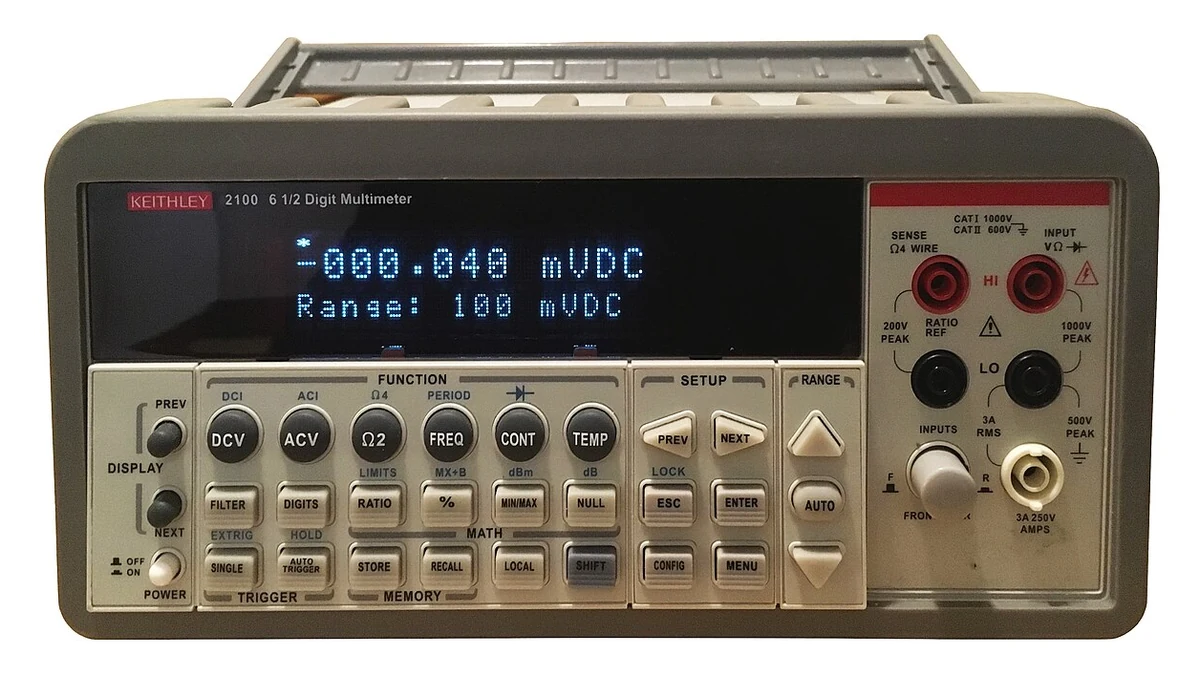
In concentric ring electrode testing at 100 V DC applied potential, the guarded electrical equation links measured surface resistance (R_s in ohms) to electrode geometry.
- Guarded Concentric Ring Resistivity Equation (
ASTM D257-14(2021)e1): Surface resistivity equalsrho_s = R_s x (P / g), wherePis the guarded center electrode perimeter (P = pi x (D1 + D2) / 2). For an inner electrode (D1 = 50.8 mm) and outer ring (D2 = 57.2 mm, gapg = 3.2 mm), multiplying byP / g = 53.0converts ohms intoohm/sq. - Over-Dry Insulating Failure (
< 3.5%Moisture,rho_s > 1.0 x 10^12 ohm/sq): Cellulose fibers are natural dielectrics; electrical conduction occurs primarily via ionic mobility in bound water layers. When sheet moisture drops below3.5%(ISO 287:2017), surface resistivity climbs above1.0 x 10^12 ohm/sq. Static charge accumulates on the sheet surface, causing multi-sheet double feeds at the vacuum pickup head, toner scatter ("halo" defects around text), and sheets clinging inside the finisher stacker. - Over-Moist Conductive Leakage (
> 5.2%Moisture,rho_s < 5.0 x 10^8 ohm/sq): Conversely, when unsealed reams absorb ambient humidity above5.2%moisture (ISO 287:2017), surface resistivity plunges below5.0 x 10^8 ohm/sq. The+2.5 kVtransfer bias current bleeds along the conductive paper surface to the grounded frame, cutting electrostatic toner transfer efficiency from94%down to68%and leaving washed-out, mottled solids. - Size-Press Electrolyte Conductivity Tuning: To stabilize resistivity across seasonal humidity swings, we dose
0.8 to 1.5 kg/MTof food-grade sodium chloride (NaCl) or calcium chloride (CaCl2) at the film size press. This ionic buffer locksrho_sinside the ideal2.0 x 10^10 to 6.0 x 10^10 ohm/sqwindow (log10 = 10.3 to 10.8).
How Bendtsen Roughness, Calendering, and AKD Sizing Control Toner Adhesion
Once electrostatic forces pull toner across the transfer nip, microscopic surface contact determines print resolution and solid-area uniformity. As shown in our five-brand A4 laboratory comparison, smoothness separates dedicated digital laser grades from commodity utility copy paper.
Bendtsen roughness is the rate of air leakage in milliliters per minute (mL/min) escaping between a flat metal blade (0.15 mm width at 1.47 kPa pressure) and paper under ISO 8791-2:2013. A lower flow rate indicates a smoother, tighter sheet profile that mates uniformly against the photoreceptor drum.
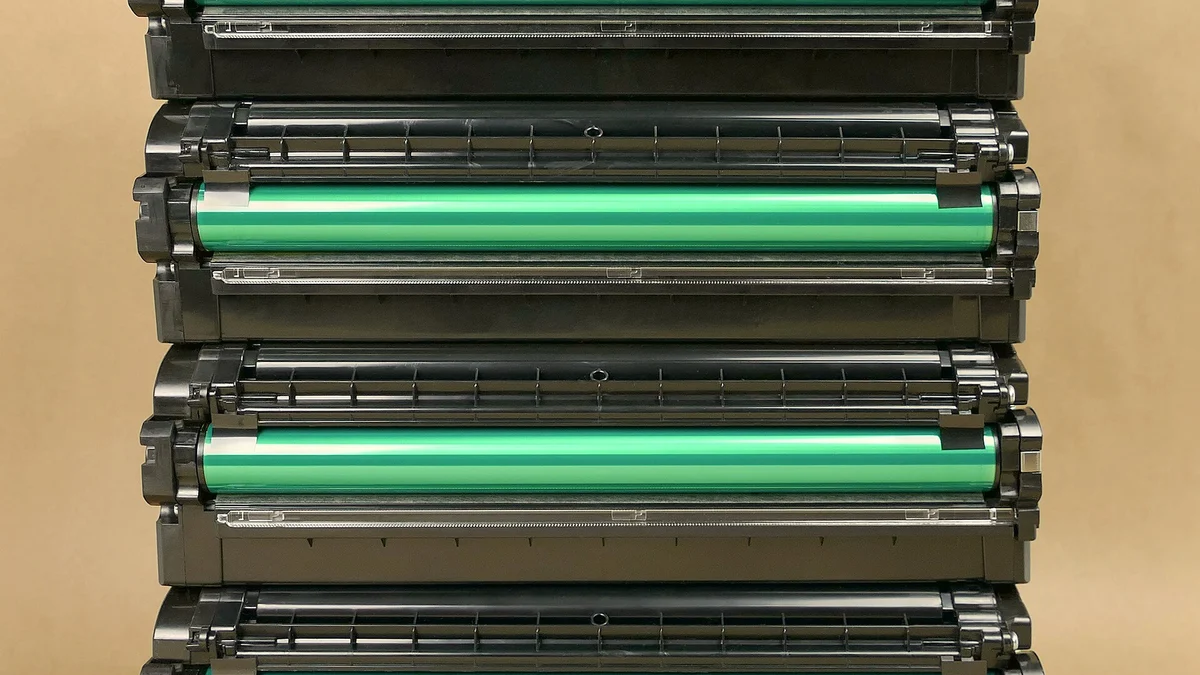
Modern color and monochrome laser engines use spherical Emulsion Aggregation (EA) polyester or styrene-acrylate toner particles measuring 5.0 to 7.0 um in diameter. Controlling surface topography and chemical sizing prevents both void speckles and fuser offset.
- Micro-Void Elimination via Nip Calendering (
ISO 8791-2:2013): Commodity copy paper with a Bendtsen roughness of200 to 250 mL/mincontains surface fiber valleys14 to 20 umdeep. In a rigid roll-to-roll transfer nip,6 umtoner particles fail to contact the bottom of those valleys, creating white pinpoint voids across solid black or cyan graphics. Precision steel-to-steel calendering at65 to 90 kN/mlinear nip load compresses roughness to110 to 140 mL/minon 80 gsm laser paper. Color digital 90 to 100 gsm grades are calendered further to80 to 115 mL/min. - Two-Sidedness Symmetry (
|TS - BS| <= 15 mL/min): Twin-wire gap formers dewater the pulp web equally from both top side (TS) and bottom wire side (BS), holding Bendtsen roughness differential within<= 15 mL/min. This symmetry guarantees identical gloss and toner density on both sides of a duplex sheet. - AKD Internal Sizing and
Cobb60Balance (ISO 535:2023): Cobb60 water absorptiveness is the mass of water in grams absorbed by1 m2of paper in 60 seconds under a10 mmwater column per ISO 535:2023. Alkaline sizing with Alkyl Ketene Dimer (AKD) and precipitated calcium carbonate (CaCO3) buffers cold-extract pH at8.0 to 9.2(ISO 6588-1:2021) to meet Library of Congress ISO 9706 archival permanence standards. HoldingCobb60at20.0 to 24.0 g/m2with styrene-acrylate surface starch provides42 to 46 mN/msurface energy. Molten toner resin then wets and bonds into the fiber network without cold offset onto fuser rollers.
| Paper Grade Tier | Basis Weight (ISO 536:2019) | Caliper & Bulk (ISO 534:2011) | Bendtsen Roughness (ISO 8791-2:2013) | Surface Resistivity (ASTM D257) | Recommended Laser Press Duty |
|---|---|---|---|---|---|
| Economy Utility Copier | 70.0 g/m2 |
96 - 99 um (1.38 cm3/g) |
180 - 220 mL/min |
8.0 x 10^10 - 3.0 x 10^11 ohm/sq |
Simplex desktop laser < 35 ppm |
| High-Bulk Office Copier | 75.0 g/m2 |
104 - 107 um (1.40 cm3/g) |
140 - 170 mL/min |
3.5 x 10^10 - 9.0 x 10^10 ohm/sq |
Fleet monochrome MFPs 40 - 65 ppm |
| Dedicated High-Speed Laser | 80.0 g/m2 |
107 - 110 um (1.35 cm3/g) |
110 - 140 mL/min |
2.0 x 10^10 - 5.0 x 10^10 ohm/sq |
Production duplex laser 90 - 120 ppm |
| Color Digital Presentation | 90.0 - 100.0 g/m2 |
112 - 124 um (1.24 cm3/g) |
80 - 115 mL/min |
1.8 x 10^10 - 4.5 x 10^10 ohm/sq |
Full-coverage CMYK digital presses |
200°C Fuser Thermodynamics: Steam Blistering Math and Duplex Curl Control
After toner transfer, the sheet enters the fuser assembly, where heated rollers or belts at 185 to 210 degrees Celsius and 400 to 600 kPa fuse toner into the fibers. At 100 ppm (1.67 sheets per second), thermal shock inside the fuser nip is extreme.
Fuser blistering is the localized internal delamination of a paper web caused by flash-vaporized bound water trapped beneath impermeable duplex toner layers when z-direction air permeance is too low. We can compute the exact steam expansion volume generated inside a single A4 sheet during a 200 C fuser pass.
- Single-Sheet Bound Water Mass (
ISO 287:2017): One A4 sheet (210 x 297 mm=0.06237 m2, ISO 216:2007) at80.0 g/m2(ISO 536:2019) weighs0.06237 m2 x 80.0 g/m2 = 4.9896 g. At4.2%oven-dry moisture (ISO 287:2017), the sheet holds4.9896 g x 0.042 = 0.2096 g(209.6 mg) of water. - Ideal Gas Steam Expansion at
200 C(473.15 K): A200 Cfuser pass flash-evaporates1.0%of sheet mass (49.9 mgor0.050 gof water,n = 0.050 / 18.015 = 0.002775 mol, ISO 287:2017). Under the ideal gas law (P = 101.325 kPa,R = 8.314 J/(mol*K),T = 473.15 K),V = nRT / P = 0.1077 L = 107.7 cm3of steam per sheet. Because50 mgof liquid water occupies only0.050 cm3, flash vaporization multiplies volume by2,154 timeswithin milliseconds! - Z-Direction Air Permeance Venting (
ISO 5636-3:2013): When printing heavy two-sided CMYK color solids (> 220%total toner coverage), melted plastic toner seals both outer faces of the sheet. If base paper is over-calendered below1.5 um/(Pa*s)air permeance (ISO 5636-3:2013) or exceeds5.0%moisture (ISO 287:2017), that107.7 cm3steam burst cannot escape. It delaminates the fiber network whenever Scott internal bond falls below150 J/m2, whereas our grades maintain3.5 to 6.5 um/(Pa*s)permeance and>= 220 J/m2bond. - Hygroexpansivity and Post-Fuser Curl Control: Uneven moisture loss between Pass 1 and Pass 2 of a duplex print job causes differential fiber shrinkage across the cross direction (CD). We lock reel-end moisture at
4.0% to 4.5%(ISO 287:2017) and seal every 500-sheet ream in80 gsmpoly-extruded (15 umLDPE) barrier wrappers. Following our tropical sea freight moisture control SOP keeps post-fuser axis curl at or below3.0 mm.
GUANHE Laser-Engineered Grades and 20GP Container Selection
Choosing the right basis weight and smoothness profile prevents service calls across high-speed digital print rooms and corporate fleets. Our A4 copy paper catalog supplies four factory-calibrated laser grades engineered for zero-jam performance and shipped globally under ICC Incoterms 2020 rules and U.S. Department of Commerce trade guidelines.
| Product Grade & Direct Link | Basis Weight & Caliper (ISO 536 / 534) | Bendtsen Roughness & Resistivity | Brightness & Whiteness (ISO 2470-2 / 11475) | 20GP FCL Container Payload (HS 4802.56.00) |
|---|---|---|---|---|
| Dedicated Laser Printer Paper | 80 / 90 gsm; 107 - 116 um |
110 - 130 mL/min; 2.5 x 10^10 ohm/sq |
103% - 105% D65; 166 CIE; 95% opacity |
8,000 reams (1,600 boxes / 19.96 MT at 80G) |
| Xerox Digital Copy & Laser Paper | 80 gsm; 106 - 109 um |
130 - 150 mL/min; 4.0 x 10^10 ohm/sq |
101% - 102% D65; 162 CIE; 94% opacity |
8,000 reams (1,600 boxes / 19.96 MT) |
| Reflex Ultra Digital 80 GSM Paper | 80 gsm; 107 - 110 um |
120 - 140 mL/min; 3.2 x 10^10 ohm/sq |
102% - 104% D65; 165 CIE; 95% opacity |
8,000 reams (1,600 boxes / 19.96 MT) |
| A3 Laser & Digital Paper (297 x 420 mm) | 80 gsm (4.990 kg/ream); Short-Grain |
115 - 135 mL/min; 3.0 x 10^10 ohm/sq |
102% - 104% D65; 165 CIE; 95% opacity |
4,000 reams (800 boxes / 19.96 MT) |
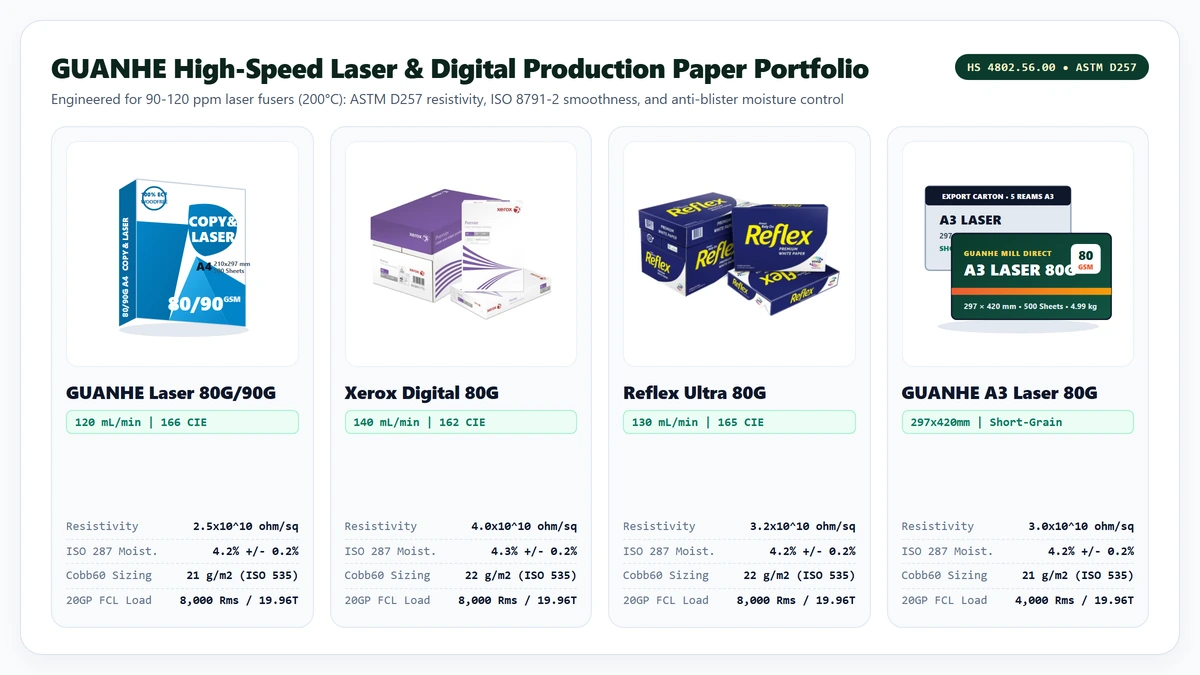
All four grades are manufactured from 100% bleached eucalyptus pulp backed by FSC Chain-of-Custody certification, plantation records aligned with FAO global forestry statistics, or recycled post-consumer specs matching U.S. EPA procurement guidelines. Export shipments use 5-ply ECT-44 master cartons tested to ASTM D4169-23e1 distribution cycle standards and IPPC ISPM 15 heat-treated pallets. Importers preparing public bids or launching a private label digital laser brand can review our government tender RFP & ISO 9706 archival compliance guide and OEM private label 3x20GP manufacturing checklist, or request sample reams and CIF/FOB pricing through our direct proforma RFQ and contact page.
Frequently Asked Questions (FAQ)
What is the ideal surface resistivity for high-speed laser printer paper?
Under ASTM D257-14(2021)e1 and IEC 62631-3-2:2023 at 23 C and 50% RH, optimal surface resistivity for 90 to 120 ppm laser paper is 1.0 x 10^10 to 8.0 x 10^10 ohm/sq. Resistivity above 10^12 ohm/sq causes static double feeds, while values below 5.0 x 10^8 ohm/sq leak transfer bias current and cause mottled print density.
Why does high-moisture copy paper blister or curl inside a 200°C laser fuser?
At 200 degrees Celsius, a single A4 80 gsm sheet flashes 50 mg (1.0% mass, ISO 287:2017) of bound water into 107.7 cm3 of steam, over 2,150 times its liquid volume. If initial sheet moisture exceeds 5.0% (ISO 287:2017) or heavy duplex toner blocks z-direction venting, trapped steam delaminates the fibers into blisters and warps the sheet into severe post-fuser curl.
How does Bendtsen roughness affect toner transfer in color laser printing?
Polymerized color laser toner particles measure only 5 to 7 um in diameter. If paper Bendtsen roughness exceeds 180 mL/min (ISO 8791-2:2013), deep surface fiber valleys prevent uniform drum contact, leaving white pinpoint voids in solid halftones. Calendering laser paper to 80 to 140 mL/min guarantees full toner contact and sharp dot reproduction.
Can standard 70 gsm copy paper run reliably in 100 ppm duplex laser presses?
No, 70 gsm paper (96 to 99 um caliper, >= 90 mN MD stiffness under ISO 2493-1:2025) lacks the bending stiffness needed for 100 ppm duplex gates after 200 C fusing. High-speed duplex presses require 80 gsm (>= 135 mN MD stiffness) or 90 gsm laser-calibrated paper to prevent accordion jams.
All surface resistivity, Bendtsen smoothness, z-direction air permeance, and 200°C fuser steam expansion metrics verified under ASTM D257-14(2021)e1, IEC 62631-3-2:2023, ISO 8791-2:2013, ISO 5636-3:2013, ISO 535:2023, and ISO 287:2017.