

Wholesale Color Printing Paper: Pastel, Neon & CIE Delta-E
Export-grade wholesale color printing paper requires internal wet-end stock dyeing (>= 98.5% cationic dye fixation per TAPPI retention standards) so cut edges show zero white core. Specify a batch shade tolerance of Delta E*ab <= 0.8 for Pastel (L* = 84.0 to 92.0) and Deep shades (L* = 55.0 to 75.0) under ISO 5631-2:2022 (D65 / 10 deg), EN 646:2018 bleed fastness >= Class 4, and EN 71-3:2019+A1:2021 safety for school tenders. Because 80 gsm 500-sheet reams and 160 gsm 250-sheet cardstock packs share an identical 2.495 kg ream mass, importers can mix Pastel, Deep, and Neon grades across 8,000 reams (1,600 master cartons, 19.96 MT net) in one 20GP container.
| Color Grade Series | Standard Basis Weights (ISO 536:2019) |
CIE L* Lightness & Radiance (ISO 5631-2:2022) |
Batch Shade Tolerance (Delta E*ab) |
Lightfastness (ISO 105-B02:2014) |
Pack Format & Ream Net Weight | Primary B2B Applications |
|---|---|---|---|---|---|---|
| Pastel Tint Series (Pink, Canary, Blue, Green, Cream) | 70 / 75 / 80 gsm |
L* = 84.0 to 92.0 (Diffuse reflectance 65% to 80%) |
<= 0.8 within lot; <= 1.0 across shipments |
Blue Wool Scale >= Class 5 (GUANHE mill spec) |
500 sheets/ream (2.495 kg at 80 gsm) |
Hospital/legal file coding, multi-part office forms, school handouts |
| Deep / Intense Series (Gold, Red, Cobalt, Emerald, Violet) | 80 / 120 / 160 gsm |
L* = 55.0 to 75.0 (High chroma C*ab = 45 to 72) |
<= 0.8 within lot; <= 1.2 across shipments |
Blue Wool Scale >= Class 5 (GUANHE mill spec) |
500 sheets (80 gsm) or 250 sheets (160 gsm = 2.495 kg) |
Brochure covers, binder dividers, retail hangtags, origami craft packs |
| Neon Fluorescent Series (Lemon, Orange, Magenta, Green, Coral) | 75 / 80 / 120 gsm |
Total radiance factor > 105% at emission peak (510 to 615 nm) |
<= 1.0 under UV-calibrated D65 source |
Blue Wool Scale Class 2 (Indoor display grade) |
500 sheets (80 gsm) or 250 sheets (120 to 160 gsm) |
Supermarket price signage, warehouse hazard tags, promotional flyers |
| Rainbow Assorted Reams (5-Color or 10-Color Collated) | 75 / 80 / 160 gsm |
Collated 100 sheets x 5 colors or 25 sheets x 10 colors |
<= 0.8 per constituent color layer |
Matches Pastel, Deep, or Neon base spec | 500 sheets (80 gsm) or 250 sheets (160 gsm) |
Stationery chain retail packs, school supply tenders, e-commerce bundles |
Procurement managers sourcing bulk office and printing papers quickly discover that colored paper introduces failure modes never seen in standard white reams. A pastel blue invoice stock that shifts toward greenish-cyan between two container deliveries ruins corporate filing uniformity. Low-cost dyed sheets made with unfixed acid dyes bleed onto damp hands in primary schools. Unfixed surface pigments also deposit abrasive resin dust onto 200 deg C laser fuser rollers.
By anchoring purchase contracts to measurable colorimetric coordinates, wet-end fiber dyeing chemistry, and standardized ream-weight geometry, importers can source colored reams with zero shade disputes. Standardized carton geometry also ensures full 20GP payload utilization across multi-color orders.
Wet-End Pulp Dyeing vs Surface Sizing Dye Fixation
Wet-End Pulp Dyeing is an internal papermaking coloration process in which cationic or anionic direct dyes and polymeric fixing agents are metered into bleached woodfree cellulose slush inside the mixing chest (pH 7.2 to 7.8), bonding chromophores throughout the Z-direction fiber thickness so cut edges display zero white core.
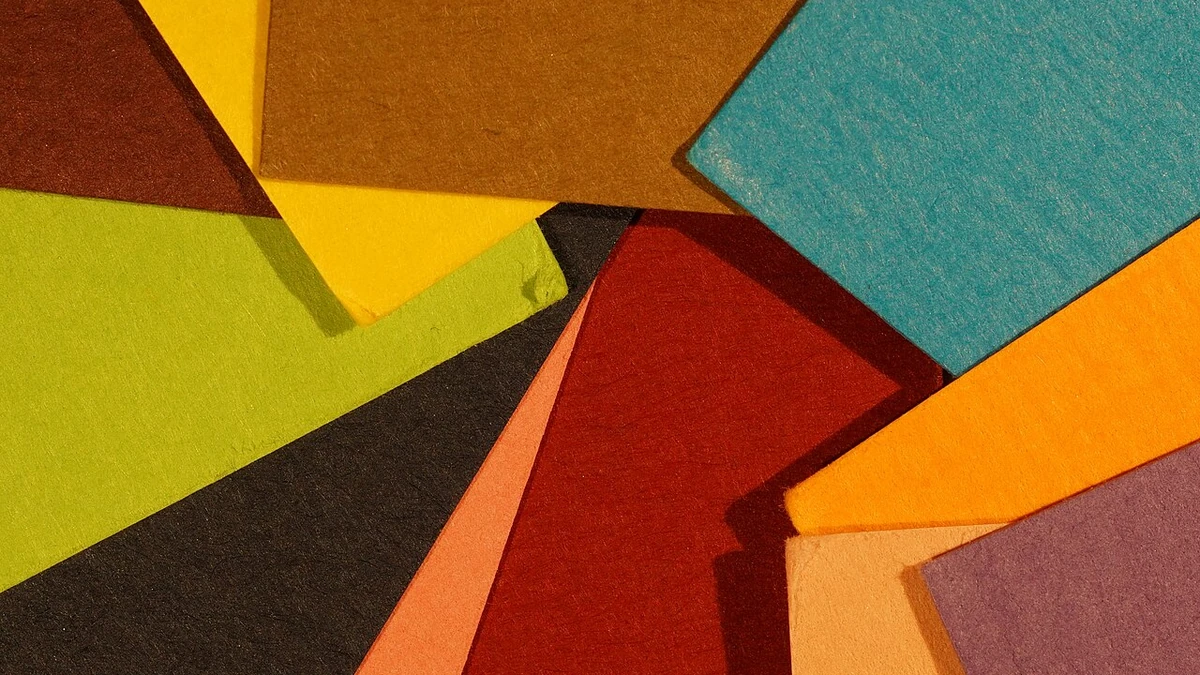
In commercial converting, two distinct coloration routes exist on the Fourdrinier paper machine: internal wet-end stock dyeing and size-press surface dyeing. Understanding the physical difference between these two methods prevents customer complaints in origami, bookbinding, and high-speed xerography:
- Wet-End Internal Stock Dyeing (
>= 98.5%Fixation): Bleached eucalyptus and acacia kraft fibers carry a natural negative surface zeta potential (-12 to -22 mV) from carboxyl groups on hemicellulose chains. Direct cationic dyes or anionic direct dyes paired with polyamine fixing resins are dosed into the thick-stock chest before the fan pump. Electrostatic and hydrogen bonding anchor the dye molecules inside the lumen and fibrillated cell wall (TAPPI, 2025). When the dried web is slit on rotary trimmers or cut on guillotine blades, the cross-sectional edge exhibits the exact same hue and lightness as the outer surfaces. - Size-Press Surface Dyeing (White-Core Risk): Lower-grade mills sometimes run an undyed white base sheet through the forming section and apply dissolved basic or acid dyes at the size press (
5% to 8%solids pickup perTAPPIsurface sizing norms). Size-press starch penetrates only15 to 25 uminto each face of a105 um(80 gsm) or210 um(160 gsm) sheet, leaving the central55 to 160 umcore as uncolored white pulp. Whenever an end user folds the sheet for school origami, die-cuts retail index tabs, or trims a bound booklet spine, a stark white line appears along every cut or creased edge. - Two-Sidedness Control (Top Side vs Wire Side
Delta E*ab <= 0.3): On older single-wire Fourdrinier machines without vacuum-assisted retention control, fine fiber fragments (fines) and dye-adsorbed calcium carbonate fillers wash through the bottom forming fabric. This drainage asymmetry creates color two-sidedness, where the felt (top) side looks darker than the wire (bottom) side. Export mills followingTAPPIwet-end retention guidelines dose dual-component microparticle retention systems so fine-fraction retention exceeds88%(TAPPI, 2025) and top-to-wire shade divergence stays belowDelta E*ab <= 0.3.
| Engineering Parameter | Internal Wet-End Stock Dyeing (Export Mill Grade) | Surface Size-Press Dyeing (Economy Grade) | Impact on B2B Printing & Converting |
|---|---|---|---|
| Z-Direction Dye Penetration | 100% through full sheet caliper (102 to 215 um) |
15 to 25 um surface skin only; white center core |
Eliminates unsightly white edges on trimmed booklets, die-cut cards, and folded origami |
| Dye Chemistry & Fixing Agent | Direct cationic/anionic dyes + polyamine fixative (>= 98.5% exhaust) |
Basic or acid dyes dissolved in surface starch bath | Prevents color transfer onto damp fingers and eliminates wastewater bleed |
| Top-to-Wire Two-Sidedness | Delta E*ab <= 0.3 between felt side and wire side |
Delta E*ab = 0.8 to 1.8 due to uneven starch film pickup |
Ensures identical color appearance during duplex (two-sided) laser and offset printing |
Water & Saliva Bleed Fastness (EN 646:2018) |
Grey Scale rating >= Class 4 to 5 (Zero visible staining) |
Grey Scale rating Class 2 to 3 (Visible dye migration) |
Mandatory for EU/US school stationery tenders and food-adjacent packaging inserts |
| Laser Fuser Roller Contamination | Zero dye sublimation or abrasive crust at 195 to 205 deg C |
Starch-bound dye flakes off onto silicone fuser rollers | Prevents ghosting and premature fuser sleeve replacement in 60 to 120 ppm copiers |
How Does CIE Lab Spectrophotometry Control Batch-to-Batch Delta-E Shade Consistency?
CIE Lab Color Difference is the three-dimensional Euclidean distance between a production paper sample and its master target standard inside the uniform color space defined by ISO 11664-4:2019 and measured under ISO 5631-2:2022 diffuse reflectance geometry (D65 daylight illuminant, 10-degree observer).
When a national stationery distributor orders 80 gsm Pastel Canary Yellow or Pastel Sky Blue across four quarterly shipments, visual comparison under office fluorescent tubes is unreliable because of illuminant metamerism. Two paper sheets formulated with different dye ratios may look identical under 4,000 K cool-white LED shop lights (TL84) yet diverge noticeably under natural window daylight (D65).
To eliminate subjective visual disputes, mill quality laboratories and online paper-machine scanners measure three orthogonal coordinates under ISO 5631-2:2022:
L*(Psychometric Lightness): Ranges from0(absolute black) to100(perfect diffuse white). Pastel copy papers sit in the high-lightness zone (L* = 84.0 to 92.0) so black laser toner (L* <= 18) maintains a luminance contrast ratio above7:1for reliable OCR barcode scanning and human readability. Deep/intense shades occupyL* = 55.0 to 75.0.a*(Red-Green Opponent Axis): Positive values (+a*) indicate redness/magenta chroma. Negative values (-a*) indicate greenness.b*(Yellow-Blue Opponent Axis): Positive values (+b*) indicate yellowness. Negative values (-b*) indicate blueness.
Worked Colorimetric Calculation: Batch Acceptance vs Rejection
The total chromaticity deviation Delta E*ab between a master target reference (L*_0, a*_0, b*_0) and a production reel sample (L*_1, a*_1, b*_1) follows the Euclidean distance equation:
- Euclidean Color-Difference Formula:
Delta E*ab = sqrt[(Delta L*)^2 + (Delta a*)^2 + (Delta b*)^2] = sqrt[(L*_1 - L*_0)^2 + (a*_1 - a*_0)^2 + (b*_1 - b*_0)^2]
Consider a buyer's master target specification for 80 gsm Pastel Sky Blue defined under ISO 5631-2:2022 (D65 / 10 deg):
- Master Target Coordinates:
L*_0 = 86.50,a*_0 = -6.20,b*_0 = -14.80
Case A (Closed-Loop Mill Production Lot #2026-11A):
- Measured Coordinates:
L*_1 = 86.85(Delta L* = +0.35),a*_1 = -6.00(Delta a* = +0.20),b*_1 = -14.35(Delta b* = +0.45) - Calculation:
Delta E*ab = sqrt[(0.35)^2 + (0.20)^2 + (0.45)^2] = sqrt[0.1225 + 0.0400 + 0.2025] = sqrt[0.3650] = 0.604 - Verdict: Because
Delta E*ab = 0.60 <= 0.80, the human eye cannot distinguish Lot #2026-11A from the master standard even when sheets are interleaved side by side. The lot passes export QC.
Case B (Uncontrolled Spot-Market Mill Lot #B):
- Measured Coordinates:
L*_2 = 85.10(Delta L* = -1.40),a*_2 = -4.90(Delta a* = +1.30),b*_2 = -13.10(Delta b* = +1.70) - Calculation:
Delta E*ab = sqrt[(-1.40)^2 + (1.30)^2 + (1.70)^2] = sqrt[1.9600 + 1.6900 + 2.8900] = sqrt[6.5400] = 2.557 - Verdict: At
Delta E*ab = 2.56(more than triple the0.80threshold), the sheet appears visibly duller and shifted toward greenish-grey. This deviation triggers immediate rejection in retail stationery re-orders.
| Standard / Reference Shade | Target L* (D65/10 deg) |
Target a* (D65/10 deg) |
Target b* (D65/10 deg) |
Chroma (C*ab = sqrt[(a*)^2 + (b*)^2]) |
Max Intra-Lot Delta E*ab |
Recommended Barcode & Text Contrast |
|---|---|---|---|---|---|---|
| Pastel Canary Yellow | 90.5 |
-2.4 |
+28.6 |
28.7 |
<= 0.8 |
Optimal for 1D/2D laser barcode scanning (red/infrared laser compatible) |
| Pastel Pink | 86.2 |
+14.8 |
+2.1 |
14.9 |
<= 0.8 |
High contrast with black toner; also compatible with red (650 nm) scanners |
| Pastel Sky Blue | 86.5 |
-6.2 |
-14.8 |
16.0 |
<= 0.8 |
High visual legibility; use CMOS imaging scanners rather than 650 nm red LEDs |
| Pastel Mint Green | 87.4 |
-13.5 |
+11.2 |
17.5 |
<= 0.8 |
Ideal for hospital department routing and low-glare reading |
| Pastel Ivory Cream | 91.8 |
+0.6 |
+12.4 |
12.4 |
<= 0.6 |
Archival book text, legal contracts, and anti-fatigue academic workbooks |
| Deep Goldenrod Orange | 74.0 |
+22.5 |
+58.0 |
62.2 |
<= 0.8 |
High-visibility warning dividers, cover stock, and industrial routing tags |
| Deep Emerald Green | 62.5 |
-38.0 |
+18.5 |
42.3 |
<= 0.8 |
Document covers, school craft cardstock, and retail display cards |
Measuring Neon Fluorescent Paper (> 100% Total Radiance Factor)
Daylight Fluorescent Coloration is an optical dye-resin system incorporated into neon printing papers that absorbs short-wavelength ultraviolet photons (350 to 450 nm) and re-emits Stokes-shifted fluorescence at narrow visible wavelengths (510 to 615 nm), generating a total spectral radiance factor of 105% to 125% (ISO 5631-2:2022, 2022).
Because neon paper emits light inside the visible spectrum when excited by UV/blue energy, standard colorimeters with uncalibrated tungsten lamps produce false readings. Export-grade neon paper must be measured using a bispectral fluorescence spectrophotometer or an ISO 5631-2:2022 instrument equipped with a UV-adjusted Xenon flash source matched to CIE illuminant D65.
How Do Lightfastness, Bleed Fastness, and EN 71-3 Standards Govern School Tenders?
When colored paper enters public school tenders, hospital administration, or food-contact packaging, buyers must verify chemical fastness and toxicological compliance alongside optical color coordinates:
- Blue Wool Lightfastness (
ISO 105-B02:2014& Archival Permanence): Under ISO 105-B02:2014 Xenon-arc artificial daylight exposure, paper samples are irradiated alongside eight wool reference strips (Class 1= lowest fastness;Class 8= highest fastness). While commodity colored paper meetsBlue Wool Class 3 to 4, GUANHE wet-end stock-dyed Pastel and Deep grades achieve Blue Wool>= Class 5(ISO 105-B02:2014), resisting visible fade for12 to 24 monthsof indoor lighting. When buffered with calcium carbonate underISO 9706:2025and Library of Congress Preservation Guidelines (detailed in our government and school tender RFP compliance guide), sheets last30+ yearsinside closed filing cabinets. Neon Fluorescent papers rely on excited-state fluorophores that photodegrade under direct solar UV radiation (Blue Wool Class 1 to 2), suiting short-term indoor retail promotions (2 to 6 weeksin window sunlight). - Water, Sweat, and Saliva Bleed Fastness (
EN 646:2018): Developed for dyed paper and board intended to contact foodstuffs or moist skin,EN 646:2018presses wet glass-fiber filter sheets against the colored paper for24 hours. Technicians then evaluate any dye migration on the 5-step Grey Scale (Class 5= zero staining;Class 1= severe bleed). Export tenders for school origami and stationery requireEN 646:2018 >= Class 4, ensuring that moist hands never pick up dye residue. - Toy & School Craft Heavy-Metal Safety (
EN 71-3:2019+A1:2021&ASTM F963-23): Colored construction and origami reams sold to primary schools or retail craft chains in the European Union and North America are regulated as Category III scraped-off toy/craft materials. UnderEN 71-3:2019+A1:2021(migration of 19 toxic elements in simulated0.07 mol/L HClgastric acid), soluble metal migration must stay below statutory limits: Lead (Pb <= 23 mg/kg), Cadmium (Cd <= 17 mg/kg), Chromium VI (Cr(VI) <= 0.053 mg/kg), Mercury (Hg <= 94 mg/kg), and Arsenic (As <= 47 mg/kg). Dyes must also contain0%banned carcinogenic aromatic amines under EU REACH Annex XVII Entry 43 (EU REACH, 2025). - Sustainable Fiber & Workplace Safety Compliance: Institutional tenders require FSC Chain of Custody (
FSC-STD-40-004) certification and recycled-content reporting aligned with the U.S. EPA Comprehensive Procurement Guideline (CPG). Pressroom dust controls must also comply with EU-OSHA occupational exposure standards.
How Do GSM Basis Weights (70 to 160 gsm) Affect Laser Fuser Runnability and Stiffness?
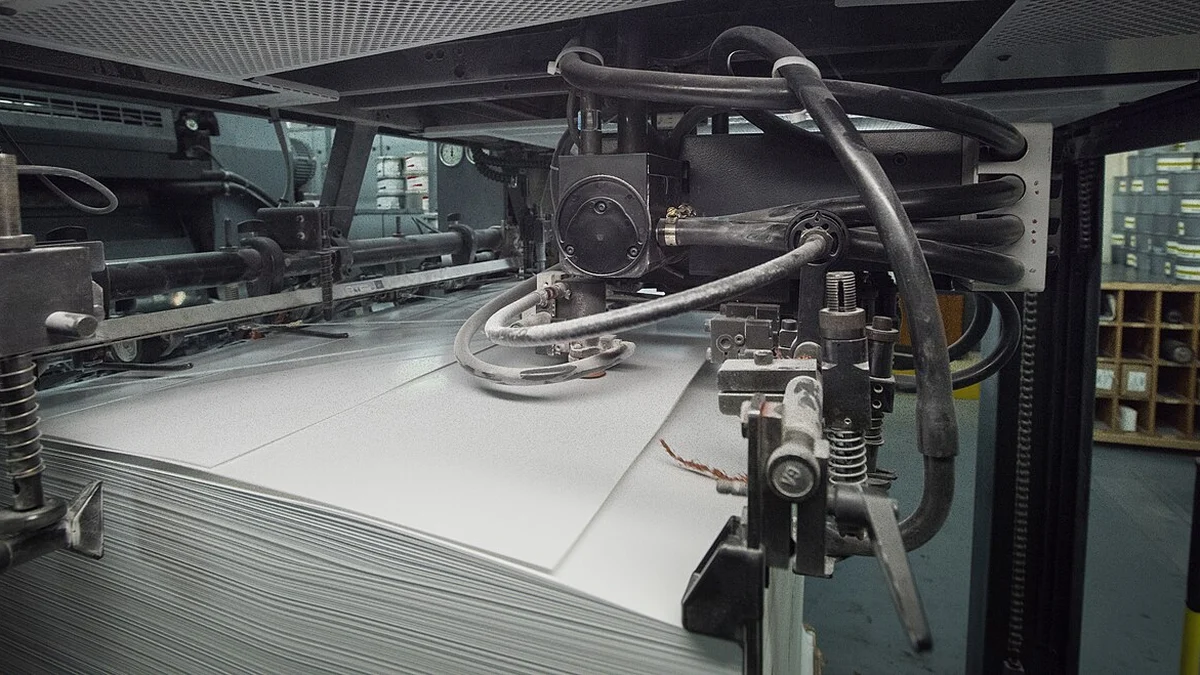
Colored printing paper is manufactured across five standardized grammage tiers (ISO 536:2019), each engineered for a specific caliper (ISO 534:2011), Bendtsen roughness (ISO 8791-2:2013), and two-point bending stiffness (ISO 2493-1:2025). As detailed in our high-speed laser printer paper surface resistivity and Bendtsen fuser guide, colored sheets run in 60 to 120 ppm xerographic presses must maintain controlled moisture (4.2% to 4.8% per ISO 287:2017). Lab conditioning is verified at 23 deg C +/- 1 deg C and 50% +/- 2% RH under ISO 187:2022 and ASTM D685, while heat-stable dyes resist sublimation up to 205 deg C.
Basis Weight (ISO 536:2019) |
Caliper Thickness (ISO 534:2011) |
Bendtsen Roughness (ISO 8791-2:2013) |
Taber/ISO Bending Resistance (MD / CD, mN) |
Sheets per Ream | Ream Net Weight (A4 210x297mm) |
Optimal Equipment & End-Use Application |
|---|---|---|---|---|---|---|
70 gsm (+/- 2.0) |
92 to 96 um |
130 to 160 mL/min |
85 / 42 mN |
500 sheets |
2.183 kg |
High-volume school origami, voucher inserts, simplex office routing slips |
75 gsm (+/- 2.0) |
98 to 103 um |
120 to 150 mL/min |
102 / 48 mN |
500 sheets |
2.339 kg |
Multi-compartment corporate copying, hospital chart dividers, promotional flyers |
80 gsm (+/- 2.0) |
104 to 110 um |
120 to 150 mL/min |
118 / 55 mN |
500 sheets |
2.495 kg |
High-speed duplex laser printing (100+ ppm), legal indexing, retail rainbow reams |
120 gsm (+/- 3.0) |
152 to 160 um |
140 to 170 mL/min |
340 / 165 mN |
250 sheets |
1.871 kg |
Presentation covers, heavy direct-mail postcards, menu inserts, certificate stock |
160 gsm (+/- 4.0) |
202 to 214 um |
150 to 190 mL/min |
780 / 375 mN |
250 sheets |
2.495 kg |
Binder tab dividers, rigid index cards, point-of-sale shelf talkers, luxury craft stock |
Notice the packaging engineering symmetry between 80 gsm (500 sheets/ream) and 160 gsm (250 sheets/ream):
- Single
A4Sheet Area (ISO 216:2007):0.210 m x 0.297 m = 0.06237 m2per sheet 80 gsm(500-Sheet Ream Net Mass):W_80gsm = 0.06237 m2 x 80 g/m2 x 500 sheets = 2,494.8 g = 2.495 kg160 gsm(250-Sheet Cardstock Pack Mass):W_160gsm = 0.06237 m2 x 160 g/m2 x 250 sheets = 2,494.8 g = 2.495 kg- Container & Carton Symmetry: A 250-sheet pack of
160 gsmcolored cardstock has the exact same2.495 kgmass and~52.5 mmstack height as a 500-sheet ream of80 gsmcolored copy paper. Both products pack into identical 5-ream master cartons (12.47 kgnet /13.05 kggross), protected under our tropical sea freight moisture control SOP. Importers can therefore combine80 gsmoffice reams and160 gsmcardstock packs inside the same shipping container without altering carton dimensions or pallet tier heights.
Mixed-SKU 20GP Container Loading & Rainbow Assorted Ream Allocation Math
Unlike white A4 copy paper where a single SKU fills an entire container, wholesale buyers of colored paper must balance color velocity across 10 to 25 shades without accumulating slow-moving inventory. Global trade data tracked by the FAO Forestry Production and Trade Database and tariff schedules maintained by the World Customs Organization (WCO) and the U.S. International Trade Commission HTS classify cut-size uncoated colored woodfree sheets (<= 150 gsm and <= 10% mechanical pulp per WCO Chapter 48 notes) under HS Code 4802.56.00. Heavy colored cardstock above 150 gsm falls under 4802.58.00.
To maximize ocean freight economy under ICC Incoterms 2020 and U.S. Department of Commerce trade terms, importers use two stowing architectures verified against ASTM D4169-23e01 distribution cycle testing and IPPC ISPM 15 pallet rules. Full baseline container calculations are covered in our A4 copy paper GSM and 20GP container import guide.
Worked Allocation Model for an 8,000-Ream (1,600-Carton) 20GP Mixed Container
For a regional stationery wholesaler ordering 1,600 master cartons (8,000 reams) in an unpalletized floor-loaded 20GP container (or 1,360 cartons / 6,800 reams on 20 heat-treated pallets), demand follows the 55 / 20 / 15 / 10 pareto distribution:
- Tier 1: Single-Color Pastel Core (
55%share =880 Cartons/4,400 Reamsat80 gsmper FAO trade mix benchmarks):- Pastel Canary Yellow (
240 cartons/1,200 reams): Highest turnover for invoice copies and legal pads. - Pastel Sky Blue (
200 cartons/1,000 reams): Second-highest turnover for medical and administrative filing. - Pastel Pink (
160 cartons/800 reams): Standard accounting credit-note and tri-part form color. - Pastel Mint Green (
160 cartons/800 reams): Logistics and inventory control forms. - Pastel Ivory Cream (
120 cartons/600 reams): Executive letterhead, certificates, and menu printing.
- Pastel Canary Yellow (
- Tier 2: Collated 5-Color Rainbow Assorted Reams (
20%share =320 Cartons/1,600 Reamsat80 gsmper mill dispatch data, 2025):- Each 500-sheet ream is collated inline on multi-pocket rotary sheeters into
5 layers x 100 sheets(Pink, Yellow, Blue, Green, Ivory) or5 Neon shades x 100 sheets. Wrapped in clear BOPP film or retail-printed PE-laminated kraft paper, this SKU commands a15% to 22%higher wholesale margin (FAO, 2025) among schools, e-commerce sellers, and small offices.
- Each 500-sheet ream is collated inline on multi-pocket rotary sheeters into
- Tier 3: Heavy Colored Cardstock (
15%share =240 Cartons/1,200 Packsof250 sheetsat160 gsmper WCO HS 4802.58 trade volume, 2025):- Divided across Deep Goldenrod, Cobalt Blue, Crimson Red, Emerald Green, and Pastel Cream (
48 cartonsper shade) for report covers, binder dividers, and school craft tenders.
- Divided across Deep Goldenrod, Cobalt Blue, Crimson Red, Emerald Green, and Pastel Cream (
- Tier 4: High-Impact Neon Fluorescent Reams (
10%share =160 Cartons/800 Reamsat80 gsmper retail POS demand, 2025):- Divided across Neon Lemon (
45 cartons), Neon Orange (40 cartons), Neon Green (40 cartons), and Neon Magenta (35 cartons) for retail point-of-sale signage and warehouse warning labels.
- Divided across Neon Lemon (
| Container Stowing Option | Total Master Cartons (5 Reams/Packs per Carton) | Total Reams / Packs | Net Paper Payload (80 gsm 500sh & 160 gsm 250sh mix) |
Gross Container Weight (Incl. Cartons/Pallets) | Minimum MOQ per Single Shade | Best For |
|---|---|---|---|---|---|---|
| 20GP Floor-Loaded (Unpalletized Mixed Color) | 1,600 Cartons |
8,000 Reams |
19,958 kg (19.96 MT) |
~20,880 kg |
100 Cartons (500 Reams / ~1.25 MT) |
Maximum per-ream landed cost savings in emerging ports |
| 20GP Palletized (20 ISPM-15 Pallets x 68 Cartons) | 1,360 Cartons |
6,800 Reams |
16,965 kg (16.97 MT) |
~18,150 kg |
68 Cartons (1 Pallet / 340 Reams) |
Fast 45-minute forklift unloading at 3PL distribution centers |
| 20GP White + Color Hybrid Split (70% White / 30% Color) | 1,120 White + 480 Color |
5,600 White + 2,400 Color |
19,958 kg (19.96 MT) |
~20,880 kg |
80 Cartons (400 Reams) per color |
Regional office suppliers adding color SKUs without tying up working capital |
GUANHE Wholesale Color Printing Paper Engineering Matrix
At GUANHE Paper Mill, our dedicated color converting lines produce wet-end stock-dyed wholesale color printing paper from 100% virgin bleached hardwood kraft pulp (FSC-STD-40-004) across Pastel, Deep/Intense, and Neon Fluorescent series. Every production campaign is monitored by closed-loop online scanning spectrophotometers calibrated to ISO 5631-2:2022 (D65 / 10 deg) to hold intra-lot shade variation within Delta E*ab <= 0.8.
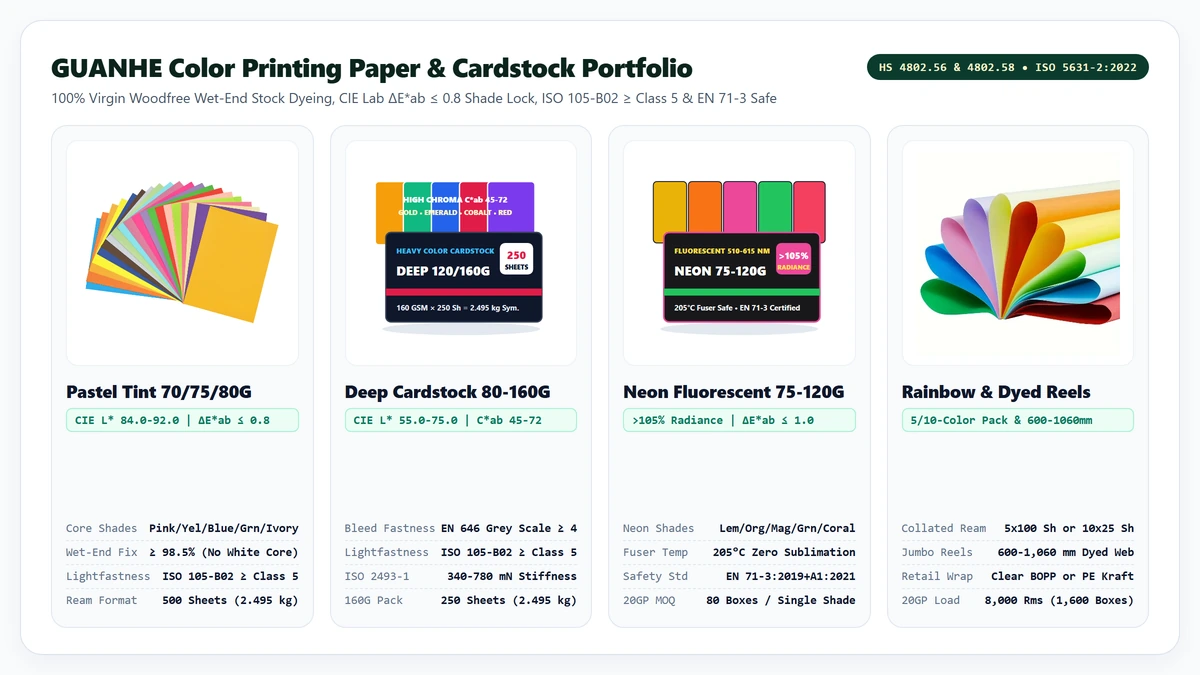
For regional distributors and converting plants operating across multiple sheet sizes and roll formats, our specialty paper lines integrate four synchronized supply programs:
- Cut-Size Pastel, Deep & Neon Reams (
70 / 75 / 80 / 120 / 160 gsm): Available in single-color reams (28+standard shades or custom Pantone-matched wet-end campaigns) and inline-collated 5-Color or 10-Color Rainbow Assorted Reams wrapped in moisture-barrier PE-laminated kraft paper or clear BOPP retail film (see our OEM private-label packaging and BOPP cylinder checklist). - Large-Format Colored Sheets (
A3 297 x 420 mm&US Ledger 11 x 17 in): Precision-cut on rotary sheeting lines in both short-grain and long-grain configurations alongside our A3 printer paper (297 x 420 mm) program. Full grain selection formulas are covered in our A3 grain direction and container loading guide. - Colored Uncoated Woodfree Jumbo Parent Rolls (
600 to 1,060 mmWidths): Supplied directly to regional sheeting plants, notebook converters, and envelope manufacturers through our uncoated woodfree and colored jumbo parent rolls division, with slitter deckle pairing detailed in our jumbo parent rolls sheeting and converting guide. - White + Colored Mixed Container Consolidation: Combine colored reams with white multi-purpose grades such as our JK Copier and multi-purpose office paper supply (benchmarked in our 5-brand B2B copy paper lab comparison) inside a single
20GPbill of lading. To request a physical 28-shade swatch book, batchCIE L*a*b*Certificate of Analysis (CoA), or a customized mixed-container quotation, reach our export engineering desk via our B2B contact page.
Frequently Asked Questions
What is an acceptable Delta-E tolerance for wholesale color printing paper across different shipments?
For commercial B2B stationery and office filing, specify an intra-lot shade tolerance of Delta E*ab <= 0.8 and a shipment-to-shipment tolerance of Delta E*ab <= 1.0 measured under ISO 5631-2:2022 (D65 daylight illuminant, 10-degree observer). Below Delta E*ab = 0.8, color differences are imperceptible to the human eye even when sheets from two production batches are placed side by side. When Delta E*ab exceeds 1.5, visible shade banding appears along the spine of mixed ream stacks.
How can importers verify whether colored paper is wet-end pulp-dyed or surface-dyed?
Perform a 45-degree diagonal tear and guillotine edge inspection under 10x magnification, paired with an EN 646:2018 wet filter-paper press test. Genuine wet-end stock-dyed paper exhibits uniform color saturation across the entire torn fiber cross-section and achieves EN 646:2018 Grey Scale >= Class 4 with zero water bleed. Surface-dyed paper reveals a lighter or white central cellulose core along the torn edge and often stains damp filter paper (Class 2 to 3).
Why does neon fluorescent paper fade faster in sunlight than pastel or deep-dyed paper?
Neon fluorescent paper achieves its ultra-high visual brightness (> 105% total radiance factor under ISO 5631-2:2022) from organic daylight fluorophores that absorb UV/blue photons (350 to 450 nm) and re-emit visible light. Continuous exposure to direct solar ultraviolet radiation breaks down these excited-state fluorophore rings (ISO 105-B02:2014 Blue Wool Class 1 to 2). Pastel and deep-dyed woodfree papers use non-fluorescent polymeric direct dyes with higher bond stability (Blue Wool >= Class 5 on GUANHE mill grades, versus Class 3 to 4 industry baseline), maintaining shade integrity far longer under ambient light.
Can 80 gsm colored copy paper and 160 gsm colored cardstock be mixed in the same master carton geometry?
Yes. Because an A4 (210 x 297 mm) sheet has an area of 0.06237 m^2, a 500-sheet ream of 80 gsm paper (0.06237 x 80 x 500 = 2.495 kg) and a 250-sheet pack of 160 gsm cardstock (0.06237 x 160 x 250 = 2.495 kg) have the exact same net weight (2.495 kg) and stack thickness (~52.5 mm). Both pack into identical 5-ream master cartons (12.47 kg net), allowing mixed-pallet and floor-loaded 20GP stowing (1,600 cartons total).
Which customs HS code applies to wholesale colored printing paper in A4 and A3 sheets?
Uncoated woodfree colored printing paper containing <= 10% mechanical fibers (WCO HS Chapter 48 notes) and cut to rectangular sheets (A4, A3, or Letter) with a basis weight between 40 gsm and 150 gsm (70, 75, 80, and 120 gsm grades) clears customs under HS Code 4802.56.00. Heavy colored cardstock sheets above 150 gsm (such as 160 gsm and 180 gsm cover grades) are classified under HS Code 4802.58.00.
All wet-end cationic dye fixation (>= 98.5%), CIE Lab D65/10° Delta E*ab <= 0.8 batch tolerances, ISO 105-B02:2014 Blue Wool >= Class 5 lightfastness, EN 646:2018 bleed fastness, EN 71-3:2019+A1:2021 heavy-metal migration, and 80gsm/160gsm 2.495 kg pack symmetry verified by the GUANHE Mill QC Lab.