

ISO 2470 vs TAPPI T 452 & CIE Whiteness: 92/96/100 COA Guide
North American 92, 96, and 100 brightness ratings follow ANSI/TAPPI T 452 om-23 (45°/0° blue-light reflectance at 457 nm, TAPPI). Export datasheets instead cite ISO 2470-1:2016 (d/0° indoor C/2°), ISO 2470-2:2008 (d/0° daylight D65/10° with full UV), or ISO 11475:2017 CIE Whiteness (CIE). Because integrating-sphere optics and UV-active Optical Brightening Agents (OBAs) push blue output past 100%, one sheet rated 96 GE (TAPPI T 452) reads 98% under ISO 2470-1:2016, 102% under ISO 2470-2:2008, and 162 to 165 under ISO 11475:2017 CIE Whiteness. Sheets over-dosed past 5Y − 280 or tint -4.0 fail ISO 11475:2017 validity rules and yellow faster under daylight (Library of Congress).
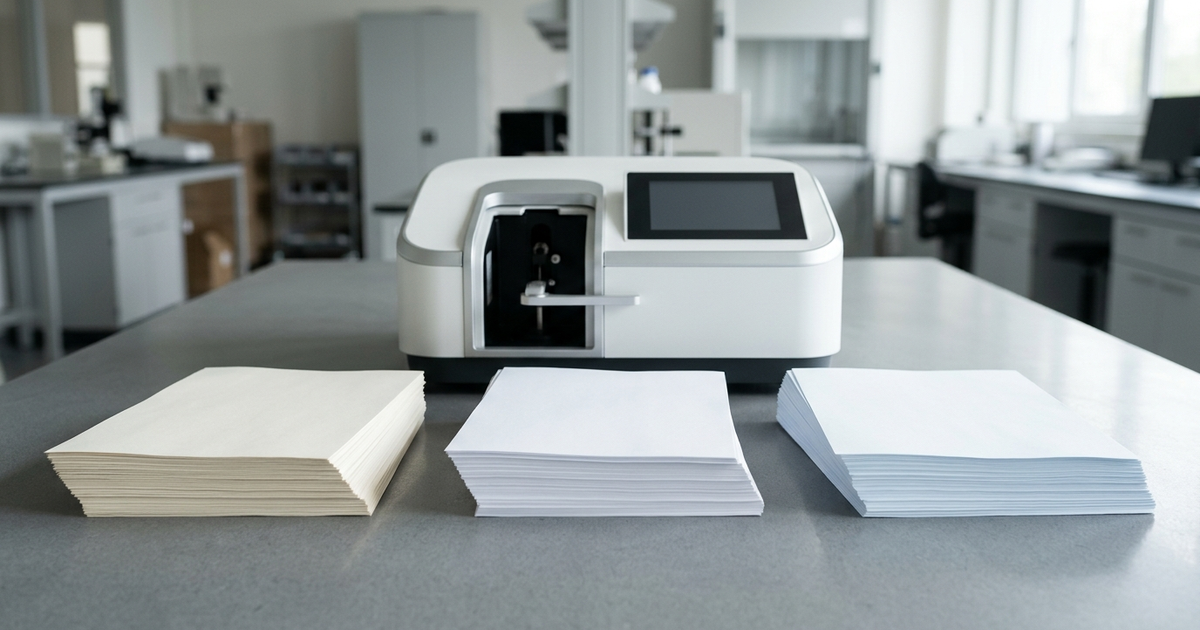
| Commercial Brightness Tier | North American GE (TAPPI T 452) |
Indoor Diffuse (ISO 2470-1) |
Daylight UV (ISO 2470-2) |
CIE Whiteness (ISO 11475) |
Recommended B2B Procurement Use |
|---|---|---|---|---|---|
| Archival / Natural Base | 88 to 90 | 89% to 91% | 90% to 92% | 78 to 110 | Long-term archives, low-glare reading, OBA-free tenders |
Standard Office (92) | 92 | 93% to 94% | 96% to 98% | 140 to 150 | Everyday black-and-white print, school exams, invoices |
Executive Grade (96) | 96 | 97% to 98% | 100% to 102% | 160 to 165 | Corporate duplex reports, government RFPs, branded wholesale |
Ultra-White Laser (98 to 100) | 98 to 100 | 99% to 101% | 103% to 104% | 165 to 170 | Color laser proposals, crisp charts, digital POD |
Global paper buyers often misread mill quotes when traders list brightness numbers without a test standard (for a quick office-level buyer primer, see our copy paper brightness 92 vs 96 vs 100 scale overview). A 92 GE North American sheet and a 98% ISO 2470-2:2008 export sheet look almost identical inside a D65 light booth. Yet one quote reports 457 nm directional light while the other reports full-UV diffuse light (ISO 2470-2:2008). Worse, pushing OBA dosage past meter limits creates purple shade shifts and gray tone loss under UV-free office LEDs.
At GUANHE Paper Mill, our lab tests every export container lot under ISO 187:2022 room rules (23 °C ± 1 °C, 50% ± 2% RH). We measure ISO 2470-2:2008, ISO 11475:2017, and ISO 2471:2008 on each batch. This guide explains why TAPPI T 452, ISO 2470, and CIE Whiteness use different scales, proves exact CIE Whiteness math, tracks OBA UV decay, and gives buyers a four-step COA audit plan.
TAPPI T 452 (GE) vs. ISO 2470-1 vs. ISO 2470-2: Optical Geometry Explained
Order disputes start when buyers treat "paper brightness" as one fixed scale. Paper brightness is a narrow-band reflectance reading taken strictly in blue light centered at 457 nm (nanometers, SI wavelength unit, NIST SI Units) with a 44 nm bandwidth filter. It ignores green, yellow, and red light across the rest of the visible band (380 to 720 nm).
Three global test methods control wholesale paper brightness, and their light paths explain why the same sheet gives three readings:
- North American GE Brightness (
ANSI/TAPPI T 452 om-23): Uses directional45°/0°optics, shining light at45°and reading straight down at0°(TAPPI). Because angled light reacts to surface gloss and grain direction, lab techs average machine direction (MD) and cross direction (CD) tests. U.S. reams marked92,96, or100and federal specs (U.S. GPO) follow this scale. - ISO Indoor Brightness (
ISO 2470-1:2016): Uses a diffused/0°sphere under CIE IlluminantC/2°, matching indoor daylight through glass (ISO 2470-1:2016). Diffuse light removes grain-angle error and keeps moderate UV matching Illuminant C (it is not strictly UV-free). Because sphere meters trap scattered light differently than45°/0°meters,ISO 2470-1:2016reads1 to 2points higher thanTAPPI T 452on the same paper. - ISO D65 Daylight Brightness (
ISO 2470-2:2008): Uses the samed/0°sphere but sets lamp UV to CIE IlluminantD65/10°, matching outdoor midday sun (ISO 2470-2:2008). Extra near-UV energy excites optical brighteners in the pulp, adding emitted blue light at457 nmon top of reflected light. High-OBA export grades therefore reach102% to 104%ISO D65 brightness (ISO 2470-2:2008).
| Optical Method | ANSI/TAPPI T 452 om-23 (GE) |
ISO 2470-1:2016 (Indoor) |
ISO 2470-2:2008 (D65 UV) |
ISO 11475:2017 (CIE Whiteness) |
|---|---|---|---|---|
| Light Path Geometry | Directional 45°/0° | Diffuse sphere d/0° | Diffuse sphere d/0° | Diffuse sphere d/0° |
| Measured Wavelength | Narrow blue (457 nm) | Narrow blue (457 nm) | Narrow blue (457 nm) | Full visible (380 to 720 nm) |
| Lamp Illuminant | Tungsten + UV adjusted | CIE C/2° (Indoor UV) | CIE D65/10° (Outdoor UV) | CIE D65/10° (Outdoor UV) |
Typical Reading (96 GE) | 96.0 | 97.5% to 98.5% | 101.5% to 103.0% | 162 to 165 CIE |
Can Score Pass 100? | Rarely (≤ 100 commercial) | Near 100% on max OBA | Yes (102% to 106% normal) | Yes (140 to 170 standard range) |
No fixed conversion factor links TAPPI T 452 and ISO 2470-2 because smoothness, calcium carbonate filler, and OBA dosage change each meter reading differently (TAPPI). For example, an unbrightened matte sheet moves up about +1.5 points from TAPPI T 452 to ISO 2470-2:2008, while a bright 96 GE laser sheet jumps +6.0 to +8.0 points once D65 UV light triggers its fluorescent dyes.
CIE Whiteness Formula, OBA Fluorescence, and UV Decay Mechanics
Brightness checks only 457 nm blue light, whereas human eyes judge white paper across all colors. CIE Whiteness (W_10) is a full-spectrum visual index in ISO 11475:2017 and CIE Publication 15 (CIE) that rewards high lightness (Y_10) plus a clean blue-white shift away from pulp yellow. Optical Brightening Agents (OBAs), or Fluorescent Whitening Agents (FWAs), are stilbene chemicals that absorb invisible UV rays (340 to 380 nm) and emit visible blue-violet glow (420 to 460 nm, CIE).
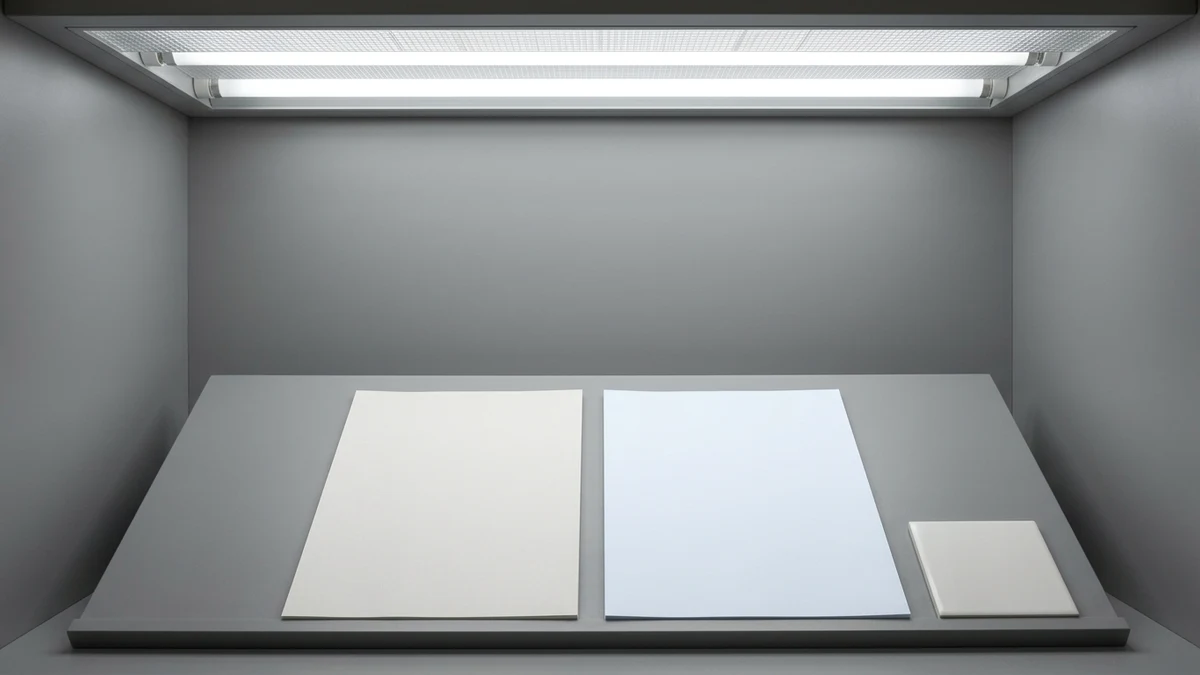
Under ISO 11475:2017 with CIE 1964 D65/10° reference coordinates (x_n = 0.3138, y_n = 0.3310), paper QC labs calculate exact whiteness (W_10), green-red tint (T_W,10), and OBA fluorescence gain (F_10) using three equations and two statutory validity bounds:
- CIE Whiteness (
D65/10°):W_10 = Y_10 + 800 × (0.3138 − x_10) + 1700 × (0.3310 − y_10) - CIE Tint (
D65/10°, 10° observer):T_W,10 = 900 × (0.3138 − x_10) − 650 × (0.3310 − y_10) - OBA Fluorescence Gain:
F_10 = W_10 (Full D65 UV) − W_0,10 (400 nm UV-Cut Filter) - Statutory Validity Bounds (
ISO 11475:2017):40 < W_10 < (5 × Y_10 − 280)and-4.0 < T_W,10 < +2.0
Watch the strict upper limit 5Y_10 − 280 and tint window -4.0 to +2.0 (ISO 11475:2017). Positive T_W,10 means a green tint, and negative T_W,10 means a red-violet tint. If a mill over-doses OBAs or purple dye to market "178 CIE" on a sheet with Y_10 = 91.5, the sample breaks past 5(91.5) − 280 = 177.5 and drops past -4.0 tint. Under ISO 11475:2017, that sheet fails as a valid white.
Bleached Woodfree Sample (D65/10°) |
Lightness Y_10 |
Chromaticity (x_10, y_10) |
W_10 & Upper Cap |
Tint T_W,10 |
ISO 11475:2017 Status & OBA Gain (F_10) |
|---|---|---|---|---|---|
OBA-Free Archival Base (W_0,10) | 91.0 | (0.3177, 0.3368) | 78.0 (cap 175.0) | +0.26 | Valid natural white; F_10 = 0.0 (zero UV fade) |
Standard 92 GE / 94% ISO Office | 91.5 | (0.2972, 0.3074) | 144.9 (cap 177.5) | -0.40 | Valid office white; F_10 ≈ 66.9 points |
Executive 96 GE / 102% ISO D65 | 92.0 | (0.2916, 0.2991) | 164.0 (cap 180.0) | -0.76 | Valid high white; F_10 ≈ 86.0 points |
Ultra-White 98 to 100 GE / 104% ISO | 92.5 | (0.2907, 0.2975) | 167.9 (cap 182.5) | -0.99 | Valid crisp white; F_10 ≈ 89.9 points |
| Over-Dosed "178 CIE" Spec Sheet | 91.5 | (0.2899, 0.2914) | 177.9 (over 177.5) | -4.23 | INVALID WHITE (fails cap & violet tint limit) |
Indoor Metamerism and Archival UV Quenching
Heavy OBA formulas create two field risks that tender buyers must weigh before ordering 168 to 170 CIE paper for every office:
- LED Indoor Metamerism (
ISO 11476:2016vs.ISO 11475:2017): Office LED lamps emit very little light below400 nm. Without340 to 380 nmUV rays, OBAs stay dormant. Under indoorC/2°lamps (ISO 11476:2016), a168 CIEsheet drops15 to 25CIE points relative toD65daylight, and under UV-free warm LEDs it reverts toward its base pulp score (W_0,10around78 to 101 CIE). - Light-Driven UV Decay and Archival Life (
ISO 9706:2025): Daylight breaks stilbene bonds inside OBA molecules, fading blue glow over months of open display (Library of Congress). Separate visual shade life from fiber strength:ISO 9706:2025secures200+years of fiber permanence through≥ 2.0%calcium carbonate reserve, low lignin (kappaunder5), and pH7.5 to 10.0(U.S. National Archives; see our government tender A4 RFP & ISO 9706 compliance guide for full archival clauses). YetISO 9706:2025does not stop OBA fade under sunlight, so museums and permanent court registries choose low-OBA grades (90 to 92GE) when color stability matters most.
92 vs. 96 vs. 100 Brightness: Print Contrast, Opacity, and Eye Comfort
Selecting 92, 96, or 100 brightness paper balances toner contrast, duplex opacity (ISO 2471:2008), and reading comfort. Brighter blue-white sheets widen the contrast gap between blank paper (L* ≈ 95 to 97) and fused black toner (L* ≈ 15 to 20, ISO 5631-2:2022), making fine 8-point text sharper and charts more vivid.
Still, brightness alone never prevents duplex bleed-through. Diffuse opacity (ISO 2471:2008) measures single-sheet reflectance over a black cavity (R_0) divided by an opaque stack (R_∞). When mills boost 70 gsm paper from 92 to 100 GE using OBAs instead of calcium carbonate (PCC) filler or heavier fiber mass, heavy duplex graphics still ghost through (review our 100 gsm & 24 lb heavyweight copy paper opacity and stiffness guide for dense color laser runs). For example, an 80 gsm 96 GE sheet holding ≥ 95.0% opacity (ISO 2471:2008) beats a 70 gsm 98 GE sheet at 91.5% opacity (ISO 2471:2008) on dense duplex financial tables with zero reverse-side ghosting.
| B2B Buyer Segment | Best Brightness Tier | Target Opacity (ISO 2471) |
Roughness (ISO 8791-2:2013) |
Why This Optical Spec Works Best |
|---|---|---|---|---|
| Government & Legal Tenders | 96 GE (102% ISO D65 / 162 to 165 CIE) | ≥ 94.5% to 95.0% | 120 to 150 mL/min | Clears 100%+ D65 RFP clauses with clean duplex print |
| Daily Monochrome Billing & Exams | 92 GE (96% to 98% ISO D65 / 145 CIE) | ≥ 93.0% (75 to 80 gsm) | 140 to 170 mL/min | Cuts eye glare on long reads while trimming FOB cost |
| Color Laser Proposals & Agency Decks | 98 to 100 GE (104% ISO D65 / 165 to 168 CIE) | ≥ 96.0% (80 to 100 gsm) | 95 to 125 mL/min | Smooth super-calendered surface boosts color contrast |
| Permanent Archives & Court Records | 88 to 92 GE (ISO 9706:2025 acid-free) | ≥ 94.5% (80+ gsm) | 130 to 160 mL/min | Low OBA formula avoids multi-year UV shade drift |
How Should B2B Importers Audit 92, 96, and 100 Brightness Claims on Mill COAs?
Scale switching is the oldest pricing trap in cut-size paper exports. A broker can test basic 92 GE (145 CIE) stock under full-UV ISO 2470-2:2008 (97% to 98%) or advertise "100% Brightness" without naming the test method. Buyers who sort quotes only by raw numbers overpay for standard pulp and face visible shade mismatches between containers.
Protect every container order (HS 4802.56, WCO HS 2022; USITC HTS) with four optical COA checks inside your purchase contract:
- Require Paired Standard and Lamp Labels: Reject any lab report showing "Brightness: 102%" or "Whiteness: 165" without the exact test edition (
ANSI/TAPPI T 452 om-23,ISO 2470-2:2008 D65/10°, orISO 11475:2017 D65/10°). For example, verify that a quote promising "96 Brightness" citesTAPPI T 452directional tests rather thanISO 2470-2:2008UV brightness. - Demand Both
W_10andW_0,10(F_10Split): Request CIE Whiteness with full D65 UV (W_10) alongside the400 nmUV-cut reading (W_0,10,ISO 11475:2017). Clean virgin eucalyptus pulp holds solid base whiteness (W_0,10at78 to 100), whereas off-grade pulp masked with heavy OBA pushesF_10above95and turns dull indoors. - Cap Batch Shade Drift with CIE
L*a*b*: ListISO 5631-2:2022D65/10°values (L*,a*,b*) on every COA and hold repeat container drift atΔE*ab ≤ 0.8(ISO 11664-4:2019; see our CIE Delta-E shade consistency metrology guide for colorimetric tolerances). KeepingT_W,10within-1.5 to +0.5prevents green or violet mismatch complaints when fresh stock sits next to prior lots. - Pair Brightness with Opacity and Weight: Always inspect optical scores beside
ISO 2471:2008opacity andISO 536:2019basis weight (±1.5 g/m²). Buyers booking containers through our A4 copy paper wholesale program should confirm FOB or CFR contract specs under Incoterms 2020 and inspect sample reams in aD65booth before loading.
GUANHE Optical Brightness & CIE Whiteness Export Portfolio
GUANHE makes calibrated optical paper grades from 100% virgin ECF eucalyptus pulp certified under ISO 9001, ISO 14001, FSC Chain of Custody, and geolocation-ready fiber traceability aligned with the EU Deforestation Regulation (EUDR 2023/1115). Every container ships with an ISO 187:2022 batch COA listing verified ISO 2470-2:2008 brightness, ISO 11475:2017 CIE Whiteness, and ISO 2471:2008 opacity (compare flagship brands side by side in our Double A vs JK Copier vs Xerox vs Rotatrim vs Reflex lab benchmark).
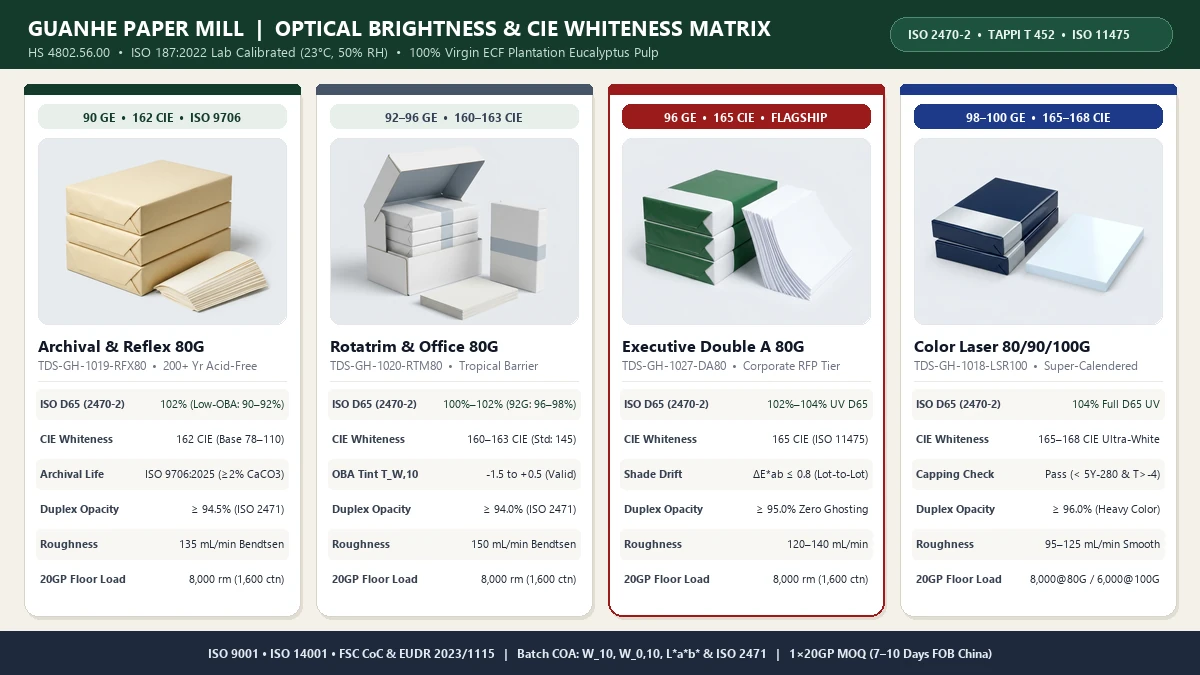
Browse our A4 copy paper catalog or all 14 wholesale paper grades to match optical grades with regional tender budgets:
| GUANHE Export Product Line | Mill TDS Reference | ISO D65 (ISO 2470-2) |
CIE Whiteness (ISO 11475) |
Opacity (ISO 2471) & Smoothness |
Ideal B2B Channel Fit |
|---|---|---|---|---|---|
| Rotatrim 80 GSM A4 | TDS-GH-1020-RTM80 | 100% to 102% | 160 to 163 CIE | ≥ 94.0% / 150 mL/min Bendtsen | Regional wholesale & tropical moisture-locked tenders |
| Reflex 80 GSM A4 | TDS-GH-1019-RFX80 | 102% | 162 CIE | ≥ 94.5% / 135 mL/min (ISO 9706:2025 acid-free) | Executive corporate print, legal archives (200+ yrs), EN 12281:2002 |
| Double A 80 GSM A4 | TDS-GH-1027-DA80 | 102% to 104% | 165 CIE | ≥ 95% / 120 to 140 mL/min | Flagship branded wholesale & heavy duplex office fleets |
Laser Production Paper (80/90/100 gsm) | TDS-GH-1018-LSR100 | 104% | 165 to 168 CIE | ≥ 96.0% / 95 to 125 mL/min | Color laser proposals, digital POD presses, heavy duplex |
All four grades load 1,600 cartons (8,000 reams) floor-stowed per 20GP at 80 gsm (6,000 reams at 100 gsm laser grade) and ship within 7 to 10 working days from Qingdao, Shanghai, Tianjin, or Ningbo (HS 4802.56.00). Request side-by-side DHL optical sample reams (160 through 168 CIE) and batch COAs from the GUANHE direct export desk.
About the Author: Dr. Wei Chen is Chief Pulp & Paper Quality Control Engineer at GUANHE Paper Mill (copypapersupplier.com). He directs ISO 187:2022 optical testing (ISO 2470-2, ISO 11475, ISO 2471, ISO 5631-2) and container quality audits across 250,000 MT/year of uncoated woodfree exports.
Frequently Asked Questions
What is the real difference between 92 brightness and 96 brightness copy paper?
On the North American ANSI/TAPPI T 452 om-23 scale (TAPPI), 92 brightness aligns with 96% to 98% ISO 2470-2:2008 D65 brightness and 140 to 150 ISO 11475:2017 CIE Whiteness for lower glare on daily black text. 96 brightness reaches 100% to 102% ISO 2470-2:2008 and 160 to 165 CIE Whiteness via higher OBA output, sharpening black-on-white contrast for client proposals and duplex decks.
How can ISO 2470-2 brightness or CIE Whiteness exceed 100?
Both ISO 2470-2:2008 and ISO 11475:2017 expose paper to CIE D65 daylight carrying UV energy (340 to 380 nm, CIE). Optical Brightening Agents absorb invisible UV photons and emit visible blue light (420 to 460 nm). Adding emitted blue glow to reflected light pushes total blue output past 100% (102% to 104%, ISO 2470-2:2008) and lifts full-spectrum CIE Whiteness to 160 to 170.
Is 100 brightness paper always better than 96 brightness paper?
No. Reaching 98 to 100 GE (168+ CIE) needs heavy OBA loads that suit super-calendered 80 to 100 gsm color laser stock (≥ 96.0% opacity, ISO 2471:2008). For multi-hour black-text reading or sunlit display files, excess blue glow raises eye glare, shifts duller under UV-free LEDs (ISO 11476:2016), and fades faster under daylight (Library of Congress).
Why do two sheets rated 96 brightness look different under office LED lights?
Office LED fixtures emit far less 340 to 380 nm UV light than D65 daylight. Two mills can hit 96 GE or 164 CIE under UV lab lamps using different blends of base pulp whiteness (W_0,10), blue-violet shading dye, and OBA load (F_10). Under UV-free indoor LEDs, the high-OBA sheet drops sharply in shade while the cleaner-pulp sheet holds its crisp white tone (ISO 11476:2016).
Does ISO 9706 archival certification prevent bright white paper from yellowing?
ISO 9706:2025 prevents acid-driven fiber decay and structural yellowing for 200+ years by requiring ≥ 2.0% calcium carbonate reserve, pH 7.5 to 10.0, and low lignin (kappa under 5, U.S. National Archives). However, if an acid-free sheet carries heavy OBAs, UV sunlight still quenches the fluorescent brighteners over time, shifting the surface back toward natural warm-white fiber.
All CIE 1964 D65/10° whiteness equations, ISO 2470 / TAPPI T 452 optical comparisons, and ISO 9706:2025 archival criteria verified by the GUANHE Paper Mill QC Laboratory under ISO 187:2022 conditions.