

100 GSM & 24 lb Copy Paper Wholesale: Stiffness & Load
Sourcing 100 gsm paper and 24 lb Bond copy paper (HS 4802.56.00) requires exact basis-weight math. Under ISO 536:2019 and ANSI/TAPPI T 410 om-23, 1 lb US Bond equals 3.75973 g/m²: 20 lb Bond is 75.2 gsm, 24 lb Bond is 90.2 gsm, and true 100 gsm equals 26.6 lb Bond (28 lb retail class). Bending stiffness scales with the cube of sheet thickness (ISO 2493-1:2010). Upgrading from 80 gsm (104 µm, 125 to 138 mN MD) to 100 gsm (125 to 130 µm, 220 to 265 mN MD) increases stiffness by 73.6% to 95.3% and raises duplex opacity to ≥ 96.5% (ISO 2471:2008). At 3.1185 kg net per A4 ream (345 mm five-ream carton), 100 gsm caps a 20GP container at 6,000 floor-loaded reams (6 tiers), 5,400 palletized reams via low-lift flush dock (6 tiers, 2,210 mm), or 4,500 palletized reams for counterbalance forklift unloading (5 tiers, 1,865 mm, ISO 668:2020).
Commercial digital print houses, architectural firms, and corporate procurement teams specify heavyweight uncoated woodfree sheets (90 gsm / 24 lb and 100 gsm / 28 lb) for full-color duplex proposals and executive letterheads. However, cross-border buyers regularly face two costly errors. First, purchase orders confuse 24 lb US Bond (90.2 gsm) with true 100 gsm stock, creating unexpected sheet-feel and carton-height mismatches (see our 20 lb vs 24 lb weight overview and 70 vs 80 vs 100 gsm selection primer for entry-level office comparisons). Second, importers apply standard 80 gsm container counts (8,000 reams per 20GP) to 100 gsm orders, breaching 20GP door clearances and highway axle weight caps.
At the GUANHE Paper Mill QC Laboratory, our papermaking engineers test every export lot across our A4 and cut-size paper catalog under ISO 187:2022 conditioning (23 °C, 50% RH). This guide derives exact US Bond and US Text constants using NIST SI definitions and quantifies cube-law stiffness under ISO 2493-1:2010. It also reviews EN 12281:2002 dry-toner printability and exact 20GP payloads under IMO SOLAS VGM.
Metric Grade (ISO 536:2019) |
US Bond (17 × 22 in) |
US Text (25 × 38 in) |
A4 Ream Net (500 sh) |
5-Ream Carton Gross |
|---|---|---|---|---|
75 gsm |
19.95 lb (20 lb std) |
50.7 lb (50 lb std) |
2.339 kg |
12.42 kg |
80 gsm |
21.28 lb (20 to 22 lb) |
54.0 lb (55 lb std) |
2.495 kg |
13.20 kg |
90 gsm |
23.94 lb (24 lb std) |
60.8 lb (60 lb std) |
2.807 kg |
14.76 kg |
100 gsm |
26.60 lb (28 lb cls) |
67.6 lb (70 lb cls) |
3.119 kg |
16.32 kg |
US Bond (20 lb / 24 lb / 28 lb) to Metric GSM Conversion Physics
Global paper trade uses two incompatible weight scales: metric grammage (ISO 536:2019) and US imperial pounds (ANSI/TAPPI T 410 om-23). Ordering without exact basic-sheet area math causes a 9.8% mass shortfall when 24 lb (90.2 gsm) ships against a 100 gsm spec (ISO 536:2019).
Basis Weight (US Bond) is the mass in pounds of 500 uncut parent sheets measuring 17 × 22 inches (374 in² per sheet, ANSI/TAPPI T 410 om-23). Grammage (g/m² or gsm) is the mass in grams of one square meter of paper conditioned at 23 °C and 50% RH (ISO 536:2019; ISO 187:2022).
Using exact SI definitions (1 in = 0.0254 m and 1 lb = 453.59237 g, NIST SI Units, 2024), derive the US Bond and US Text (25 × 38 in) conversion constants below:
- US Bond Basic Ream Area (
500sheets):500 × (17 × 0.0254 m) × (22 × 0.0254 m) = 120.6449 m². - US Bond Conversion Factor:
453.59237 g / 120.6449 m² = 3.75973 g/m² per lb. - US Text Basic Ream Area (
500sheets):500 × (25 × 0.0254 m) × (38 × 0.0254 m) = 306.4510 m². - US Text Conversion Factor:
453.59237 g / 306.4510 m² = 1.48015 g/m² per lb.
Those two exact constants expose three common B2B specification traps.
24 lbBond Is90 gsm, Not100 gsm: Multiplying24 lb × 3.75973yields90.23 gsm(ANSI/TAPPI T 410 om-23). True100 gsm paperequals100 / 3.75973 = 26.60 lbUS Bond, between24 lb(90.2 gsm) and28 lb(105.3 gsm). When US buyers write "24 lb/100 gsm", confirm in writing whether they need90 gsm(2.807 kgA4 ream) or true100 gsm(3.119 kg, which is11.1%heavier than nominal90 gsmperISO 536:2019).- US Letter (
8.5 × 11 in) Reams Weigh ExactlyBond Weight / 4: One17 × 22 inBond parent sheet cuts evenly into4US Letter sheets (2 × 2). Therefore, a500-sheetLetter ream weighs exactly one-quarter of the Bond weight:20 lbLetter weighs5.00 lb(2.268 kg),24 lbweighs6.00 lb(2.722 kg), and28 lbweighs7.00 lb(3.175 kg). - WCO Customs Classification Remains
HS 4802.56.00: Chapter 48 of the WCO HS 2022 Nomenclature and USITC HTS covers uncoated woodfree sheets from40 gsmto150 gsm. All A4 and US Letter grades (75,80,90, and100 gsm, unfolded≤ 435 × 297 mm) clear underHS 4802.56.00.
How Does Caliper Cube-Law Stiffness Stop Duplex Curl and Show-Through?
Many office buyers assume 100 gsm paper is simply 25.0% stiffer than 80 gsm because it carries 25.0% more wood fiber (ISO 536:2019). In structural mechanics, however, plate bending resistance increases with the cube of sheet caliper (t³), producing a sharp jump in mechanical snap and duplex printer reliability.
Bending Stiffness (ISO 2493-1:2010) is the flexural resistance of a conditioned paper strip bent at a standard 15° angle using an L&W constant-rate-of-deflection tester (50 mm test span). It follows the Euler-Bernoulli plate rigidity relation S = (E × t³) / 12, where E is elastic modulus and t is caliper thickness (ISO 534:2011).
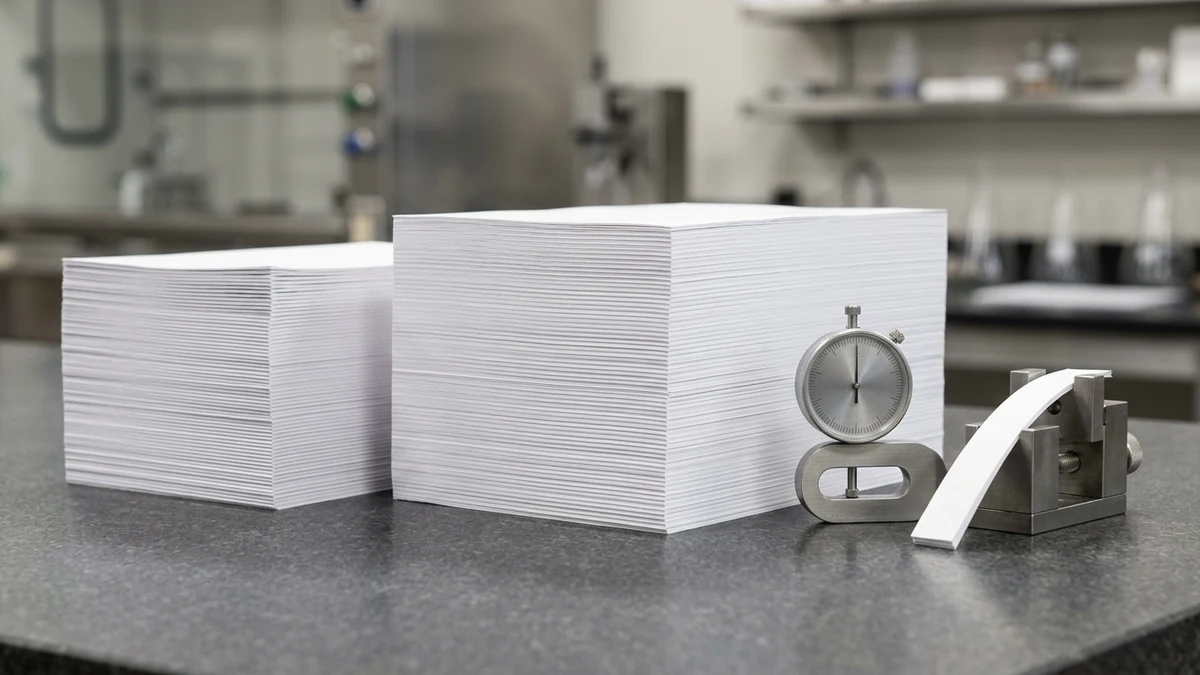
For example, evaluate exact caliper and cube-law stiffness gains for 100% bleached eucalyptus virgin pulp across two finishing profiles (ISO 534:2011; ISO 2493-1:2010):
- Profile A (Uniform High-Bulk Finish,
1.30 cm³/g): An80 gsmsheet measurest = 104 µm(500sheets =52.0 mmstack height; typicalMDbending force125 to 138 mN). Stepping up to90 gsm(t = 117 µm,58.5 mmream) raises bending stiffness by(117 / 104)³ = 1.4238(+42.4%stiffer,~178 to 196 mNMD for+12.5%fiber mass,ISO 2493-1:2010). Stepping up to100 gsm(t = 130 µm,65.0 mmream) raises stiffness by(130 / 104)³ = 1.9531(+95.3%stiffer,~244 to 265 mNMD, nearly double the resistance for+25.0%fiber mass). - Profile B (Super-Calendered Color Laser Finish,
1.25 cm³/g): Color laser mills apply higher steel-nip calendering pressure to cut Bendtsen roughness to95 to 125 mL/min(ISO 8791-2:2013;TDS-GH-1018-LSR100, 2026). Even at a denser125 µmcaliper (62.5 mmream),100 gsmstill yields(125 / 104)³ = 1.7363(+73.6%stiffer than80 gsm,~220 to 240 mNMD,ISO 2493-1:2010).
| Optical & Mechanical Spec | Standard 80 gsm |
90 gsm (24 lb) |
100 gsm (28 lb cls) |
Test Standard |
|---|---|---|---|---|
Caliper Thickness (t) |
102 to 106 µm |
113 to 117 µm |
125 to 130 µm |
ISO 534:2011 |
| 500-Sheet Stack Height | 51.0 to 53.0 mm |
56.5 to 58.5 mm |
62.5 to 65.0 mm |
ISO 534:2011 |
| MD Bending Force (50 mm / 15°) | 125 to 138 mN |
178 to 196 mN |
220 to 265 mN |
ISO 2493-1:2010 |
Relative Stiffness (t³) |
1.00× (baseline) |
1.42× (+42.4%) |
1.74× to 1.95× |
ISO 2493-1:2010 |
| Duplex Opacity | 93.0% to 95.0% |
95.5% to 96.5% |
96.5% to 98.0% |
ISO 2471:2008 |
| Bendtsen Roughness | 120 to 150 mL/min |
100 to 130 mL/min |
95 to 125 mL/min |
ISO 8791-2:2013 |
Higher caliper and stiffness eliminate three print defects defined in EN 12281:2002 (European standard for dry-toner copy paper).
- Zero Duplex Show-Through Under Heavy Color Coverage: Full-bleed charts and dark headers often exceed
240%toner area coverage (ISO 2471:2008). On75 to 80 gsmsheets (93% to 94%opacity), reverse-side graphics bleed visibly through the page. Moving to90 gsm(≥ 95.5%opacity) or100 gsm(≥ 96.5%opacity,ISO 2471:2008) stops ghosting on both sides of corporate reports and catalogs. - Thermal Fuser Curl Suppression at
180 to 200 °C: When dry toner melts under a hot fuser roller, rapid single-sided moisture evaporation contracts the printed face. Because curl deflection falls inversely with flexural rigidity (S ∝ t³), a100 gsmsheet held at4.3% to 4.7%factory moisture (ISO 287:2017) stays flat after fusing. Review our high-speed laser paper resistivity and fuser curl guide for fullASTM D257electrostatic specs, or our A3 short-grain vs long-grain stiffness guide for wide-format297 × 420 mmduplex runs. - Inkjet Cockling Resistance: Pigment-ink business printers deposit aqueous droplets that swell uncoated cellulose fibers. Heavy
90 to 100 gsmsheets sized with alkyl ketene dimer (AKD, Cobb6020 to 24 g/m²,ISO 535:2023) absorb ink cleanly without edge wave.
Why Do 90 GSM and 100 GSM A4 Containers Shift from Cube-Limited to Weight-Limited?
Container procurement managers often budget 8,000 reams (1,600 five-ream cartons) per 20GP regardless of grammage. That assumption works strictly for 70 to 80 gsm stock (detailed in our A4 copy paper specifications and 20GP import guide). Once buyers step up to 90 gsm or 100 gsm paper, both vertical door clearance (ISO 668:2020) and gross highway payload limits (IMO SOLAS VGM) force a lower ream count per container.
Weight-Limited Containerization occurs when high-density cargo reaches the legal ocean-chassis or container gross mass limit before filling the container's 33.2 m³ internal volume (ISO 668:2020).
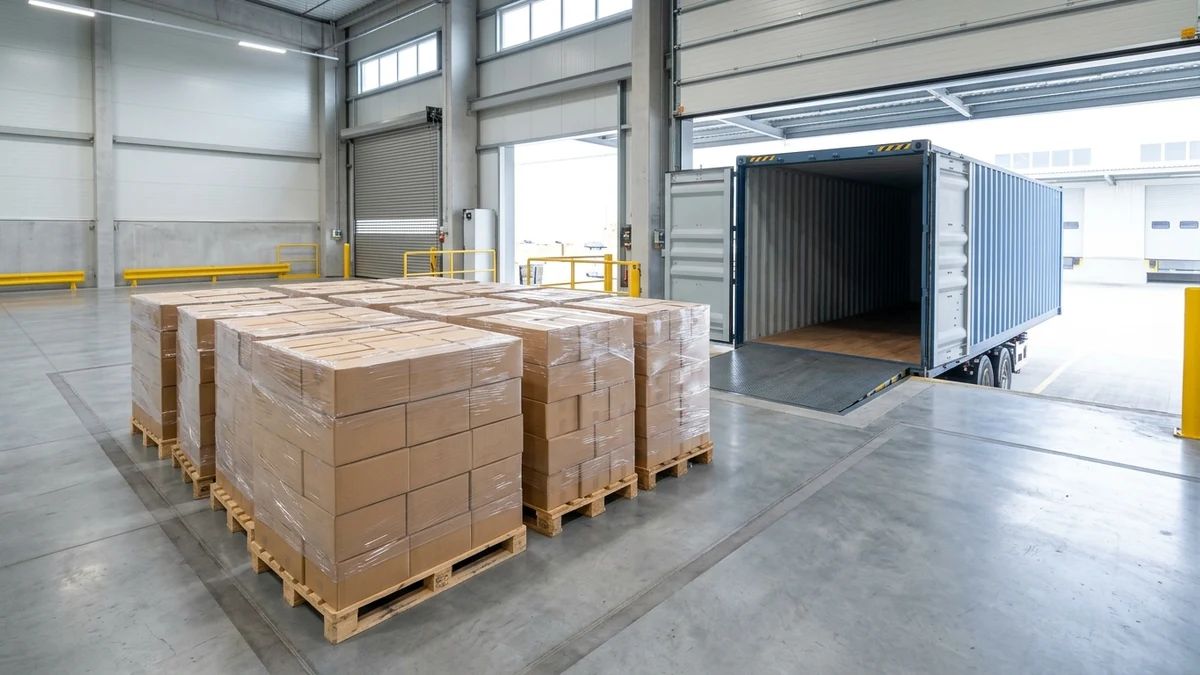
Exact 20GP Ream Weight, Carton Tier Height, and SOLAS VGM Math
A standard 20GP dry container (ISO 668:2020) measures 5,898 × 2,352 × 2,393 mm internally, with a rear door height of 2,280 mm. While ISO 668:2020 allows 30,480 kg maximum gross mass (~28,230 kg structural net after ~2,250 kg tare), inland road laws impose tighter ceilings. Most highway corridors in North America, Europe, and Africa cap 20GP cargo gross mass at 20,000 to 24,000 kg (requiring tri-axle overweight permits above 20.0 to 21.5 MT in many US states).
Compute exact A4 (210 × 297 mm, 31.185 m²/ream) five-ream carton gross mass using 0.726 kg packaging tare per 5-ply box plus 5 PE wrappers:
80 gsm5-Ream Carton:5 × 2.4948 kg = 12.474 kgnet paper (+ 0.726 kgpack =13.200 kggross;5 × 52 mmpaper +15 mmflaps =275 mmcarton height).90 gsm5-Ream Carton:5 × 2.8067 kg = 14.033 kgnet paper (+ 0.726 kgpack =14.759 kggross;315 mmcarton height).100 gsm5-Ream Carton:5 × 3.1185 kg = 15.593 kgnet paper (+ 0.726 kgpack =16.319 kggross;345 mmcarton height).
Compare upright 200-carton floor tiers and single-stacked ISPM 15 pallets against the 2,280 mm door clearance and 20.0 to 24.0 MT highway weight limits below:
80 gsmBaseline (8upright tiers =1,600cartons /8,000reams):8tiers ×275 mm = 2,200 mm(80 mmtop door clearance). Total mass equals1,600 × 13.200 = 21,120 kggross (19,958 kgnet paper), meeting door height and highway caps.90 gsm(24 lbclass) Floor Load (7upright tiers =1,400cartons /7,000reams): Eight tiers of315 mmcartons equal2,520 mm, exceeding the2,280 mmdoor by240 mm. Reducing to7tiers (2,205 mmheight,75 mmclearance) loads1,400cartons =19,647 kgnet paper (20,663 kggross).100 gsmFloor Load (6upright tiers =1,200cartons /6,000reams): Eight tiers of345 mmcartons would reach2,760 mmand weigh26,110 kggross, exceeding both door clearance and road caps. Dropping to6upright tiers (2,070 mmheight,210 mmclearance) loads1,200cartons (6,000reams) =18,711 kgnet paper (19,582 kggross).100 gsmPalletized — Standard Forklift (10Pallets ×5tiers =900cartons /4,500reams, Figure 2): A20GPfloor (5,898 × 2,352 mm) fits10single-stacked1,140 × 1,140 mmheat-treated pallets (5 × 2 = 5,700 × 2,280 mm). Stacking18pinwheel cartons/layer ×5tiers (90cartons/pallet) keeps total height at5 × 345 + 140 mm = 1,865 mm, leaving415 mmheadroom for standard counterbalance forklifts over dock plates (14,033 kgnet paper +653 kgpackaging +220 kgpallets =14,907 kggross).100 gsmPalletized — Max-Cube Low-Lift (10Pallets ×6tiers =1,080cartons /5,400reams): Adding a sixth tier (108cartons/pallet) raises height to6 × 345 + 140 mm = 2,210 mm(28.7 m³ ≤ 33.2 m³), leaving only70 mmclearance under the2,280 mm20GPdoor header. Specify5,400palletized reams only when destination warehouses operate a flush dock with a low-lift electric pallet jack (25 to 30 mmlift), or upgrade to a40HQ(2,585 mmdoor). Total mass equals16,840 kgnet paper +784 kgpackaging +220 kgwood pallets (10 × 22 kg) =17,844 kggross.
Loading Plan (20GP, ISO 668:2020) |
Reams / Cartons | Stack Height / Clearance | Net Paper / Cargo Gross | Freight / Ream ($2,000) |
|---|---|---|---|---|
80 gsm Floor-Loaded (8 tiers) |
8,000 rm (1,600 ctn) |
2,200 mm (80 mm clr) |
19,958 kg / 21,120 kg |
$0.250 / ream |
90 gsm Floor-Loaded (7 tiers) |
7,000 rm (1,400 ctn) |
2,205 mm (75 mm clr) |
19,647 kg / 20,663 kg |
$0.286 / ream |
100 gsm Floor-Loaded (6 tiers) |
6,000 rm (1,200 ctn) |
2,070 mm (210 mm clr) |
18,711 kg / 19,582 kg |
$0.333 / ream |
100 gsm Palletized (6 tiers, low-lift) |
5,400 rm (1,080 ctn) |
2,210 mm (70 mm clr) |
16,840 kg / 17,844 kg |
$0.370 / ream |
100 gsm Palletized (5 tiers, forklift) |
4,500 rm (900 ctn) |
1,865 mm (415 mm clr) |
14,033 kg / 14,907 kg |
$0.444 / ream |
Consider an illustrative $2,000 per 20GP sea freight rate under Incoterms 2020. Moving from 80 gsm (8,000 reams) to 100 gsm floor-loaded (6,000 reams) reduces reams per container by 25.0% (2,000 / 8,000, ISO 668:2020). As a result, ocean freight per ream rises by 33.3% ($0.333 vs $0.250/ream, an extra $0.083/ream in our worked 2026 lane model). For retail ergonomics, distributors often order 250-sheet half-reams (1.559 kg each, 8 packs per carton = 12.47 kg net) so single cartons match 80 gsm handling weight. Importers mixing heavyweight and standard 80 gsm reams in one 20GP can review our A4 copy paper wholesale container program and tropical sea freight moisture-barrier packaging SOP.
GUANHE 80 / 90 / 100 GSM Production Laser & Copy Paper Matrix
Our mill produces super-calendered GUANHE 80 / 90 / 100 GSM laser printer paper (TDS-GH-1018-LSR100, 2026) from 100% virgin bleached eucalyptus chemical pulp. We also supply commercial Double A 80 GSM A4 paper, Xerox commercial copy paper, and Reflex executive white paper. Every export carton uses 5-ply ECT-44 double-wall kraft board and PE-laminated moisture-barrier wrappers (4.3% to 4.7% moisture lock under ISO 287:2017).
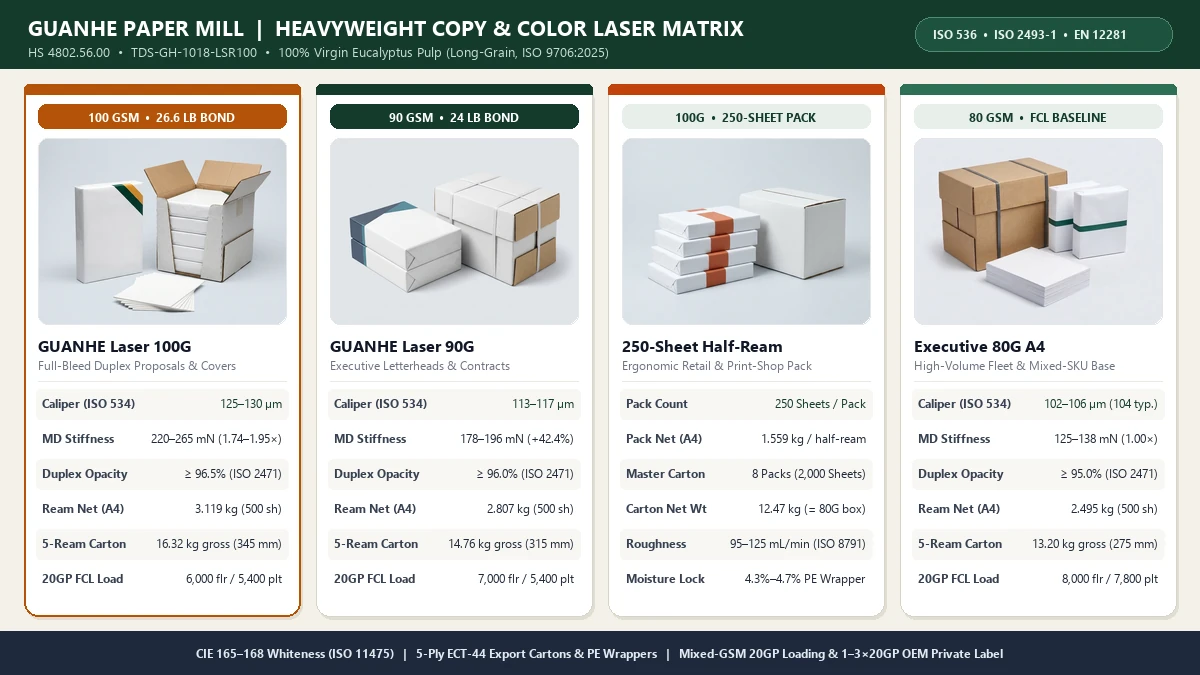
GUANHE Export Grade (HS 4802.56.00) |
Basis Weight | CIE Whiteness (ISO 11475:2017) |
Opacity (ISO 2471:2008) |
20GP FCL Capacity |
|---|---|---|---|---|
GUANHE Laser 100G (TDS-GH-1018) |
100 gsm (26.6 lb) |
165 to 168 CIE |
≥ 96.5% |
6,000 flr / 4,500–5,400 plt |
GUANHE Laser 90G (TDS-GH-1018) |
90 gsm (24 lb) |
165 to 168 CIE |
≥ 96.0% |
7,000 flr / 5,400 plt |
Double A A4 (TDS-GH-1027) |
80 gsm (21.3 lb) |
165 CIE |
≥ 95.0% |
8,000 flr / 7,800 plt |
Xerox Commercial (TDS-GH-1022) |
80 gsm (21.3 lb) |
164 CIE |
≥ 95.0% |
8,000 flr / 7,800 plt |
Reflex Executive (TDS-GH-1019) |
80 gsm (21.3 lb) |
162 CIE |
≥ 94.5% |
8,000 flr / 7,800 plt |
Export execution terms across our heavyweight laser and office lines cover four standard buyer requirements:
- Minimum Order Quantity (MOQ) & OEM Branding: Standard FCL orders start at
1 × 20GP(4,500 to 7,000reams for90 / 100 gsm), with mixed-grammage20GPsplitting (80,90, and100 gsm) available in one container. Custom OEM private-label trial runs start from1 × 20GP(cylinder fee applicable), while3 × 20GPcontracts qualify for full 6-color rotogravure BOPP wrapper cylinder rebates (see our OEM private-label A4 manufacturing checklist). - Sheet Formats & Grain Direction: We cut standard
ISO 216:2007A4 (210 × 297 mm), US Letter (8.5 × 11 in), Legal (8.5 × 14 in), and A3 (297 × 420 mm). Every cut-size sheet runs long-grain for jam-free laser feeding. - Sustainability & Archival Compliance: Manufactured from
100%virgin plantation pulp backed by FSC Chain of Custody certification,ISO 9706:2025acid-free alkaline reserve (CaCO3sizing), and geolocation-ready traceability aligned with the EU Deforestation Regulation (EUDR 2023/1115) and FAO Forestry Statistics (2025). - Dispatch & Lab Verification: Orders ship in
7 to 10working days from deposit or L/C confirmation FOB Qingdao, Shanghai, or Tianjin. Each lot ships with batchISO 536:2019grammage,ISO 2493-1:2010stiffness,ISO 2471:2008opacity,ISO 8791-2:2013roughness, andISO 287:2017moisture Mill Test Certificates (MTC).
Request a Mill-Direct 90 GSM / 100 GSM Proforma Invoice
Submit your target grammage (90 gsm / 24 lb or 100 gsm), sheet size (A4 or US Letter), and destination port via our export quote desk or email info@copypapersupplier.com. Indicate whether you need 500-sheet reams or 250-sheet half-reams and whether your warehouse unloads by counterbalance forklift or flush-dock pallet jack. Our quality control engineers return a CIF/FOB proforma invoice with a 20GP weight-balanced loading plan and lab MTC within 24 hours.
Frequently Asked Questions
Is 24 lb paper equal to 90 gsm or 100 gsm?
Under ANSI/TAPPI T 410 om-23 and ISO 536:2019, 24 lb US Bond equals exactly 90.23 gsm (24 × 3.75973 g/m²), not 100 gsm. True 100 gsm paper converts to 26.60 lb US Bond (often sold under the 28 lb US Bond / 105.3 gsm retail tier). Specifying exact metric g/m² prevents a 9.8% mass shortfall (100 gsm is 10.8% heavier than 24 lb, ISO 536:2019).
How much stiffer is 100 gsm paper compared to 80 gsm copy paper?
Bending stiffness follows the cube of sheet thickness (S ∝ t³, ISO 2493-1:2010). Upgrading A4 stock from 80 gsm (104 µm, 125 to 138 mN MD) to 100 gsm (125 to 130 µm, 220 to 265 mN MD) increases stiffness by 73.6% (super-calendered finish) to 95.3% (uniform bulk finish, ISO 2493-1:2010). That near-doubling of stiffness prevents duplex curl in 200 °C laser fusers (EN 12281:2002).
How many reams of 100 gsm A4 paper fit inside a 20GP container?
Under ISO 668:2020 door-height (2,280 mm) and highway axle limits (20.0 to 24.0 MT), a 20GP loads 6,000 upright floor-loaded reams (1,200 five-ream cartons in 6 tiers = 18,711 kg net / 19,582 kg gross). Palletized loads on 10 single-stacked 1,140 × 1,140 mm ISPM 15 pallets hold 4,500 reams (5 tiers, 1,865 mm, 14,907 kg gross) for standard counterbalance forklift unloading, or 5,400 reams (6 tiers, 2,210 mm, 17,844 kg gross) when unloading via a flush-dock low-lift electric pallet jack (IMO SOLAS VGM).
What is the exact net weight of one ream of 100 gsm A4 paper vs 24 lb US Letter?
One 500-sheet ream of 100 gsm A4 (210 × 297 mm, 31.185 m², ISO 216:2007) weighs exactly 3.119 kg net (3,118.5 g). By comparison, 90 gsm A4 weighs 2.807 kg and 80 gsm A4 weighs 2.495 kg (ISO 536:2019). One 500-sheet ream of 24 lb US Letter (8.5 × 11 in) weighs 6.00 lb (2.722 kg net, NIST SI Units, 2024).
Does 100 gsm paper eliminate double-sided print show-through in color laser printers?
Yes. High-grade uncoated woodfree 100 gsm paper achieves 96.5% to 98.0% opacity under ISO 2471:2008 (versus 93.0% to 95.0% for standard 80 gsm stock, TDS-GH-1018-LSR100, 2026). Paired with 95 to 125 mL/min Bendtsen roughness (ISO 8791-2:2013) and 4.3% to 4.7% moisture (ISO 287:2017), 100 gsm stops reverse-side ghosting on heavy duplex color presentations.
All physical, optical, and 20GP container stowage parameters verified by the GUANHE Paper Mill Quality Control Laboratory under active ISO, TAPPI, and EN testing standards.