

OCC 11 Waste Paper Bales (HS 4707): ISRI Moisture & Load
Profitable importing of OCC 11 waste paper bales (HS 4707.10.00) depends on bone-dry fiber cost, not headline CIF price. Under the ISRI Scrap Specifications Circular (ReMA, 2024), Grade #11 OCC caps prohibitive materials at 1.0% and total outthrows at 5.0% with a 12.0% moisture ceiling. Grade #12 DSOCC tightens those limits to 0.5% prohibitives and 2.0% total outthrows (ISRI, 2024). European EN 643:2014 sets a stricter 10.0% air-dry moisture baseline and caps 1.05.00 total unwanted material at 2.5% (Cepi, 2014). High-density 150-ton hydraulic baling (460 to 540 kg/m³) with galvanized steel wire loads 25.0 to 26.35 MT net per 40HQ container (ISO 668:2020). That payload cuts ocean freight per metric ton by 25.9% versus 20GP boxes, avoiding a 35.0% dead-freight penalty (worked model below, ISO 668, 2020).
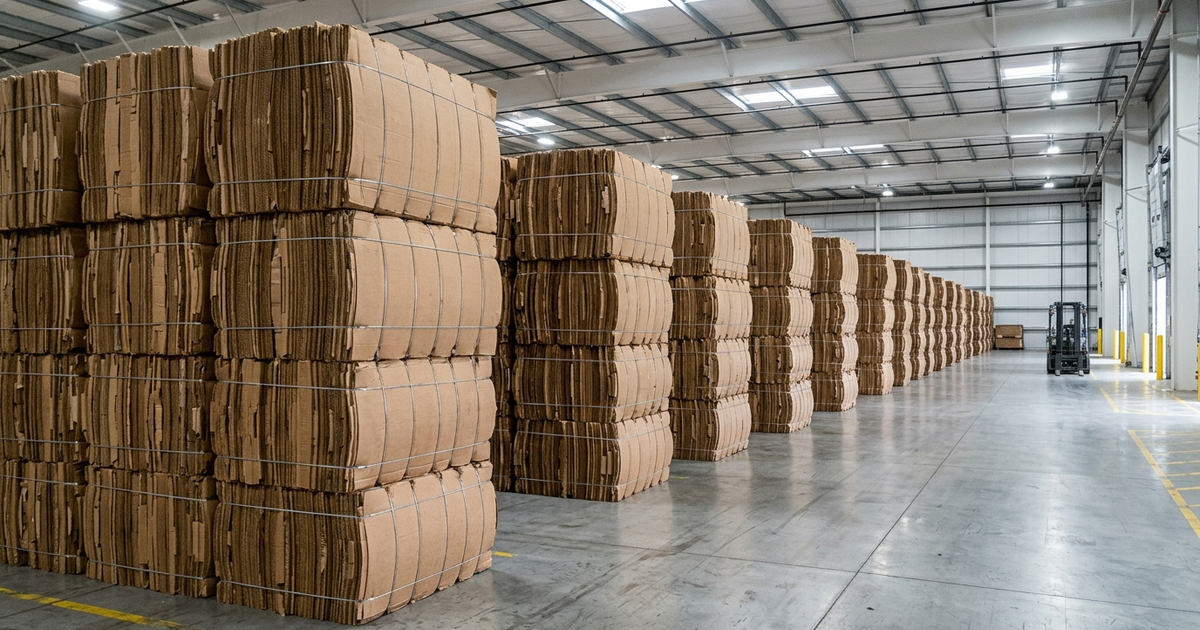
Containerboard and recycled pulp mills rely on recovered corrugated containers as their primary packaging furnish worldwide (FAO, 2024; U.S. EPA, 2024). In practice, many international buyers lose real mill margin at the receiving weighbridge. Purchase orders often settle on gross shipped weight instead of usable oven-dry cellulose fiber. Excess bale-core moisture, hidden waxed cartons, and plastic strapping quickly turn a discounted container into a hydrapulper shutdown and landfill expense.
At GUANHE Paper Mill, our pulp and quality control laboratory audits every export lot across all recovered paper grades before container sealing. This guide details customs classification under WCO HS 2022 and contrasts ISRI against EN 643:2014 grading caps. It also derives exact ISO 287:2017 moisture deduction equations and verifies 40HQ stowing physics under IMO SOLAS VGM.
| Grade Standard | HS 2022 Code | Moisture Ceiling | Prohibitives Limit | Outthrows Limit |
|---|---|---|---|---|
| ISRI #11 OCC | 4707.10.00 |
≤ 12.0% (ISRI, 2024) |
≤ 1.0% |
≤ 5.0% total |
| ISRI #12 DSOCC | 4707.10.00 |
≤ 12.0% (ISRI, 2024) |
≤ 0.5% |
≤ 2.0% total |
| EN 643 1.05.00 | 4707.10.00 |
≤ 10.0% (EN 643:2014) |
0.0% prohibited |
≤ 2.5% total (≤ 1.5% non-paper) |
| ISRI #37 SOP | 4707.20.00 |
≤ 10.0% (mill spec) |
≤ 1.0% |
≤ 5.0% total (ISRI, 2024) |
| ISRI #58 (#8 ONP) | 4707.30.00 |
≤ 11.0% (mill spec) |
≤ 0.5% |
≤ 1.0% total (ISRI #58) |
WCO HS 2022 Heading 4707 Classification and Customs Quarantine Boundaries
Smooth port clearance for baled waste paper begins with accurate tariff classification under Chapter 47 of the WCO HS 2022 Nomenclature and the USITC Harmonized Tariff Schedule. Misdeclaring sorted corrugated bales as unsorted mixed waste invites customs detention, environmental rejection, or costly re-export orders across Asian and Middle Eastern ports.
Old Corrugated Containers (OCC #11) is a standardized recovered paper grade made of used shipping cartons with testliner or kraft liners, classified under HS 4707.10.00 (ISRI, 2024; WCO HS 2022). Because corrugated medium and linerboard contain long unbleached kraft fibers, mills repulp HS 4707.10.00 bales directly into testliner, fluting medium, and recycled industrial kraft paper furnish.
Customs authorities divide Heading 4707 recovered fiber into four legal subheadings (WCO HS 2022).
HS 4707.10.00(Unbleached Kraft or Corrugated): Covers OCC #11, DSOCC #12, corrugated plant clippings (DLK #13), and EuropeanEN 643Grades1.04.00and1.05.00. Most importing markets clear cleanHS 4707.10.00lots when non-paper impurities stay within national environmental limits (≤ 0.5% wtto1.0% wtper destination port regulations).HS 4707.20.00(Bleached Chemical Pulp Paper): Covers Sorted Office Paper (SOP #37), white ledger, and unprinted woodfree converting trimmings used in tissue and recycled printing grades.HS 4707.30.00(Mechanical Pulp Paper): Covers Sorted Clean News (ISRI #58, formerly ONP #8) and uncoated magazine returns feeding deinked pulp (DIP) lines for coldset web newsprint rolls. Review our web newsprint HS 4801 engineering guide for how DIP furnish shapes45.0 gsmpress runnability.HS 4707.90.00(Other / Unsorted Mixed Waste): Covers unsorted residential mixed paper and contaminated post-consumer scraps. Many environmental ministries ban or tightly regulateHS 4707.90.00under national waste controls aligned with the Basel Convention framework.
Therefore, confirm that the commercial invoice, packing list, bill of lading, and inspection certificate all print the exact 8-digit code (4707.10.00). Include the explicit ISRI or EN 643 grade name plus a signed "Free from Municipal Solid Waste and Hazardous Materials" statement. For buyers comparing recycled testliner against virgin softwood multiwall grades, see our industrial unbleached kraft paper HS 4804 guide.
ISRI OCC #11 vs DSOCC #12 and European EN 643:2014 Grading Thresholds
Global waste paper contracts rely on two core frameworks: the North American ISRI Scrap Specifications Circular (ISRI/ReMA, 2024) and Europe's EN 643:2014 standard maintained with Cepi. Procurement teams often treat ISRI #11 and EN 643 1.05.00 as identical grades. However, their definitions for unwanted paper, non-paper rejects, and moisture baselines differ sharply.
Outthrows are all papers manufactured or treated in a way that makes them unsuitable for the specified grade, such as gray chipboard, boxboard, or kraft bags mixed into corrugated bales (ISRI, 2024). Prohibitive Materials are substances that exceed contract limits and render a bale unusable or damage pulping equipment, including waxed cartons, wet-strength resin board, plastics, metal, glass, asphalt, and food waste (ISRI, 2024).
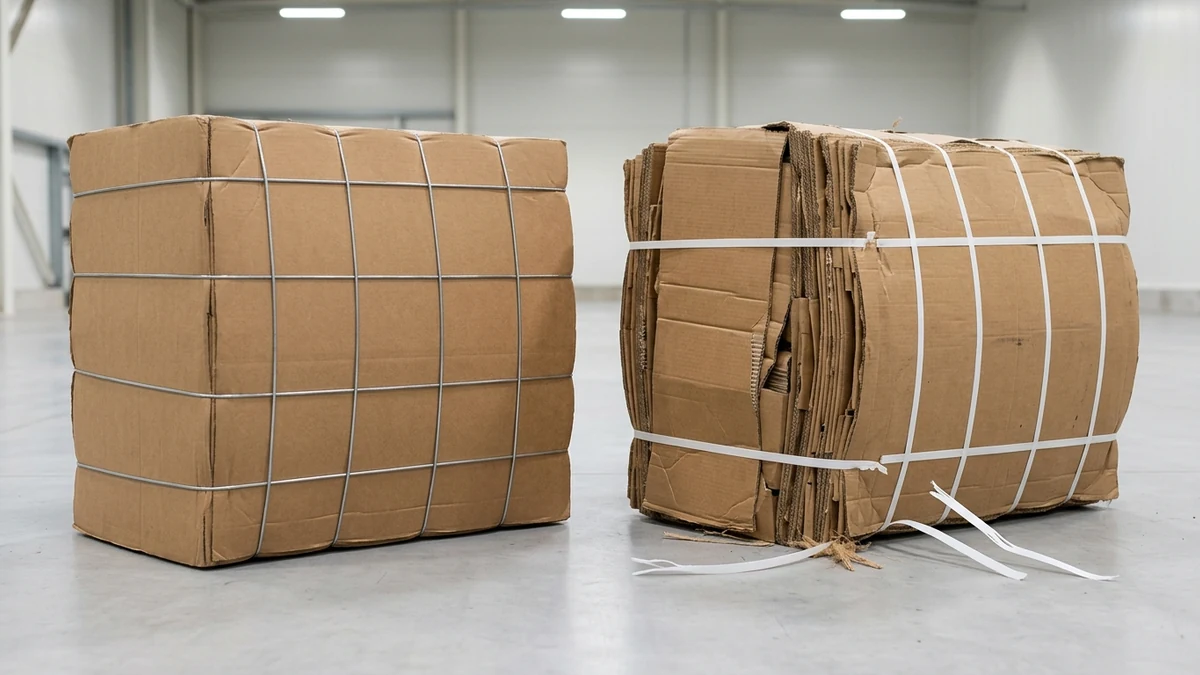
Figure 1: Side-by-side pre-shipment quality control comparison on an indoor concrete floor: compliant export OCC #11 bound with five 3.2 mm galvanized steel wires (left) versus retail corrugated stock bound with white synthetic plastic straps (right) that shred into screen-blinding ribbons inside continuous hydrapulpers.
Compare the two binding methods shown in Figure 1. Retail stores frequently apply polyester or polypropylene strapping on small vertical balers, yet export mills strictly reject plastic straps on deep-sea OCC 11 waste paper bales. Inside a continuous hydrapulper, steel tie wires wind cleanly onto the rotating ragger rope for intact removal. By contrast, plastic straps shred into thin floating ribbons that blind 0.15 to 0.25 mm slotted pressure screens and cause sticky sheet breaks.
| Quality Parameter | ISRI #11 (OCC) | ISRI #12 (DSOCC) | EN 643 1.04.00 | EN 643 1.05.00 |
|---|---|---|---|---|
| Core Fiber Source | Corrugated boxes (kraft/test) | Double-sorted supermarket OCC | ≥ 70% corrugated board |
≥ 90% corrugated boxes |
| Prohibitive Cap | ≤ 1.0% (ISRI, 2024) |
≤ 0.5% (ISRI, 2024) |
0.0% prohibited |
0.0% prohibited |
| Total Outthrows Cap | ≤ 5.0% (incl. prohibitives) |
≤ 2.0% (incl. prohibitives) |
≤ 3.0% unwanted total |
≤ 2.5% unwanted total |
| Non-Paper Limit | Inside 1.0% prohibitives |
Inside 0.5% prohibitives |
≤ 1.5% (EN 643:2014) |
≤ 1.5% (EN 643:2014) |
| Air-Dry Moisture | ≤ 12.0% default ceiling |
≤ 12.0% (10% mill target) |
≤ 10.0% reference |
≤ 10.0% reference |
Three sorting controls prevent unexpected mill yield losses.
- DSOCC #12 Eliminates Weak Short-Fiber Boxboard: Standard ISRI #11 permits up to
5.0%total outthrows (ISRI, 2024), which often includes gray boxboard that weakens Ring Crush Test (RCT) and Burst Index strength. DSOCC #12 cuts total outthrows to2.0%and excludes waxed produce cartons and weak offshore boxes (ISRI, 2024), preserving long softwood kraft fibers. - Destination Port Caps Override ISRI Defaults: Although ISRI #11 allows
1.0%prohibitive materials (ISRI, 2024), several Asian customs agencies enforce a strict0.5%ceiling on non-paper impurities such as plastic film, tape, foam, and wood. Purchase orders should specify≤ 0.5%non-paper prohibitives instead of citing baseline ISRI #11 alone (ISRI, 2024). - Cross-Border Traceability & Recycled Chain-of-Custody: Packaging converters exporting corrugated cartons into regulated European and international markets align supplier audits with FSC Chain of Custody Recycled standards and cross-border secondary-fiber rules under the EU Waste Shipment Regulation (EU) 2024/1157.
How Do ISRI and EN 643 Moisture Deduction Formulas Impact Payable Weight?
Paying full fiber rates for excess water is the largest hidden margin leak in recovered paper imports. Under temperate storage (ISO 187:2022), air-dry corrugated fiber naturally equilibrates near 8.0% to 10.0% moisture. However, bales stored outdoors before container loading absorb rain deep into their cores, driving internal moisture to 15.0% to 22.0%.
Bone-Dry Metric Ton (BDMT) is the net mass of oven-dry cellulose fiber remaining after drying at 105 ± 2 °C to constant weight under ISO 287:2017 and TAPPI T 412 test methods. Every commercial moisture claim clause must preserve equal bone-dry fiber parity rather than relying on simple percentage-point subtraction.
For example, consider one 40HQ container arriving with a certified weighbridge net mass (W_gross) of 26.00 MT (26,000 kg) and a verified core moisture (M_actual) of 16.5% (ISO 287:2017). That lot holds 83.5% oven-dry solids, equal to 21,710 kg (21.71 MT) of bone-dry mass. Compare the three contractual settlement formulas below.
Formula A: Exact Bone-Dry Parity Under ISRI Air-Dry Ceiling (12.0%, ISRI 2024)
This formula adjusts delivered weight to preserve identical bone-dry fiber mass at 88.0% contract solids (ISO 287:2017):
- Algebraic Equation:
W_payable = W_gross × [(100 - M_actual) / (100 - M_max)] - Substitution (
16.5%vs12.0%):W_payable = 26,000 kg × [(100 - 16.5) / (100 - 12.0)] = 26,000 kg × (83.5 / 88.0) - Settled Net Mass:
24,670 kg(24.67 MT) — Exact weight deduction:-1,330 kg(-5.11%).
Formula B: Simple Excess-Point Subtraction (Seller-Biased Shortcut)
Some informal trades subtract excess moisture points straight from gross weight, distorting dry-fiber parity:
- Shortcut Equation:
W_payable = W_gross × [1 - (M_actual - M_max) / 100] - Substitution (
16.5%vs12.0%):W_payable = 26,000 kg × [1 - (16.5 - 12.0) / 100] = 26,000 kg × 0.955 - Settled Net Mass:
24,830 kg(24.83 MT) — Shortcut deduction:-1,170 kg(-4.50%).
Formula C: Exact Bone-Dry Parity Under European EN 643:2014 (10.0%, Cepi 2014)
European mill contracts normalize delivered dry solids against the stricter 90.0% air-dry reference (EN 643:2014):
- Substitution (
16.5%vs10.0%):W_payable = 26,000 kg × [(100 - 16.5) / (100 - 10.0)] = 26,000 kg × (83.5 / 90.0) - Settled Net Mass:
24,122 kg(24.12 MT) — ExactEN 643:2014deduction:-1,878 kg(-7.22%).
These three equations reveal two major commercial pitfalls.
- Formula B Overpays Suppliers by
160 kg(0.160 MT) per Container: Simple percentage subtraction fails to normalize against the contract dry-solids baseline (88.0%instead of100.0%underISRI, 2024). Across a20 × 40HQmonthly supply schedule (520 MTgross), Formula B silently transfers3,200 kg(3.20 MT) of uncompensated water weight to the buyer every month. - ISRI vs
EN 643:2014Creates a548 kg(0.548 MT) Gap per Box: One26,000 kgcontainer settles at24,670 kgunder ISRI (12.0%cap, ISRI 2024). UnderEN 643:2014(10.0%cap, Cepi 2014), that same container settles at24,122 kg. Even a lot arriving at11.5%moisture carries zero claim under ISRI (≤ 12.0%), yet triggers a1.67%(433 kg) deduction underEN 643:2014(Cepi, 2014). Always print the exact algebraic formula inside the sales contract and Letter of Credit (L/C).
True Hydrapulper Bone-Dry Fiber Cost ($/BDMT) Model
Smart procurement teams compare competing CIF quotes by computing effective usable dry fiber yield (Y_eff) and net cost per bone-dry metric ton (Cost_BDMT). Include landfill disposal fees for pulper rejects to see true headbox economics:
- Effective Dry Fiber Yield Formula:
Y_eff = (1 - M_actual) × (1 - R_nonpaper) × E_pulper - True Bone-Dry Cost Formula:
Cost_BDMT = (P_cif + R_nonpaper × C_landfill) / Y_eff
Here, M_actual is measured core moisture fraction and R_nonpaper is non-paper reject fraction. E_pulper denotes hydrapulper plus screening fiber retention efficiency, P_cif is CIF price per gross ton, and C_landfill is mill reject disposal cost ($45.00/MT illustrative rate).
| Cost & Yield Metric | Clean Export OCC #11 | Discount Unsorted OCC | Engineering Delta |
|---|---|---|---|
Headline Invoice Price (P_cif) |
$225.00 / MT |
$205.00 / MT |
-$20.00 / MT nominal |
Measured Moisture (M_actual) |
10.5% |
15.5% |
+5.0 pts excess water |
Non-Paper Rejects (R_nonpaper) |
1.0% (10 kg/MT) |
4.5% (45 kg/MT) |
+35 kg/MT waste |
Pulper Retention (E_pulper) |
96.0% |
94.0% |
-2.0 pts screen loss |
Effective Dry Yield (Y_eff) |
85.1% (0.8506) |
75.9% (0.7586) |
-9.2 pts fiber yield |
Reject Disposal ($45/MT) |
$0.45 / MT |
$2.03 / MT |
+$1.58 / MT landfill |
True Fiber Cost (Cost_BDMT) |
$265.05 / BDMT |
$272.92 / BDMT |
+$7.87 / BDMT higher |
As a result, the wet, high-reject lot costs $7.87/BDMT more at the headbox ($272.92 vs $265.05/BDMT) despite looking $20.00/MT cheaper on the proforma invoice. For a containerboard mill consuming 20,000 BDMT/year, buying the lower-grade discount lot drains $157,400/year in wasted water freight, fiber loss, and landfill charges. That figure still excludes unscheduled screen-cleaning downtime.
Why Does 40HQ Hydraulic Baling Beat 20GP Containers on Landed Freight Cost?
Recovered corrugated paper is a bulky commodity whose ocean freight makes up a major share of landed mill cost under Incoterms 2020. Maximizing legal tonnage inside a 40ft High-Cube (40HQ) box requires high-tonnage hydraulic baling matched to ISO 668:2020/Amd 1:2022 internal dimensions and IMO SOLAS VGM weight caps.
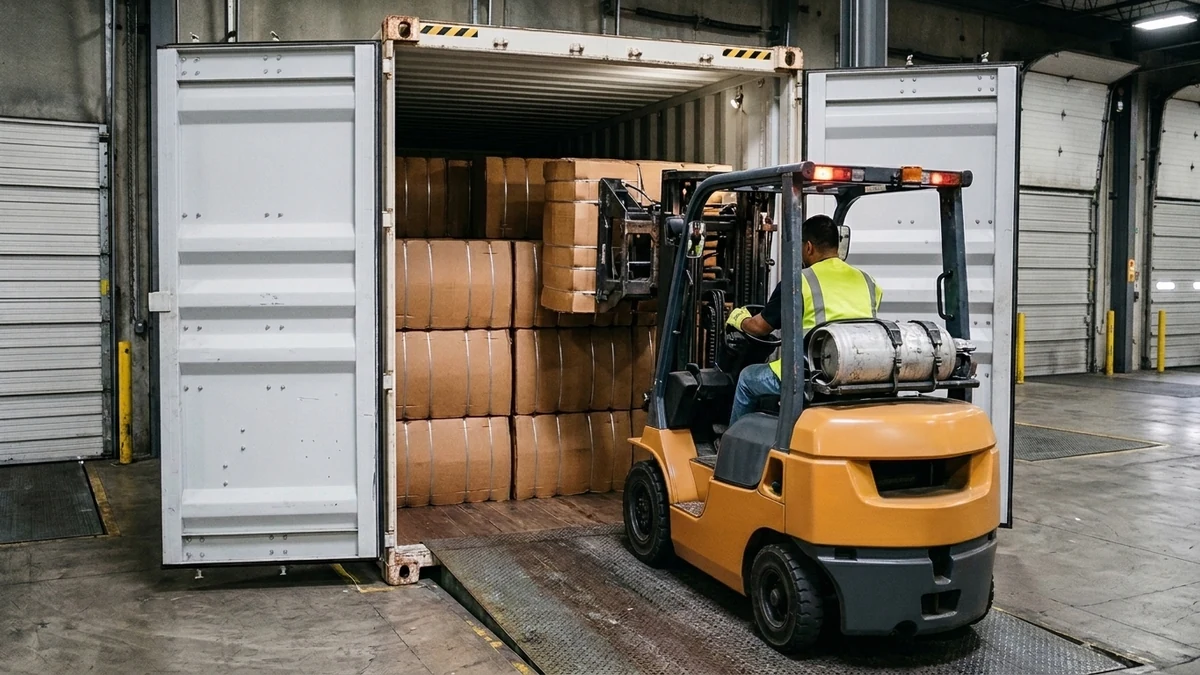
Figure 2: Bale-clamp forklift stowing high-density 150-ton hydraulically compressed OCC #11 corrugated bales bound with galvanized steel wires in interlocking double-tier rows inside a 40HQ high-cube container to achieve 25.0 to 26.35 MT net under SOLAS VGM limits.
3D Bale Volume, Press Density, and 40HQ vs 20GP Payload Math
A 150-ton horizontal hydraulic baler compresses sorted corrugated cartons to an export density of 460 to 540 kg/m³. Each bale is secured with 5 strands of 3.2 mm galvanized steel tie wire (≥ 1,100 N/mm² tensile strength) to prevent spring-back expansion during sea transit (ASTM D4169-23e1, 2024). Review the exact container stowing physics under ISO 668:2020.
40HQStandard Export Bale (1,100 × 1,100 × 1,300 mm,1.573 m³): The40HQinternal cavity measures12,032 × 2,352 × 2,698 mm(76.3 m³, door2,585 mm). At540 kg/m³, unit bale mass equals1.573 × 540 = 849.4 kg(~850 kg). The cavity geometrically fits2 wide × 2 high × 9 long = 36bale positions. Loading30 to 31bales achieves30 × 850 = 25,500 kg(25.50 to 26.35 MTnet), staying beneath the26,580 kgSOLAS VGMnet limit (30,480 kggross minus~3,900 kgtare). At460 kg/m³(723.6 kg/bale),34 to 35bales achieve24.60 to 25.33 MT.40HQHeavy Export Bale (1,100 × 1,100 × 1,650 mm,1.9965 m³): Pressed at500 kg/m³, each bale weighs1.9965 × 500 = 998.3 kg(~1,000 kg). Stowing25 to 26heavy bales (2 wide × 2 high, inside28floor-to-ceiling slots) delivers25.00 to 26.00 MTnet with faster clamp-truck loading.20GPCube-Limited Cavity (5,898 × 2,352 × 2,393 mm,33.2 m³, door2,280 mm): A20GPfits only2 wide × 2 high × 4 long = 16standard850 kgbales (leaving only80 mmdoor-header clearance above2,200 mm, so balers must cap height at≤ 1,050 to 1,080 mmto prevent header scuffing). That geometry caps net payload at16 × 850 = 13,600 kg(13.60 MT; typical range12.0 to 14.0 MT), leaving over half of the28,200 kgstructural payload unused.
| Container Type | Internal Size (ISO 668:2020) |
Standard 850 kg Bales |
Net Payload (MT) |
Illustrative Freight / MT |
|---|---|---|---|---|
40HQ (Optimal) |
12,032 × 2,352 × 2,698 mm |
30 to 31 bales |
25.50 to 26.35 MT |
$98.04 / MT (at $2,500, 25.5 MT) |
40HQ (Heavy Bale) |
12,032 × 2,352 × 2,698 mm |
25 to 26 (1,000 kg) |
25.00 to 26.00 MT |
$96.15 to $100.00 / MT (at $2,500) |
20GP (Cube-Limited) |
5,898 × 2,352 × 2,393 mm |
16 bales max |
12.00 to 13.60 MT |
$132.35 / MT (at $1,800, 13.6 MT) |
In the worked freight comparison above ($2,500 per 40HQ vs $1,800 per 20GP under ISO 668:2020), shipping OCC 11 waste paper bales in a 20GP raises ocean freight from $98.04/MT to $132.35/MT. That $34.31/MT (35.0% per the table above, ISO 668:2020) dead-freight penalty wipes out procurement savings. Importers consolidating palletized office sheets alongside recovered fiber should dedicate 20GP boxes to high-density A4 copy paper wholesale orders and reserve 40HQ containers exclusively for baled waste paper.
Pre-Shipment CCIC / SGS / Intertek Inspection Checklist
Before sealing doors and submitting the SOLAS VGM declaration, require accredited third-party inspectors (CCIC, SGS, Intertek, or destination-mandated schemes such as India PSIC, Indonesia LS/KSO, and Malaysia SIRIM) to verify five physical checkpoints.
- Random Bale-Breaking Sort: Cut wires on
3 to 5randomly chosen bales per100 MTlot on a clean sorting floor. Weigh all non-paper outthrows, waxed cartons, and prohibitives separately to confirm compliance (≤ 1.0%export grade or≤ 0.5%destination port cap). - Deep-Core Moisture Probing: Insert a calibrated microwave or dielectric spear probe into
10random bales per container (6core and perimeter readings per bale). Pair every meter log with anISO 287:2017oven-dry laboratory voucher. - Container Dryness & Light-Leak Test: Inspect timber floors for oil stains, odor, or standing dampness. Perform a closed-door daylight leak test across roof panels and door seals to prevent saltwater damage at sea.
- Certified Weighbridge & VGM Slips: Record timestamped empty-container tare weight and loaded gross weight on a calibrated truck scale. Confirm net cargo falls between
25.0and26.35 MTwhile meeting destination road axle limits. - Sequential Loading Photos & Seal Logs: Capture timestamped photos at one-quarter, half, three-quarter, and full container fill. Finish with half-door and closed-door photos showing steel door safety bars, the container ID, and high-security bolt seal.
GUANHE Recovered Waste Paper Bales Supply Matrix (OCC #11 / #12 / SOP / ONP)
GUANHE recovered waste paper bales are indoor-sorted and 150-ton hydraulically baled for containerboard, tissue, and deinked newsprint pulp mills (TDS-GH-1040-OCC, 2026). Every export bale uses 5 × 3.2 mm galvanized steel tie wire (≥ 1,100 N/mm²) with zero plastic strapping and zero unsorted municipal solid waste.
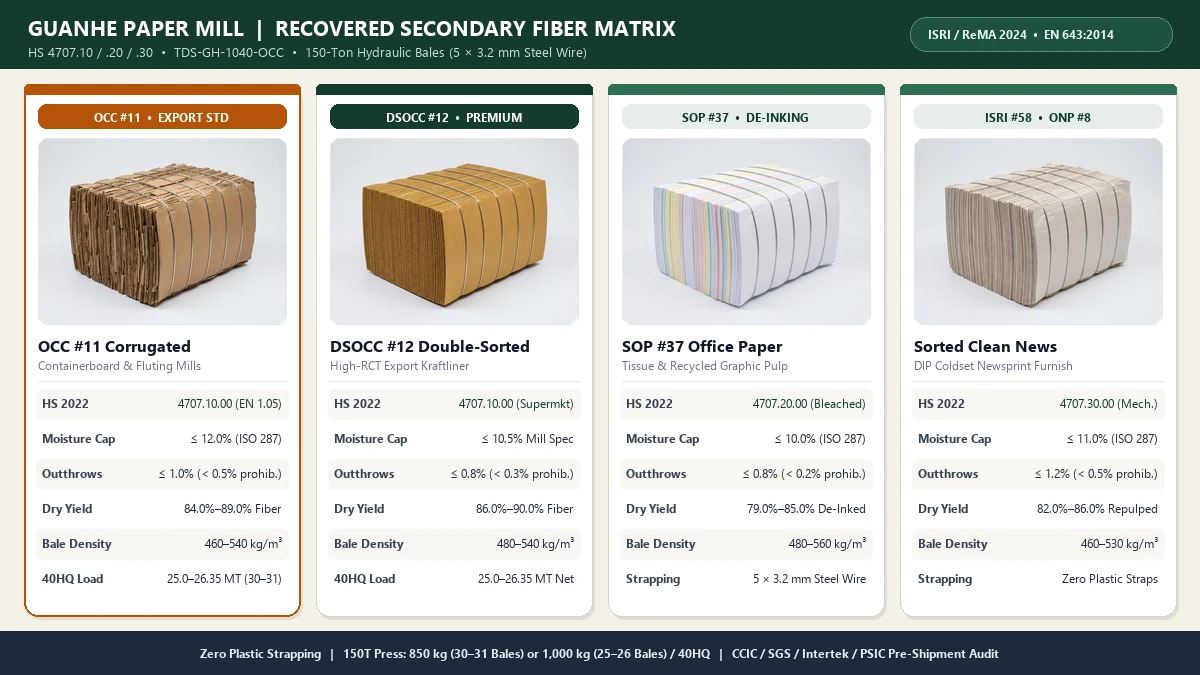
Figure 3: GUANHE 4-grade recovered secondary fiber specification matrix (OCC #11, DSOCC #12, SOP #37, and ISRI #58 / ONP #8), compressed by 150-ton horizontal balers with five galvanized steel wires and verified against pre-shipment moisture and outthrow caps.
GUANHE Grade (TDS-GH-1040) |
HS 2022 Code | Moisture Cap | Export Outthrows | Dry Fiber Yield |
|---|---|---|---|---|
| OCC #11 (Export Grade) | 4707.10.00 |
≤ 12.0% |
≤ 1.0% (< 0.5% prohib.) |
84.0% to 89.0% |
| DSOCC #12 (Supermarket) | 4707.10.00 |
≤ 10.5% |
≤ 0.8% (< 0.3% prohib.) |
86.0% to 90.0% |
| SOP #37 (Sorted Office) | 4707.20.00 |
≤ 10.0% |
≤ 0.8% (< 0.2% prohib.) |
79.0% to 85.0% |
| ONP #8 / ISRI #58 (News) | 4707.30.00 |
≤ 11.0% |
≤ 1.2% (< 0.5% prohib.) |
82.0% to 86.0% |
Commercial execution specifications for GUANHE recovered waste paper bales cover four export terms.
- Minimum Order Quantity (MOQ):
2 × 40HQcontainers (48.0 to 52.0 MTcombined net mass), with mixed-grade trial orders available for qualified paper mills. - Bale Compression & Wire Specs:
150-tonhydraulic press density of460 to 540 kg/m³, bound with5 × 3.2 mmgalvanized steel wire. Choose standard1,100 × 1,100 × 1,300 mmbales (~850 kg,30 to 31bales per40HQ) or heavy1,100 × 1,100 × 1,650 mmbales (~1,000 kg,25 to 26bales per40HQ). - Lead Time & Export Routing:
7 to 12working days after deposit or L/C confirmation via direct or bonded export routing (Qingdao, Shanghai, Tianjin, or approved regional hubs) on FOB, CFR, and CIF sailings into Southeast Asia, India, the Middle East, and Africa. - Pre-Shipment Documentation: Accredited CCIC, SGS, Intertek, or destination-specific (
PSIC / LS / SIRIM) pre-shipment certificates, bale-breaking photo logs,ISO 287:2017oven-dry moisture reports, certified weighbridge slips, and non-hazardous declarations.
Request a Mill-Direct OCC #11 / #12 Proforma Quote
Submit your target grade (OCC #11, DSOCC #12, SOP #37, or ONP #8 / ISRI #58), destination port, and monthly 40HQ volume via our export inquiry desk or email info@copypapersupplier.com. State your destination port non-paper impurity limit (≤ 0.5% wt or ≤ 1.0% wt). Our recovered-fiber quality engineers issue a CIF/FOB proforma invoice with sample CCIC/SGS bale-breaking inspection reports within 24 hours.
Frequently Asked Questions
What is the difference between ISRI OCC #11 and DSOCC #12 waste paper bales?
Under the ISRI Scrap Specifications Circular (2024), OCC #11 allows up to 1.0% prohibitive materials and 5.0% total outthrows, including boxboard and mixed cartons. DSOCC #12 (Double-Sorted Old Corrugated) tightens prohibitives to 0.5% and total outthrows to 2.0% (ISRI, 2024) by excluding boxboard, waxed boxes, and plastic. Export linerboard mills choose DSOCC #12 for higher hydrapulper dry fiber yield (86.0% to 90.0% per TDS-GH-1040-OCC, 2026).
How do you calculate moisture weight deduction on imported OCC #11 bales?
Apply exact bone-dry fiber parity (ISO 287:2017): Payable Weight = Gross Net Weight × [(100 - Actual Moisture %) / (100 - Contract Max Moisture %)]. For a 26,000 kg container measured at 16.5% moisture under an ISRI 12.0% ceiling (ISRI, 2024), payable weight equals 26,000 × (83.5 / 88.0) = 24,670 kg (24.67 MT). Avoid simple excess-point subtraction (24,830 kg), which overpays the seller by 160 kg per container.
Why do ISRI and European EN 643:2014 produce different moisture claims?
The ISRI Scrap Specifications Circular (2024) sets 12.0% as the default air-dry moisture ceiling for OCC #11. Conversely, European EN 643:2014 (1.04.00 and 1.05.00) uses 10.0% as its reference air-dry moisture threshold (Cepi, 2014). A 26.00 MT lot arriving at 11.5% moisture incurs zero weight claim under ISRI (2024), yet triggers a 1.67% (433 kg) weight deduction under EN 643:2014 (Cepi, 2014).
How many metric tons of OCC #11 waste paper fit inside a 40HQ vs 20GP container?
Under ISO 668:2020 and IMO SOLAS VGM rules, a 40HQ box carries 25.0 to 26.35 MT net of 150-ton hydraulically pressed OCC #11 bales (460 to 540 kg/m³). That equals 30 to 31 standard 850 kg bales or 25 to 26 heavy 1,000 kg bales. A 20GP box fits only 16 standard bales (12.0 to 13.6 MT), inflating ocean freight per metric ton by 35.0% ($132.35 vs $98.04/MT, worked ISO 668 model, 2020).
Why must export OCC waste paper bales use galvanized steel wire instead of plastic straps?
Inside a paper mill hydrapulper, 3.2 mm galvanized steel tie wires (≥ 1,100 N/mm²) wind cleanly onto the continuous ragger rope for intact extraction. Polypropylene or polyester straps shred under rotor shear into floating plastic ribbons. Those filaments blind 0.15 to 0.25 mm slotted pressure screens, raise landfill reject fees, and trigger sheet breaks on the paper machine.
All WCO HS 4707 subheadings, ISRI/ReMA 2024 and EN 643:2014 outthrow ceilings, ISO 287:2017 bone-dry moisture deduction equations, and ISO 668:2020 40HQ bale payload calculations verified by the GUANHE Mill QC Lab (TDS-GH-1040-OCC).