

Industrial Kraft Paper Rolls (HS 4804): TEA, Burst & Stowing
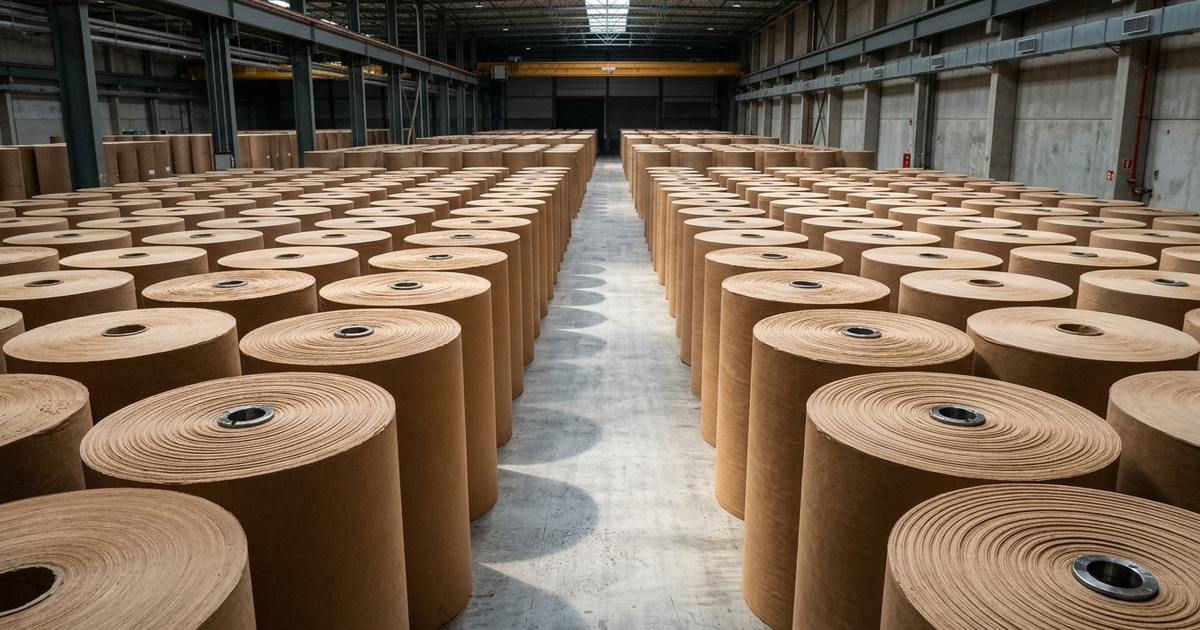
Export-grade industrial kraft paper rolls must contain at least 80% chemical sulfate wood fiber under WCO HS Chapter 48 Note 6 (WCO, 2022). Unbleached kraftliner above 115 gsm clears under HS 4804.11, while 60 to 115 gsm sack kraft clears under HS 4804.21. Multi-wall cement bag converters should specify ISO 1924-3:2005 Tensile Energy Absorption (TEA >= 180 J/m2 on extensible grades) and ISO 5636-5:2013 Gurley air permeance of 10 to 25 s/100 mL. High-speed corrugators running above 350 m/min need ISO 2758:2014 Burst Index >= 3.6 to 4.2 kPa*m2/g, ISO 12192:2011 CD Ring Crush >= 2.45 to 4.20 kN/m, and ISO 535:2023 Cobb60 of 24 to 30 g/m2. Clamped reel loads reach 17 to 19 MT per 20GP or 25 to 27 MT per 40HQ (GUANHE TDS-GH-1036-KFT).
| Kraft Grade & Application | Grammage & WCO HS Code (ISO 536:2019 / WCO, 2022) |
Burst Index (ISO 2758:2014) |
Target TEA (ISO 1924-3:2005) |
RCT CD & Cobb60 (ISO 12192 / ISO 535) |
|---|---|---|---|---|
| Flat MF Sack Kraft (Flour, grain, carrier bags) | 70 to 80 gsm (HS 4804.21.00, opt. b / 4804.31) |
>= 3.6 kPa*m2/g |
>= 65 to 110 J/m2 |
>= 1.20 kN/m; 25 to 32 g/m2 |
Extensible Sack Kraft (50 kg cement valve sacks) |
70 to 80 gsm (HS 4804.21.00, opt. a) |
>= 3.7 kPa*m2/g |
>= 180 to 260 J/m2 |
>= 1.35 kN/m; 25 to 30 g/m2 |
| Industrial Packaging Kraft (Facings, interleaving) | 120 to 150 gsm (HS 4804.11.00) |
>= 3.7 kPa*m2/g |
>= 120 J/m2 |
>= 2.45 kN/m; 25 to 30 g/m2 |
| Heavy Unbleached Kraftliner (Export & cold-chain cartons) | 180 to 250 gsm (HS 4804.11.00) |
>= 3.8 to 4.2 kPa*m2/g |
>= 185 J/m2 |
>= 4.20 kN/m; 24 to 28 g/m2 |
Packaging converters buying wholesale industrial paper grades face costly downtime when contracts specify only basis weight and brown shade. Global packaging paperboard trade continues to expand across both virgin kraftliner and recycled containerboard lines (FAO Forestry Statistics, 2025). A 70 gsm flat kraft reel looks identical to extensible sack kraft, yet it splits open on 3,000-bag-per-hour rotary cement packers. Likewise, an under-sized linerboard reel absorbs carrier starch too fast on a 350 m/min corrugator and causes loose edges across export cartons.
Compiled by Dr. Wei Chen at the GUANHE Paper Mill QC Laboratory, this guide converts fiber chemistry, ISO mechanical tests, and container stowage math into enforceable purchase order clauses. Distributors combining packaging reels with cut-size office reams can also review our A4 copy paper wholesale program and 20GP container import specification guide.
Virgin Softwood Sulfate Kraft vs Recycled Testliner: Fiber Morphology and HS 4804 Rules
Unbleached Virgin Softwood Kraft Paper is an industrial packaging paper produced by alkaline sulfate pulping of coniferous softwood without bleaching. Under Chapter 48 Note 6 of the World Customs Organization HS Nomenclature (WCO, 2022) and the USITC Harmonized Tariff Schedule (2025), true kraft must contain at least 80% chemical sulfate or soda wood fibers by weight.
Long pine and spruce tracheids measure 2.5 to 4.0 mm (TAPPI T 271 optical fiber length; TAPPI, 2025), with thick, flexible cell walls that collapse into dense hydrogen-bonded ribbons during pressing. By contrast, recovered fibers from corrugated boxes suffer irreversible hornification during repeated drying cycles. Repeated recycling cuts average fiber length to 0.9 to 1.5 mm and reduces inter-fiber bonding area by 25% to 40% (USDA Forest Products Laboratory Wood Handbook, 2021).
Port customs officers enforce this fiber boundary during tariff audits. Declaring recycled testliner under HS 4804.11 triggers customs reclassification penalties and demurrage delays. Importers must match commercial invoices to four exact WCO Chapter 48 legal definitions (WCO, 2022):
HS 4804.11.00(Unbleached Kraftliner): Unbleached kraft in rolls with>= 80%chemical sulfate pulp, weighing strictly more than115 gsm(ISO 536:2019). UnderWCO Subheading Note 1(2022), minimum Mullen bursting strength must reach>= 393 kPaat115 gsmand>= 417 kPaat125 gsm(linearly interpolated between weights, scaling to>= 637 kPaat200 gsm).HS 4804.21.00(Unbleached Sack Kraft Paper): Machine-finished unbleached kraft in rolls with>= 80%chemical sulfate pulp, weighing60 to 115 gsm. UnderWCO Subheading Note 2(2022), it must satisfy option (a) (Mullen burst index >= 3.7 kPa*m2/gunderISO 2758:2014and stretch> 4.5%CD and> 2.0%MD) or option (b) (minimum Elmendorf tear and tensile strength per the60 to 115 gsmtariff matrix). Flat MF grades with burst index3.6 kPa*m2/gor lower CD stretch qualify for4804.21only when meeting option (b); otherwise they classify underHS 4804.31.HS 4804.31 / 4804.41 / 4804.51(Other Unbleached Kraft Paper): Unbleached kraft grades with>= 80%chemical sulfate fiber that fall outside kraftliner or sack kraft rules. Customs segments them strictly by grammage (<= 150 gsm,> 150 to < 225 gsm, and>= 225 gsm) per the USITC HTS (2025).HS 4805.24 / 4805.25(Recycled Testliner): Multi-ply linerboard made primarily from recovered corrugated fiber such as OCC #11 recovered waste paper bales (< 80%virgin chemical sulfate pulp). Even when dyed brown and surface-starched for dry crush, recycled testliner loses40% to 55%of its dry stacking strength above80% RH(ISO 187:2022/USDA Forest Products Laboratory, 2021).
| Engineering & Customs Attribute | Virgin Unbleached Kraftliner (HS 4804.11) |
Unbleached Sack Kraft (HS 4804.21) |
Recycled Testliner Grade 2 (HS 4805.24 / 4805.25) |
Procurement Impact for Converters |
|---|---|---|---|---|
| Chemical Sulfate Fiber Share | >= 80% to 100% virgin softwood (WCO, 2022) |
>= 80% to 100% virgin softwood (WCO, 2022) |
0% to 35% virgin top ply; 65% to 100% OCC |
Governs legal WCO HS classification and import duty rate |
| Average Fiber Length | 2.5 to 4.0 mm softwood tracheids (TAPPI T 271) |
2.8 to 4.0 mm long softwood (TAPPI T 271) |
0.9 to 1.5 mm shortened recycled fibers (FPL, 2021) |
Long fibers bridge crease scores without cracking |
Burst Index (ISO 2758:2014) |
>= 3.7 to 4.2 kPa*m2/g (TDS-GH-1036-KFT) |
>= 3.6 to 4.0 kPa*m2/g (TDS-GH-1036-KFT) |
1.8 to 2.6 kPa*m2/g (industry baseline) |
Virgin liner resists sharp cargo punctures in sea transit |
Moisture Retention at 85% RH |
Retains 65% to 72% of dry RCT (ISO 12192:2011) |
Retains 70% to 78% of drop impact work |
Loses 40% to 55% of dry compression (FPL, 2021) |
Mandatory virgin outer liner for cold-chain and fruit cartons |
| Food-Contact Eligibility | OBA-free 100% virgin option with SGS audit |
OBA-free 100% virgin option for flour/sugar |
Unsuitable for direct dry-food contact (MOSH/MOAH) | Eliminates mineral-oil migration risk in grain and food bags |
Why Does Tensile Energy Absorption (TEA) Outperform Tensile Strength for Multi-Wall Cement Sacks?
Tensile Energy Absorption (TEA) is the total mechanical work per unit area required to rupture a paper strip stretched at 100 mm/min under ISO 1924-3:2005 (corresponding to TAPPI T 494). Measured in joules per square meter (J/m2), TEA integrates the full area beneath the force-elongation curve.
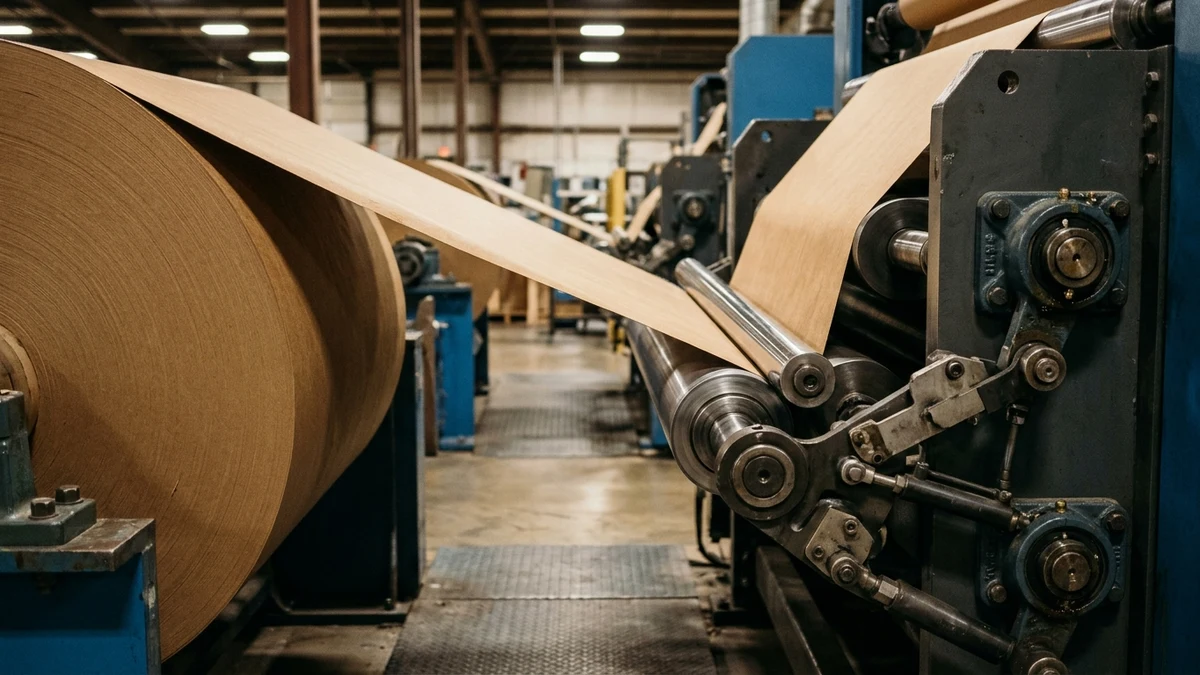
Many sack buyers compare mills strictly on peak machine-direction tensile strength (kN/m under ISO 1924-2:2008). Peak tensile force measures slow static pull, not dynamic drop survival. When a 50 kg cement valve sack drops 1.2 meters onto a concrete floor, the powder load triggers a radial shock wave lasting under 50 milliseconds.
A stiff flat machine-finished (MF) sheet with high peak tensile (7.0 kN/m) but low elongation (2.0% to 2.5% MD per ISO 1924-3:2005) tears instantly once local strain exceeds 2.5% (ISO 1924-3:2005). Export sack mills pass the moist web (35% to 45% moisture) through a rubber-blanket mechanical compaction unit (TAPPI T 494). Micro-creping compacts fibers longitudinally without rupturing hydrogen bonds, boosting MD stretch to 6.0% to 7.0% and CD stretch to 8.0% to 8.5% (ISO 1924-3:2005).
Worked Engineering Calculation: TEA Area Integral and 3-Ply vs 2-Ply Cement Sack Down-Gauging
Under ISO 1924-3:2005, exact TEA equals the integral of tensile force across elongation divided by specimen area (width b x span L). For procurement verification, unbleached softwood kraft follows a reliable stress-strain shape factor k of 0.62 to 0.70 (using k = 0.65 in standard calculations):
- TEA Approximation Formula:
TEA (J/m2) ~= k * Tensile_Strength (kN/m) * Stretch_at_Break (%) * 10 - Geometric Mean TEA:
TEA_GM = sqrt(TEA_MD * TEA_CD) - TEA Index (Mass-Normalized):
TEA_Index (J/g) = TEA (J/m2) / Grammage (g/m2)
For example, compare two 80 gsm virgin softwood sack kraft bids conditioned under ISO 187:2022 (23 deg C, 50% RH):
Case A (Standard Flat MF 80 gsm Sack Kraft, ISO 1924-3:2005):
- Measured MD Tensile Strength:
7.0 kN/m; MD Stretch at Break:2.2%(ISO 1924-3:2005); Shape Factork = 0.65. - MD TEA Calculation:
TEA_MD = 0.65 * 7.0 * 2.2 * 10 = 100.1 J/m2(TEA Index = 1.25 J/g). - 3-Ply Cement Sack Total MD Energy (
3 x 80 gsm = 240 gsm):3 * 100.1 = 300.3 J/m2.
Case B (Extensible Micro-Creped 80 gsm Sack Kraft, ISO 1924-3:2005):
- Measured MD Tensile Strength:
6.5 kN/m(7.1%lower peak force than Case A); MD Stretch at Break:6.5%(ISO 1924-3:2005); Shape Factork = 0.65. - MD TEA Calculation:
TEA_MD = 0.65 * 6.5 * 6.5 * 10 = 274.6 J/m2(TEA Index = 3.43 J/g). - 2-Ply Cement Sack Total MD Energy (
2 x 80 gsm = 160 gsm):2 * 274.6 = 549.2 J/m2.
Case B shows a lower static tensile value (6.5 vs 7.0 kN/m). Yet switching from 3-ply flat kraft (240 gsm) to 2-ply extensible kraft (160 gsm) raises total drop energy by 82.9% ((549.2 - 300.3) / 300.3, ISO 1924-3:2005). At the same time, raw paper tonnage per 1,000 cement sacks falls by 33.3% ((240 - 160) / 240, ISO 536:2019).
Why Gurley Air Permeance (ISO 5636-5:2013) Prevents Rotary Packer Blowouts
High TEA alone cannot stop bag blowouts on 2,400 to 4,000 bags/hour impeller and air-packer cement lines. Fluidized cement enters the valve sleeve mixed with compressed air at 35 to 60 kPa. Over-refined, non-porous sheets (Gurley > 60 s/100 mL) trap pressurized air inside the ply walls and tear open pasted bottom seams.
Porous extensible sack kraft with ISO 5636-5:2013 Gurley air permeance of 10 to 25 s/100 mL vents air rapidly through inter-fiber pores during filling. Meanwhile, the dense fiber mat retains fine Portland cement dust (< 45 um) inside the sack. Converters using micro-perforated outer plies should still hold inner-ply porosity below 25 s/100 mL to keep palletizers clean.
Mullen Burst Index, Ring Crush (RCT), and Cobb60 Sizing for High-Speed Corrugators
Corrugated plants running BHS, Fosber, or Marquip combiners at 300 to 380 m/min depend on three lab metrics for box stacking strength and glue speed. These core specs are Mullen Burst Index, Ring Crush Test (RCT), and Cobb60 Water Absorptiveness.
Mullen Burst Index is hydrostatic bursting pressure (kPa, ISO 2758:2014) divided by conditioned basis weight (g/m2, ISO 536:2019). Dividing pressure by grammage lets buyers compare puncture strength fairly across 60 to 250 gsm linerboard rolls.
Ring Crush Test (RCT) is the edgewise compressive force (kN/m) supported by a 152.4 x 12.7 mm strip seated in a circular groove under ISO 12192:2011 (TAPPI T 822 rigid-support method). Box engineers use CD RCT to predict corrugated board Edge Crush Test (ECT, ISO 3037:2022 / TAPPI T 839) and warehouse stacking limits.
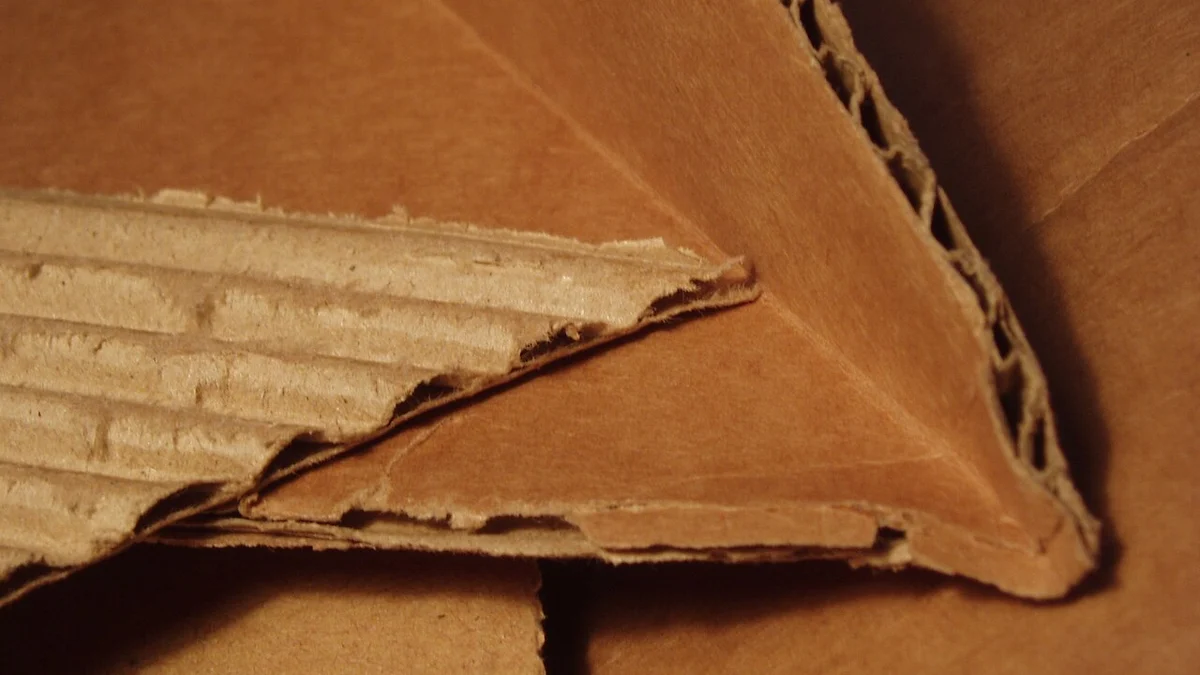
Photo credit: Richard Wheeler (Zephyris), CC BY-SA 3.0 via Wikimedia Commons (cropped to 16:9).
Worked Engineering Calculation: Burst Index Compliance and RCT-to-ECT Box Strength Estimation
Verify every incoming Mill Certificate of Analysis (CoA) with two fast benchmark calculations:
- Burst Index Equation (
ISO 2758:2014):Burst_Index (kPa*m2/g) = Bursting_Pressure P (kPa) / Basis_Weight W (g/m2). - Linerboard Check (
200 gsmGUANHE Heavy Kraftliner,P = 850 kPa):Burst_Index = 850 / 200 = 4.25 kPa*m2/g. That result exceeds both WCOHS 4804.11limits (>= 637 kPaat200 gsm) andTDS-GH-1036-KFT(>= 3.8 to 4.2 kPa*m2/g). By comparison, a200 gsmrecycled testliner bursting at460 kPadelivers only2.30 kPa*m2/g, forcing box plants to step up to250 gsmto pass export drop targets. - Single-Wall Corrugated ECT Estimate (
ISO 3037:2022/TAPPI T 839):ECT (kN/m) ~= 0.80 * [RCT_outer + RCT_inner + (alpha * RCT_medium)]. For C-flute (~128 flutes/m), take-up factoralphaequals1.42with~0.80coupling efficiency (TAPPI T 839). - Worked C-Flute Export Box Check: For instance, combine two
180 gsmvirgin kraftliners (RCT CD = 3.60 kN/meach underISO 12192:2011) with one140 gsmsemi-chemical medium (RCT CD = 1.95 kN/m). The predicted board strength isECT ~= 0.80 * [3.60 + 3.60 + (1.42 * 1.95)] = 7.98 kN/m(~45.6 lb/in, exceeding heavyECT-44export box ratings).
Balancing Cobb60 Hydrophobic Sizing (ISO 535:2023) and Reel Moisture (ISO 287:2017)
Corrugator crews often blame starch viscosity for loose liners when the root cause is poor kraft surface sizing. At 350 m/min, the outer kraftliner contacts the glue roll and enters 175 deg C double-backer hot plates in under 0.4 seconds.
- Under-Sized Liner (
Cobb60 > 35 g/m2): Rapid capillary wicking pulls water out of cornstarch glue before gelatinization finishes at62 to 68 deg C. Chalky white dry glue lines appear along flute tips and delaminate during die-cutting. - Over-Sized Liner (
Cobb60 < 20 g/m2): Heavy rosin or AKD hydrophobic sizing repels liquid starch and blocks fiber anchoring. Trapped steam beneath the sealed liner creates blisters and low pin adhesion. - Calibrated Export Window (
ISO 535:2023+ISO 287:2017): Keep Cobb60 within24 to 28 g/m2for180 to 250 gsmlinerboard and25 to 32 g/m2for70 to 150 gsmgrades. Pair this sizing with uniform cross-direction reel moisture of7.5% +/- 0.5%(ISO 287:2017) to ensure rapid tack and zero banana warp.
| Converting Line Defect | Primary Root Metric Deviation | Governing ISO Standard | Corrective Mill Specification (TDS-GH-1036-KFT) |
|---|---|---|---|
| Cement sack bursts during drop or air filling | Low MD stretch (< 3.0%) or tight porosity (Gurley > 50 s) |
ISO 1924-3:2005 / ISO 5636-5:2013 |
Extensible kraft: TEA >= 180 J/m2, Gurley 10 to 25 s/100 mL |
| Corrugated board banana warp (up-warp / down-warp) | Cross-direction moisture streak (> 1.5% edge-to-center delta) |
ISO 287:2017 |
Moisture 7.0% to 8.5%, CD 2-sigma profile < 0.5% |
| Loose liner edges and chalky white starch lines | Under-sized surface (Cobb60 > 35 g/m2) wicking glue water |
ISO 535:2023 |
Rosin/AKD sizing Cobb60 = 24 to 28 g/m2 (linerboard) |
| Score-line cracking on folding carton creases | Short recycled fiber furnish (< 1.4 mm) or over-dried web (< 5.5%) |
ISO 1974:2012 / ISO 287:2017 |
100% virgin softwood tear >= 1,550 to 2,400 mN, moisture 7.5% |
Flying-paster web breaks at 350 m/min |
Out-of-round crushed reel core or uneven winding tension | ISO 11093-9:2019 / ISO 11093-4:2022 |
152 mm heavy-wall core with steel plugs; max 1 ultrasonic splice |
How Do You Calculate Kraft Reel Weight, Linear Length, and 20GP vs 40HQ Container Payloads?
Industrial kraft paper rolls carry high apparent winding density (720 to 780 kg/m3). Ocean loading depends on both floor circle geometry and maritime Verified Gross Mass (VGM) weight ceilings. Picking the wrong outer diameter (OD) leaves up to 25% of container floor area unused or crushes outer plies (ISO 668:2020 / ASTM D4169-23e1).
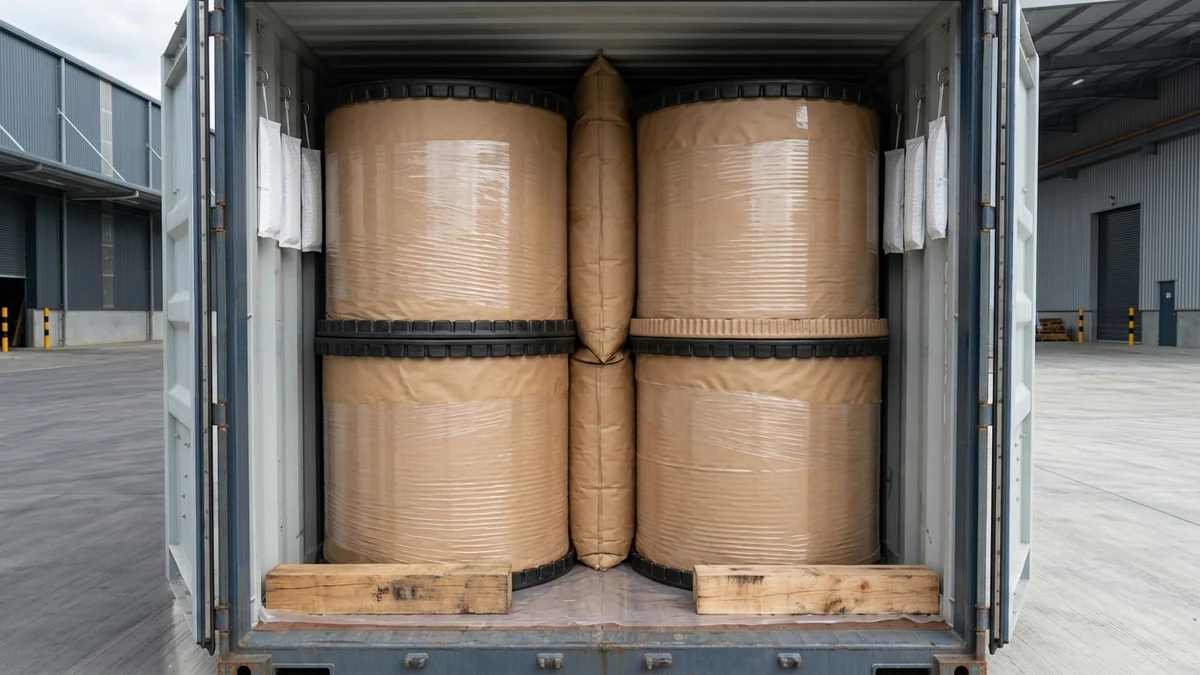
Worked Engineering Calculation: Cylindrical Reel Mass, Linear Web Length, and Staggered Stowage Geometry
Before signing a Proforma Invoice, verify single-reel net weight (M), linear web length (L), and transverse container clearance with cylindrical math:
- Net Reel Weight Formula:
M (kg) = (pi / 4) * (D^2 - d^2) * W_reel * rho - Linear Web Length Formula:
L (m) = (M * 1,000) / (W_reel * GSM)
Consider a standard 150 gsm Unbleached Kraftliner reel with D = 1.20 m outer diameter and W_reel = 1.60 m width. Assume a 152 mm (6 in) core (d = 0.176 m core outer diameter) and apparent density rho = 750 kg/m3 (ISO 534:2011 caliper ~200 um):
- Cross-Sectional Paper Area:
(3.1416 / 4) * (1.20^2 - 0.176^2) = 0.7854 * (1.4400 - 0.0310) = 1.1066 m2. - Solid Paper Volume:
1.1066 m2 * 1.60 m = 1.7706 m3. - Net Reel Mass (
M):1.7706 m3 * 750 kg/m3 = 1,328 kg(1.328 MTnet per reel). - Linear Web Length (
L):(1,328 * 1,000) / (1.60 * 150) = 5,533 metersper reel. At300 m/mincorrugator speed, one reel runs18.4 minutesbetween flying splices.
Next, verify transverse width clearance inside a standard ISO 668:2020 shipping container (2,352 mm internal width, 2,340 mm door opening):
- Twin-Column Side-by-Side Stowage (
OD <= 1,150 mm): Two1,150 mmreels occupy2,300 mmacross the floor, leaving52 mmclearance for PE-kraft wrap and clamp-truck jaws. - Staggered Triangular Nesting (
OD = 1,200 to 1,400 mm): Two1,250 mmreels (2,500 mmtotal) exceed the2,352 mmwall width. Set transverse center offsetdy = 1.07 m(2.352 m - 1.250 m - 0.032 mwall gap) to calculate longitudinal pitch:dx = sqrt(1.25^2 - 1.07^2) = 0.646 m. Along a12.032 m40HQfloor, staggered nesting stows15 to 17 reelsper tier cleanly.
Maritime Moisture Barrier and Core-Protection SOP
Kraft reels crossing tropical sea lanes face 25 deg C daily temperature swings inside steel containers, triggering condensation without sealed barriers. Our export reel protection follows the dew-point controls detailed in our tropical sea freight moisture control guide:
- 3-to-5 Ply PE-Coated Extensible Kraft Wrap: Heat-sealed inner LDPE film blocks
> 90% RHport humidity while outer extensible kraft absorbs clamp-truck friction. - Double-Wall Corrugated End Discs and Radial Chine Guards: Crimped corrugated discs cap both flat reel faces while heavy molded edge rings prevent fork bruising and telescoping.
- Steel or High-Density Composite Core Plugs (
76 mm/152 mm): Pressed plugs stop core ovalization under2.0 Gvessel roll forces and heavy clamp-truck pressure. - Floor Chocks, Dunnage Airbags, and Desiccant Poles: Waterproof PE floor film, nailed hardwood timber chocks, and center kraft dunnage airbags lock roll movement. Hanging
6 x 1.0 kg(20GP) or8 to 10 x 1.0 kg(40HQ) Calcium Chloride desiccant poles (200%weight absorption capacity perTDS-GH-1036-KFT, 2026) traps residual container moisture.
| Container Stowage Parameter | 20ft General Purpose (20GP) |
40ft High-Cube (40HQ) |
Operational Selection Rule |
|---|---|---|---|
Internal Dimensions / Door Height (ISO 668:2020) |
5,898 x 2,352 x 2,393 mm (Door H 2,280 mm) |
12,032 x 2,352 x 2,698 mm (Door H 2,585 mm) |
Check vertical reel width against 2,280 mm vs 2,585 mm door opening height |
| Standard Reel Orientation | Eye-to-Sky (vertical) or Eye-to-Wall (clamped) | Staggered Eye-to-Sky (single or double-tier) | Double-tier 1,100 to 1,200 mm widths only in 40HQ (2,585 mm door H) |
Net Kraft Paper Payload (TDS-GH-1036-KFT) |
17 to 19 Metric Tons |
25 to 27 Metric Tons |
Verify destination highway axle weight limits before loading > 25 MT |
Typical Reel Count (1,000 to 1,400 mm OD) |
14 to 24 Reels |
28 to 44 Reels |
Exact count depends on W_reel, OD, and twin vs staggered nesting |
| Desiccant & Bracing Kit | 6 x 1.0 kg CaCl2 poles + PE floor + timber chocks |
8 to 10 x 1.0 kg CaCl2 poles + airbags + chocks |
Mandatory for voyages exceeding 14 days or crossing tropical latitudes |
| Commercial Freight Advantage | Lower trial working capital; ideal for feeder ports | Lowest ocean freight cost per metric ton (-18% to -25%) |
Standard choice for corrugators consuming > 100 MT/month |
GUANHE Industrial Kraft Paper Reels & Linerboard Matrix
GUANHE Paper Mill manufactures 100% virgin unbleached softwood sulfate kraft, golden kraft, bleached white kraft, and testliner grades from 60 to 250 gsm. Production operates under FSC Chain of Custody (FSC-STD-40-004), EU Deforestation Regulation (EUDR 2023/1115) traceability (see our EUDR and COA compliance framework), and ISO 9001 / 14001 quality systems. Every export order is conditioned under ISO 187:2022 (23 +/- 1 deg C, 50% +/- 2% RH) and ships with a serialized 12-point Mill COA (TDS-GH-1036-KFT).
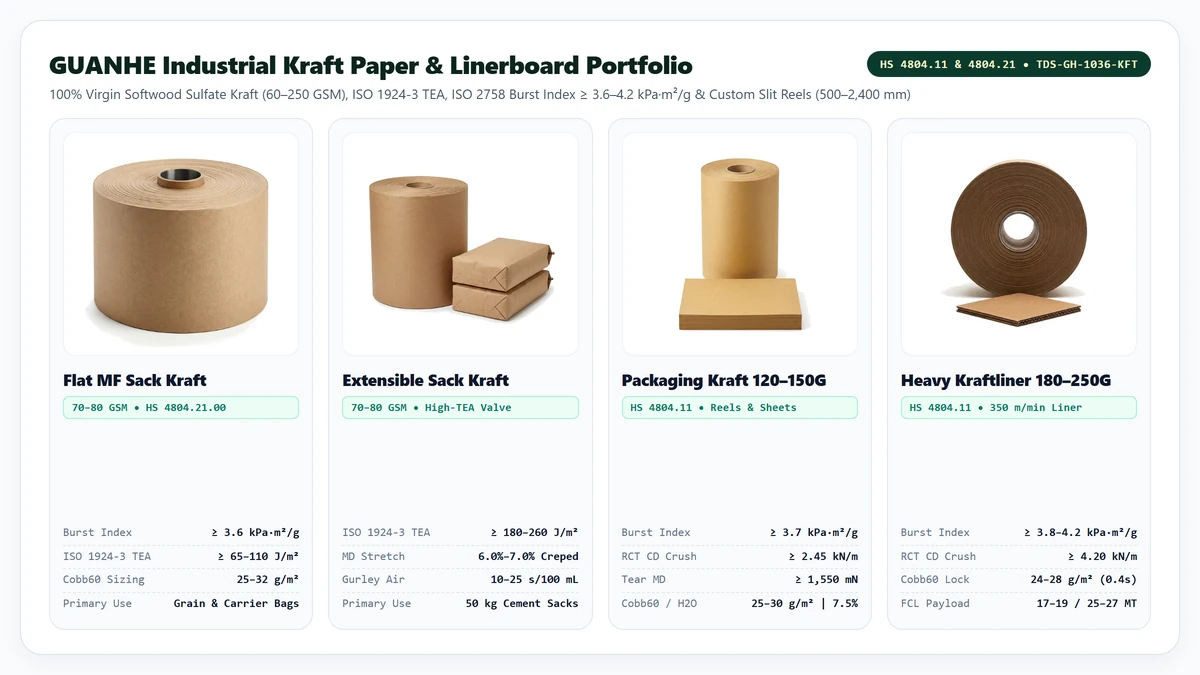
Specification Parameter (TDS-GH-1036-KFT) |
Governing Standard | Sack Kraft (70 to 80 gsm) |
Packaging Kraft (120 to 150 gsm) |
Heavy Linerboard (180 to 250 gsm) |
|---|---|---|---|---|
| Basis Weight Tolerance | ISO 536:2019 |
70 to 80 +/- 2.5 g/m2 |
120 to 150 +/- 3.0 g/m2 |
180 to 250 +/- 4.0 g/m2 |
| Caliper / Thickness | ISO 534:2011 |
95 to 110 um |
160 to 200 um |
240 to 330 um |
| Bursting Strength (Mullen, Ref. GSM) | ISO 2758:2014 |
>= 280 kPa (75 gsm ref.) |
>= 520 kPa (140 gsm ref.) |
>= 850 kPa (200 gsm ref.) |
| Burst Index | ISO 2758:2014 |
>= 3.6 kPa*m2/g |
>= 3.7 kPa*m2/g |
>= 3.8 to 4.2 kPa*m2/g |
| Tensile Strength (MD / CD) | ISO 1924-2:2008 |
>= 6.5 / >= 3.8 kN/m |
>= 11.5 / >= 6.8 kN/m |
>= 18.0 / >= 10.5 kN/m |
| Tensile Energy Absorption (TEA) | ISO 1924-3:2005 |
>= 65 J/m2 (MF) / >= 180 J/m2 (Ext.) |
>= 120 J/m2 |
>= 185 J/m2 |
| Elmendorf Tear Resistance (MD) | ISO 1974:2012 |
>= 850 mN |
>= 1,550 mN |
>= 2,400 mN |
| Ring Crush Test (RCT CD) | ISO 12192:2011 |
>= 1.20 kN/m |
>= 2.45 kN/m |
>= 4.20 kN/m |
| Water Absorbency (Cobb60) | ISO 535:2023 |
25 to 32 g/m2 |
25 to 30 g/m2 |
24 to 28 g/m2 |
| Absolute Moisture Content | ISO 287:2017 |
7.0% to 8.5% |
7.0% to 8.5% |
7.0% to 8.5% |
Converters operating multi-grade facilities can consolidate four mill supply programs under one export contract:
- Precision Custom Reel Slitting (
500 to 2,400 mmWidth): Reels slit to+/- 1.0 mmwidth tolerance on76 mm (3 in)or152 mm (6 in)cores (1,000 to 1,400 mmOD). Winding profiles matchWindmoller & Holschertubers,BHS / Fosbercorrugators, andNewlong / Garantbag machines. - Uncoated Woodfree Parent Reels (
HS 4802.55.00): Plants operating parallel rotary cut-size lines can procure70 to 120 gsmwhite reels from our uncoated woodfree jumbo parent rolls division. Full deckle optimization math appears in our jumbo parent rolls sheeting and converting guide. - Recovered Containerboard Fiber (
HS 4707.10.00): Mills pairing virgin kraftliner outer faces with recycled inner plies can source ISRI-graded OCC #11 and OCC #12 bales directly from our fiber supply chain. - Complete 6-Document Export Clearance Packet: Shipments dispatch within
10 to 14 working daysunder Incoterms FOB, CFR, or CIF from Qingdao, Shanghai, or Tianjin. Every packet includes Commercial Invoice (HS 4804.11.00/4804.21.00), VGM Packing List, Clean On Board Ocean B/L, CCPIT Certificate of Origin (or Form E / FTA),ISO 187:2022Batch COA, and ISPM-15 / optional SGS audit. Request physical reel swatches or a container quotation via our direct export desk.
Frequently Asked Questions
What is the customs difference between HS 4804.11 kraftliner and HS 4804.21 sack kraft paper?
Both subheadings require at least 80% chemical sulfate or soda wood fiber by weight under WCO Chapter 48 Note 6 (WCO, 2022). HS 4804.11.00 covers unbleached kraftliner in rolls weighing more than 115 gsm with minimum Mullen burst of >= 393 kPa at 115 gsm and >= 417 kPa at 125 gsm (linearly interpolated, scaling to >= 637 kPa at 200 gsm). HS 4804.21.00 covers unbleached sack kraft paper in rolls weighing 60 to 115 gsm meeting WCO Subheading Note 2 option (a) (Burst Index >= 3.7 kPa*m2/g and stretch > 4.5% CD and > 2.0% MD) or option (b) minimum tear and tensile thresholds (WCO, 2022). Recycled testliner below 80% sulfate fiber classifies under HS 4805.24 or 4805.25.
Why is Tensile Energy Absorption (TEA) more reliable than burst strength for cement sacks?
Mullen burst (ISO 2758:2014) applies gradual hydrostatic pressure over a small circular diaphragm, whereas dropping a 50 kg cement bag creates rapid shock tension across the entire sack wall. Tensile Energy Absorption (ISO 1924-3:2005) integrates both tensile force and elongation at break (J/m2). Micro-creped extensible sack kraft (6.0% to 7.0% MD stretch, TEA >= 180 to 260 J/m2, ISO 1924-3:2005) absorbs nearly double the drop energy of flat kraft and supports 3-ply to 2-ply down-gauging.
How do Cobb60 water sizing and reel moisture prevent corrugator warp at 350 m/min?
On high-speed BHS or Fosber corrugators, Cobb60 (ISO 535:2023) regulates how fast linerboard absorbs starch adhesive inside the 0.4-second bonding window. Specifying 24 to 28 g/m2 prevents both glue starvation (> 35 g/m2) and blistering (< 20 g/m2). Holding cross-direction reel moisture uniform at 7.0% to 8.5% (ISO 287:2017) ensures outer and inner liners shrink equally over 175 deg C hot plates, preventing banana warp.
What is the maximum outer diameter for side-by-side vs staggered kraft reel stowing in a 40HQ container?
A standard ISO 668:2020 40HQ container has an internal width of 2,352 mm (2,340 mm door width and 2,585 mm door opening height). For twin-column side-by-side stowing, maximum reel OD is 1,150 mm (2 x 1,150 = 2,300 mm, leaving 52 mm clamp clearance). Larger reels (1,200 to 1,400 mm OD) require staggered triangular eye-to-sky nesting braced with hardwood timber chocks and kraft dunnage airbags. That layout reaches 25 to 27 MT net payload safely without edge crushing.
Can importers mix unbleached virgin kraft reels and flat sheets inside one 20GP or 40HQ container?
Yes. GUANHE Paper Mill consolidates mixed basis weights (70 to 250 gsm), custom reel widths (500 to 2,400 mm), or clamped jumbo reels with palletized flat sheets under one Bill of Lading. Palletized sheet stacks are segregated behind braced wooden bulkheads so heavy reels cannot shift during ocean transit.
All WCO HS 4804.11/4804.21 fiber rules, ISO 1924-3:2005 TEA integrals, ISO 2758:2014 Mullen burst indices, ISO 12192:2011 CD RCT, ISO 535:2023 Cobb60 sizing, and ISO 668:2020 20GP/40HQ reel stowage payloads verified by the GUANHE Mill QC Lab (TDS-GH-1036-KFT).