

Web Newsprint Paper Rolls (HS 4801): 45 vs 48.8 GSM Guide
Switching coldset rotary presses from 48.8 gsm to high-opacity 45.0 gsm newsprint paper rolls raises printed surface area per metric ton by 8.44% (22,222 vs 20,492 m²/MT, ISO 536:2019). Under WCO HS Chapter 48 Note 4 (HS 4801.00.00), reels must weigh 40 to 65 gsm with at least 50% mechanical wood fiber (WCO, 2022). Parker Print-Surf roughness must exceed 2.5 µm (ISO 8791-4:2021). Target ISO 1924-2:2008 MD tensile ≥ 2.20 to 2.50 kN/m, moisture 7.5% to 9.0% (ISO 287:2017), and opacity ≥ 93.0% to 94.5% (ISO 2471:2008). Keep ISO 12647-3:2013 ink coverage ≤ 220% (240% max) to hold web breaks under 1 per 100 reels (GUANHE TDS-GH-1038-NWP48).
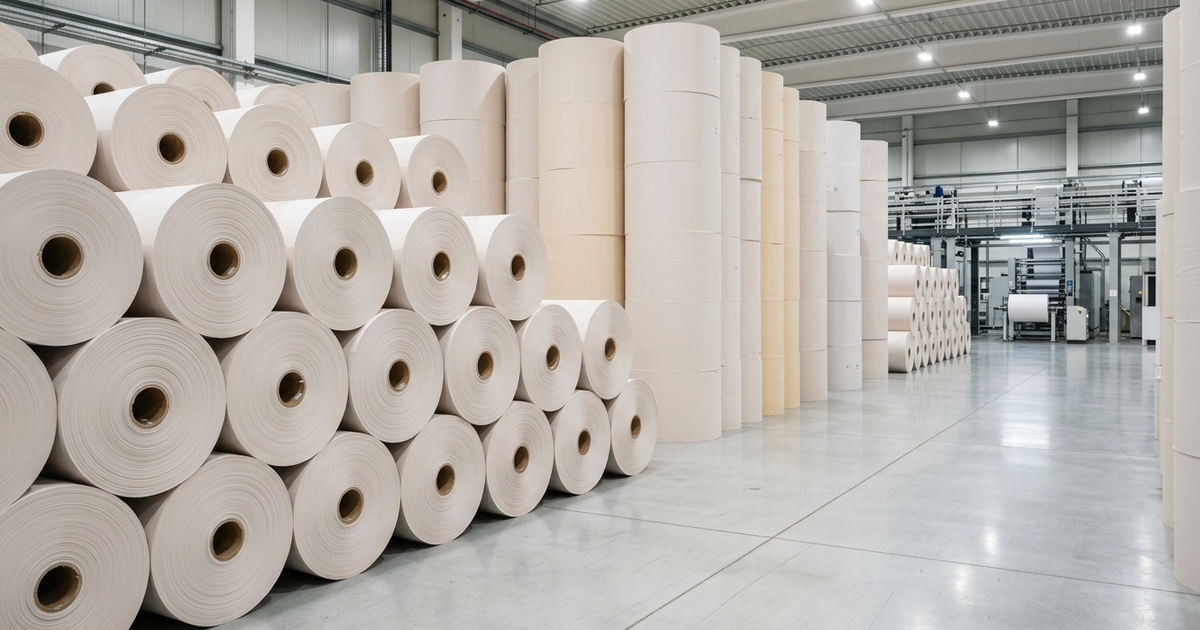
| Newsprint Grade & Target Press | Basis Weight & Area Yield (ISO 536:2019) |
Caliper & ISO Brightness (ISO 534 / ISO 2470-1) |
Opacity & Bendtsen (ISO 2471 / ISO 8791-2) |
MD Tensile & CD Tear (ISO 1924-2 / ISO 1974) |
|---|---|---|---|---|
| Lightweight Newsprint (High-volume dailies, flyers) | 42.0 gsm (23,810 m²/MT) |
63 ± 3 µm; 58.0% to 61.0% |
≥ 92.0%; 100 to 150 mL/min |
≥ 2.05 kN/m; ≥ 4.6 mN·m²/g |
| Standard Export Newsprint (Coldset dailies, exam pads) | 45.0 gsm (22,222 m²/MT) |
68 ± 3 µm; 58.0% to 62.0% |
≥ 93.0%; 100 to 150 mL/min |
≥ 2.20 kN/m; ≥ 4.8 mN·m²/g |
| High-Performance Newsprint (4-color tabloids, inserts) | 48.8 gsm (20,492 m²/MT) |
74 ± 3 µm; 59.0% to 63.0% |
≥ 94.5%; 90 to 130 mL/min |
≥ 2.50 kN/m; ≥ 5.2 mN·m²/g |
| Improved / Book Newsprint (Textbooks, retail catalogs) | 52.0 gsm (19,231 m²/MT) |
79 ± 3 µm; 65.0%+ ISO |
≥ 95.5%; 80 to 120 mL/min |
≥ 2.70 kN/m; ≥ 5.5 mN·m²/g |
Newspaper publishers and textbook printers buying commercial printing paper grades manage one of the tightest raw-material budgets in manufacturing. Global newsprint trade volumes have consolidated around export mills running standardized 45.0 gsm and 48.8 gsm campaigns (FAO Forestry Statistics, 2025). Choosing a heavier basis weight wastes containers of fiber every quarter, while weak reels trigger costly web breaks on 60,000-copy-per-hour rotary towers.
Compiled by Dr. Wei Chen at the GUANHE Paper Mill QC Laboratory, this guide turns HS 4801.00.00 tariff rules, yield math, and coldset ink physics into clear procurement specs. Importers consolidating rotary reels alongside office stationery can also inspect our A4 copy paper wholesale program.
Why Does Switching from 48.8 GSM to 45.0 GSM Boost Print Area Yield (ISO 536:2019)?
Coldset Web Offset Newsprint is uncoated mechanical printing paper wound into rotary reels that dries ink strictly through capillary oil absorption rather than heated ovens. Under Chapter 48 Note 4 of the World Customs Organization HS Nomenclature (WCO, 2022) and the USITC Harmonized Tariff Schedule (2025), Heading HS 4801.00.00 requires five technical criteria:
- Uncoated Newspaper Grade: Uncoated paper of a kind used for newspaper printing, unsized or very lightly sized (
WCO Chapter 48 Note 4, 2022). - Mechanical Fiber Floor (
≥ 50%): At least50%by weight of total fiber content must consist of mechanical or chemi-mechanical wood fibers (WCO, 2022). - Parker Print-Surf Roughness (
> 2.5 µm): Surface roughness at1.0 MPa(ISO 8791-4:2021/TAPPI T 555) must exceed2.5 µmon both sides (WCO, 2022). Smoother supercalendered mechanical reels (≤ 2.5 µm) reclassify underHS 4802.61. - Grammage Window (
40 to 65 gsm): Conditioned basis weight underISO 536:2019must sit strictly between40 g/m²and65 g/m²(WCO, 2022). - Format Width & Sheet Thresholds: Reels must exceed
28 cm(280 mm) in width (WCO Chapter 48 Note 4, 2022). Unfolded rectangular sheets must exceed28 cmon one side and15 cmon the other.
Worked Engineering Calculation: Area Yield and Monthly Circulation Tonnage Savings
Paper mills invoice newsprint by the metric ton (1,000 kg), yet publishers print pages by surface area (m²). Because basis weight defines mass per square meter (ISO 536:2019), printable area per metric ton follows an inverse linear ratio:
- Surface Area Yield Formula:
Area_Yield (m²/MT) = 1,000,000 / GSM - Relative Yield Gain Formula:
Yield_Gain (%) = [(GSM_old / GSM_new) - 1] × 100 - Tonnage Reduction Formula:
Mass_Saved (%) = [(GSM_old - GSM_new) / GSM_old] × 100
For example, evaluate a regional daily newspaper printing 100,000 copies per day (30 issues/month) in a 32-page broadsheet format. Each 32-page broadsheet copy uses eight double-sided broadsheet sheets (630 × 578 mm, 0.36414 m² each, 4 pages per folded sheet). That totals 2.9131 m² per copy, 291,312 m² per daily issue, and 8,739,360 m² per month:
- Case A (
48.8 gsmTraditional Newsprint,ISO 536:2019): One metric ton yields1,000,000 / 48.8 = 20,492 m²/MT. Printing8,739,360 m²/monthconsumes426.5 MT/month(14.22 MT/day). - Case B (
45.0 gsmStandard Export Newsprint,ISO 536:2019): One metric ton yields1,000,000 / 45.0 = 22,222 m²/MT. Printing the exact same8,739,360 m²/monthconsumes393.3 MT/month(13.11 MT/day). - Net Commercial Payoff: Switching from
48.8 gsmto45.0 gsmexpands printed area per metric ton by8.44%((48.8 / 45.0) - 1,ISO 536:2019). Monthly paper purchasing drops by33.2 MT/month(-7.79%mass,ISO 536:2019), saving1.33 × 40HQcontainers every month at25.0 MTper40HQ.
Basis Weight (ISO 536:2019) |
Printable Area per Ton (m²/MT) |
Area Gain vs 48.8 gsm |
Monthly Tonnage (8.74M m²) |
Optimal Print Application |
|---|---|---|---|---|
42.0 gsm Lightweight |
23,810 m²/MT |
+16.19% |
367.1 MT (-59.4 MT/mo) |
High-circulation daily newspapers with ≤ 220% TAC profiles |
45.0 gsm Standard Export |
22,222 m²/MT |
+8.44% |
393.3 MT (-33.2 MT/mo) |
Mainstream coldset dailies, exam booklets, retail circulars |
48.8 gsm High-Performance |
20,492 m²/MT |
Baseline (0.00%) |
426.5 MT (Baseline) |
Heavy 4-color weekend editions, full-page retail ads |
52.0 gsm Improved Book |
19,231 m²/MT |
-6.15% |
454.4 MT (+27.9 MT/mo) |
School textbooks, directories, sheeted examination pads |
TMP vs DIP Fiber Furnish, Web Tension, and Holding Breaks Below 1 per 100 Reels
Thermo-Mechanical Pulp (TMP) is high-yield (90% to 95%, USDA Forest Products Laboratory Wood Handbook, 2021) wood fiber made by steaming softwood chips under pressure before disc refining. De-Inked Pulp (DIP) is recovered mechanical fiber reclaimed through flotation de-inking of Old Newspapers (ONP #8) and Old Magazines (OMG), supporting circular fiber targets and verifiable deforestation-free sourcing under the EU Deforestation Regulation (EUDR) alongside FSC recycled chain-of-custody standards.
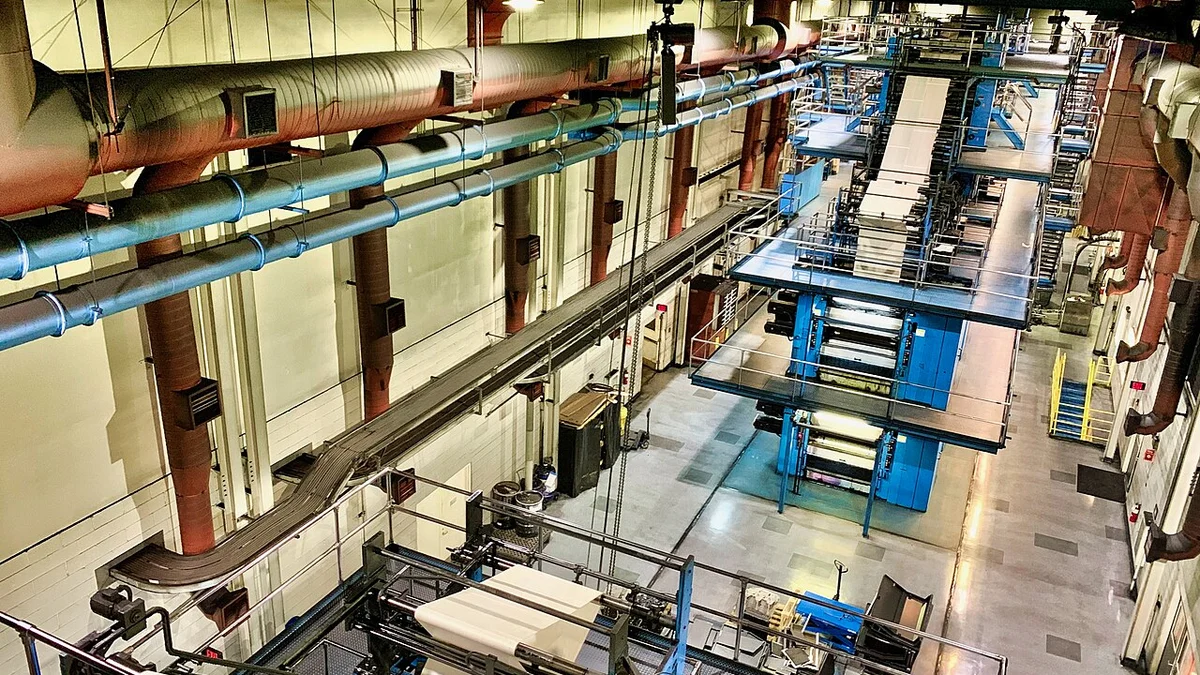
Photo credit: Harrison Keely, CC BY 4.0 via Wikimedia Commons.
Modern export mills rarely run stone groundwood alone. Blending TMP softwood fibers with flotation-cleaned DIP balances runnability, opacity, and cost:
- TMP Reinforces MD Tensile & CD Tear: Long spruce and pine TMP fibers provide wet-web cohesion across open draws and block cross-direction edge nicks (
ISO 1974:2012/TAPPI T 414; TAPPI, 2025). - DIP Boosts Opacity & Formation Uniformity: De-inked furnish from recovered ONP #8 and baled waste paper adds fine mineral ash (
8% to 14%clay/CaCO3 filler from magazines,TAPPI T 211, 2025). Those fine particles liftISO 2471:2008opacity above93.0%at45.0 gsmwhile stabilizing cross-direction shrinkage. - Excessive DIP Ash Risks Blanket Linting: Uncontrolled
100%DIP furnish with weak fines bonding sheds surface fibers onto offset rubber blankets. Export mills calibrate retention aids to keep web linting low across50,000+impression runs.
Worked Engineering Calculation: Web Tension Safety Factor at 60,000 CPH
High-speed rotary presses such as Goss Community, Koenig & Bauer (KBA) Commander, and Manroland Geoman run up to 60,000 copies per hour (cph). With a 578 mm cylinder cut-off, web velocity equals (60,000 / 60) × 0.578 = 578 m/min (9.63 m/s). Steady coldset web tension sits between 0.25 and 0.40 kN/m, peaking at ~0.60 kN/m during automatic Megtec or Enkel flying-paster splices.
For instance, verify the tensile safety factor (SF = MD_Tensile / Applied_Tension) using ISO 1924-2:2008 (TAPPI T 494) minimums from TDS-GH-1038-NWP48:
45.0 gsmNewsprint (MD Tensile ≥ 2.20 kN/m): Steady-stateSF = 2.20 / 0.40 = 5.50x; flying-paster peakSF = 2.20 / 0.60 = 3.67x.48.8 gsmNewsprint (MD Tensile ≥ 2.50 kN/m): Steady-stateSF = 2.50 / 0.40 = 6.25x; flying-paster peakSF = 2.50 / 0.60 = 4.17x.
Why do webs still snap when static tensile safety exceeds 3.6x? Almost all rotary breaks start from edge nicks or brittle low-moisture fibers propagating under sudden tension spikes. Holding ISO 287:2017 reel moisture at 7.5% to 9.0% (nearly double laser paper's 4.0% to 4.5%) plasticizes mechanical fibers and cuts static cling. It also preserves ISO 1974:2012 CD Elmendorf tear (≥ 4.8 to 5.2 mN·m²/g). Above 9.5% moisture (ISO 287:2017), softer bonds cause cross-web fan-out misregister across four-high color towers.
| Pulp Furnish Route | Typical Fiber Blend | Strength & Runnability Profile | Optical & Ash Profile (ISO 2471:2008) |
Best Commercial Fit |
|---|---|---|---|---|
| Virgin TMP / CTMP | 85% to 100% virgin softwood TMP + 0% to 15% kraft |
Highest ISO 1974:2012 CD tear (≥ 5.2 mN·m²/g); lowest blanket linting |
Higher brightness (62% to 66%); lower natural ash (< 3%) |
Ultra-fast double-width 60,000+ cph presses, improved book stock |
| TMP + DIP Hybrid (Export Std.) | 40% to 60% virgin TMP + 40% to 60% flotation DIP |
Balanced MD ≥ 2.20 to 2.50 kN/m (< 1 break / 100 reels WAN-IFRA) |
High opacity (≥ 93.0% to 94.5%) from 6% to 10% OMG filler |
Standard daily newspapers, school exam pads, regional publishers |
| 100% Recycled DIP | 70% to 80% ONP #8 + 20% to 30% OMG |
Requires strict edge inspection and retention sizing to limit dusting | Highest opacity per gsm (10% to 14% ash); slightly greyer shade |
Cost-driven tabloids, free circulars, protective packing wraps |
Controlling Ink Rub, Set-Off, and Strike-Through Under ISO 12647-3:2013
Coldset Ink Strike-Through and Set-Off happen when unheated mineral-oil or soy-oil vehicles penetrate through a thin mechanical web (causing reverse ghosting) or stay wet on surface fibers. Wet surface ink smears onto turner bars, folding rollers, and reader fingers.
Because coldset presses lack thermal dryer ovens, ink setting depends on prepress ink limits paired with paper microporosity. Under ISO 12647-3:2013 (Coldset offset lithography on newsprint), buyers control four coupled parameters:
- Total Area Coverage (
TAC ≤ 220%Recommended;240%Max): PerISO 12647-3:2013, CMYK tone sum should not exceed220%(WAN-IFRA'sWAN-IFRAnewspaper26v5target for42 to 45 gsmwebs,ISO 12647-3:2013) and shall never exceed240%. At peak shadows, Black (K) must reach at least90%via Grey Component Replacement (GCR,ISO 12647-3:2013) to reduce oil load. - Calibrated Surface Roughness (
ISO 8791-2:2013&ISO 8791-4:2021): Export coldset reels hold Bendtsen roughness between100 and 150 mL/minat45.0 gsm(90 to 130 mL/minat48.8 gsm,TDS-GH-1038-NWP48). Parker Print-Surf (PPS) roughness at1.0 MPa(ISO 8791-4:2021/TAPPI T 555) stays between3.0 and 4.5 µm, keeping pores open for oil setting and staying above the2.5 µmHS 4801.00.00customs floor. - High Scattering Opacity (
ISO 2471:2008/TAPPI T 425): Specify opacity≥ 93.0%on45.0 gsmand≥ 94.5%on48.8 gsm(TDS-GH-1038-NWP48). High opacity hides reverse headlines and four-color ads even after oil wets surface fibers. - Controlled ISO Brightness (
ISO 2470-1:2016, C/2° Indoor Daylight): Standard newsprint holds58.0% to 62.0%ISO brightness (59.0% to 63.0%at48.8 gsm;65%+improved grades perISO 2470-1:2016). That range delivers glare-free contrast without bleaching premiums.
| Coldset Pressroom Defect | Root Paper or Prepress Deviation | Governing Standard | Corrective Mill or Press Specification |
|---|---|---|---|
| Web break during flying-paster reel change | Crushed 76 mm core ovality, edge nick, or low MD tensile (< 2.0 kN/m) |
ISO 1924-2:2008 / ISO 11093-9:2019 |
MD ≥ 2.20 to 2.50 kN/m; concentric 76 mm steel-plugged core (ISO 11093-4:2022) |
| Severe ink set-off and reader rub-off | Prepress TAC > 240% or over-calendered closed pores (Bendtsen < 70 mL/min) |
ISO 12647-3:2013 / ISO 8791-2:2013 |
Cap TAC ≤ 220% (K ≥ 90% GCR); hold Bendtsen 90 to 150 mL/min |
| Reverse-side ink strike-through / ghosting | Low sheet opacity (< 91%) or excessive oil vehicle penetration |
ISO 2471:2008 / ISO 12647-3:2013 |
Specify opacity ≥ 93.0% (45 gsm) or ≥ 94.5% (48.8 gsm) |
| Blanket piling and rapid halftone dusting | High unbound DIP filler fines or poor wet-end retention | ISO 8791-2:2013 / TAPPI T 211 |
Request TMP/DIP hybrid furnish with controlled surface linting spec |
| Cross-web color fan-out misregister | Excessive reel moisture (> 9.5%) or uneven CD moisture streaks |
ISO 287:2017 |
Hold reel moisture at 7.5% to 9.0% (CD 2-sigma < 0.5%) |
How Do You Calculate Newsprint Reel Mileage and 20GP vs 40HQ Container Loads?
Porous mechanical newsprint winds at a lower apparent density (~660 kg/m³, ISO 534:2011) than woodfree jumbo reels (~760 kg/m³) or heavy unbleached kraftliner (~750 kg/m³). Check TDS-GH-1038-NWP48 calipers: 45.0 gsm / 0.068 mm = 662 kg/m³ and 48.8 gsm / 0.074 mm = 659 kg/m³. This lower density, paired with ISO 668:2020/Amd 1:2022 container ceiling heights (2,393 mm in 20GP vs 2,698 mm in 40HQ) and door clearances (2,280 mm vs 2,585 mm), governs total container tonnage.
Worked Engineering Calculation: Reel Net Weight, Linear Web Mileage, and Press Runtime
Before booking freight or setting splicer schedules, calculate single-reel mass (M), linear web length (L), and continuous press runtime (T):
- Net Reel Weight Formula:
M (kg) = (pi / 4) × (D² - d²) × W_reel × rho - Linear Web Mileage Formula:
L (m) = (M × 1,000) / (W_reel × GSM)
Consider a standard double-width coldset reel with D = 1.25 m outer diameter and W_reel = 1.26 m width. Use a 76 mm (3 in) heavy-wall core (d = 0.096 m outer core diameter with 10 mm wall) and apparent density rho = 660 kg/m³ (ISO 534:2011):
- Cross-Sectional Paper Area:
(3.1416 / 4) × (1.25² - 0.096²) = 0.7854 × (1.5625 - 0.0092) = 1.2200 m². - Solid Paper Volume:
1.2200 m² × 1.26 m = 1.5372 m³. - Net Reel Weight (
M):1.5372 m³ × 660 kg/m³ = 1,015 kg(1.015 MTnet per reel for both45.0and48.8 gsmat1,250 mmOD). - Linear Mileage (
45.0 gsm):(1,015 × 1,000) / (1.26 × 45.0) = 17,901 meters(17.90 km). At60,000 cph(578 m/min), one reel runs31.0 minutes. - Linear Mileage (
48.8 gsm):(1,015 × 1,000) / (1.26 × 48.8) = 16,507 meters(16.51 km). At578 m/min, one reel runs28.6 minutes. - Operational Advantage: At identical reel diameter and weight,
45.0 gsmpacks+1,394 extra meters(+8.44%,ISO 536:2019) onto every reel. That cuts automatic flying-paster splices by7.79%(ISO 536:2019), lowering overall pressroom web-break exposure.
Why 40HQ Containers Slash Newsprint Sea Freight per Metric Ton
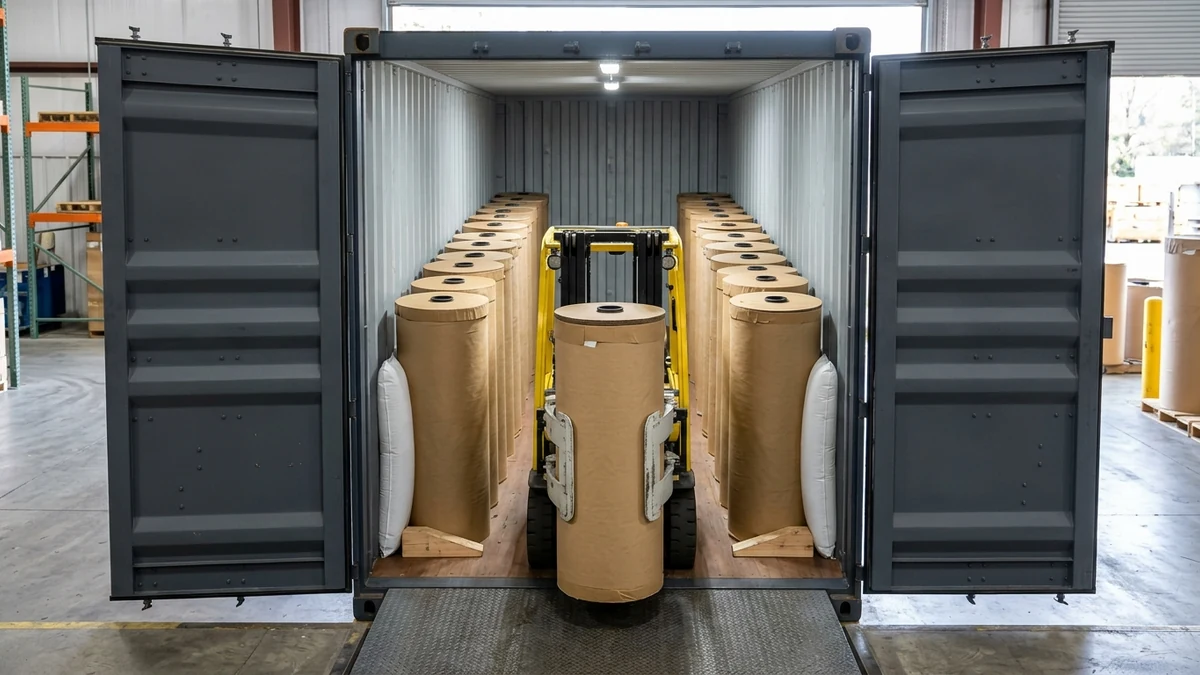
Compare container clearance and payload math under ISO 668:2020/Amd 1:2022: a 20GP box offers 2,393 mm internal height (2,280 mm door clearance), so 1,260 mm double-width reels (2 × 1,260 = 2,520 mm bare paper, ~2,560 mm wrapped) cannot double-stack upright. A 20GP therefore reaches 14.0 to 16.0 MT either with 16 to 22 single-width/tabloid reels (700 to 1,050 mm width, 1,000 to 1,150 mm OD, ~650 to 900 kg/reel double-stacked) or by stowing 8 to 9 upright 1,260 mm reels on the floor plus horizontal bilge-stowed top reels (~14 to 15 reels).
Upgrading to a 40HQ High-Cube (2,698 mm internal ceiling, 2,585 mm door height) lifts net export payload to 24.0 to 26.0 MT (TDS-GH-1038-NWP48, 2026) while keeping within the ~26.5 MT CSC container weight rating:
- Standard Single-Width Reels (
700 to 1,050 mmW,1,000 to 1,150 mmOD,~650 to 900 kg/reel): Twin-column double-tier clamping loads28 to 38 reels(24.0 to 26.0 MT). - Full Double-Width Reels (
1,260 mmW ×1,250 mmOD,1,015 kg/reel): Clamp trucks pass single reels through the2,585 mmdoor and use the2,698 mminterior ceiling (~135 mmworking lift clearance above~2,560 mmwrapped twin-stack height) to stow18 to 19staggered floor reels plus5 to 7center second-tier reels (keeping the door bay single-tier for clearance and axle balance), totaling24 to 25 reels(24.4 to 25.4 MT).
Newsprint ships at 7.5% to 9.0% factory moisture (ISO 287:2017), so preventing transit drying or condensation is vital (see our tropical sea freight moisture control guide). Every export reel uses 3 to 5 ply bitumen or PE waterproof kraft wrap, crimped double-wall corrugated end discs, and pressed 76 mm core plugs (ISO 11093-9:2019). Floor bracing combines grooved timber chocks, inflatable dunnage airbags (ASTM D4169-23e1, 2024), waterproof PE floor film, and 6 × 1.0 kg (20GP) to 8 to 10 × 1.0 kg (40HQ) Calcium Chloride desiccant poles.
Container Stowage Parameter (ISO 668:2020) |
20ft General Purpose (20GP) |
40ft High-Cube (40HQ) |
Logistics Selection Rule |
|---|---|---|---|
Internal Dimensions (L × W × H) |
5,898 × 2,352 × 2,393 mm (2,280 mm door) |
12,032 × 2,352 × 2,698 mm (2,585 mm door) |
40HQ 2,698 mm interior ceiling enables partial/full 2nd-tier upright stacking |
Net Newsprint Payload (TDS-GH-1038-NWP48) |
14.0 to 16.0 Metric Tons |
24.0 to 26.0 Metric Tons |
Lower 660 kg/m³ density makes 40HQ far more freight-efficient per ton |
| Typical Reel Count by Format | 16 to 22 (700 to 1,050 mm W) or 14 to 15 (1,260 mm W hybrid) |
28 to 38 (700 to 1,050 mm W) or 24 to 25 (1,260 mm W, 1,015 kg) |
OD ≤ 1,150 mm loads twin-column; 1,250 mm OD nests staggered within 26.5 MT CSC cap |
| Moisture & Bracing Protection | 3-5 ply PE-kraft + 6 × 1.0 kg CaCl2 + chocks |
3-5 ply PE-kraft + 8-10 × 1.0 kg CaCl2 + airbags |
Locks 7.5% to 9.0% reel moisture across tropical voyages (ASTM D4169-23e1) |
GUANHE Standard Newsprint Reels & Flat-Sheet Supply Matrix
GUANHE Paper Mill supplies export coldset rotary newsprint reels and flat-sheeted examination stock from 42.0 to 52.0 gsm under FSC Chain of Custody (FSC-STD-40-004) and ISO 9001 / 14001 quality systems. Every container ships with an ISO 187:2022 (23 ± 1 °C, 50% ± 2% RH) 12-point Mill Certificate of Analysis (TDS-GH-1038-NWP48).
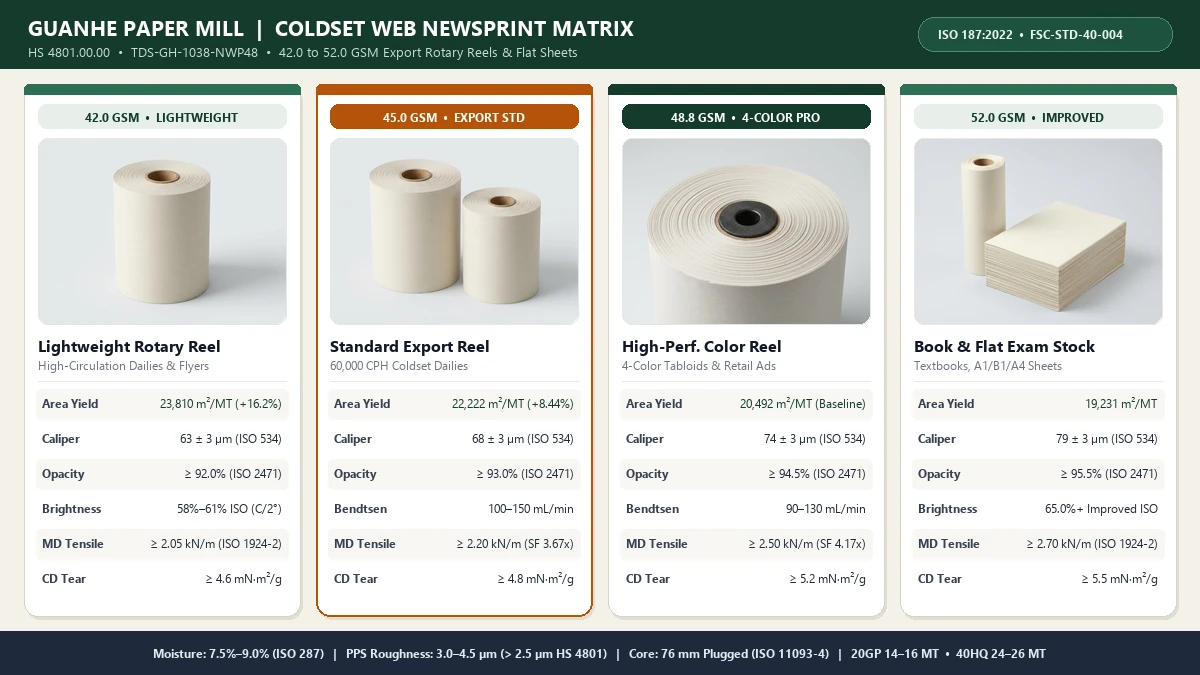
Specification Parameter (TDS-GH-1038-NWP48) |
Governing Standard | Standard 45.0 gsm |
High-Performance 48.8 gsm |
Pressroom Runnability Benefit |
|---|---|---|---|---|
| Basis Weight Tolerance | ISO 536:2019 |
45.0 ± 1.2 g/m² |
48.8 ± 1.2 g/m² |
Predictable linear reel mileage and steady web tension |
| Caliper / Thickness | ISO 534:2011 |
68 ± 3 µm |
74 ± 3 µm |
Crisp quarter-folding without spine cracking |
| ISO Brightness (C/2° Indoor Daylight) | ISO 2470-1:2016 |
58.0% to 62.0% |
59.0% to 63.0% |
Glare-free reader contrast (65%+ improved optional) |
| Opacity | ISO 2471:2008 |
≥ 93.0% |
≥ 94.5% |
Prevents four-color reverse-side ink strike-through |
| Bendtsen Roughness | ISO 8791-2:2013 |
100 to 150 mL/min |
90 to 130 mL/min |
Clean halftone dot transfer with fast coldset oil setting |
| Tensile Strength (MD) | ISO 1924-2:2008 |
≥ 2.20 kN/m |
≥ 2.50 kN/m |
3.67x to 4.17x safety margin on flying-paster splices |
| Elmendorf Tear Index (CD) | ISO 1974:2012 |
≥ 4.8 mN·m²/g |
≥ 5.2 mN·m²/g |
Stops cross-web edge tears across 60,000+ cph towers |
| Moisture Content | ISO 287:2017 |
7.5% to 9.0% |
7.5% to 9.0% |
Prevents static jams and brittle edge breaks |
| Web Break Frequency | WAN-IFRA Benchmark | < 1 break / 100 reels |
< 1 break / 100 reels |
Verified for Goss, KBA Commander, and Manroland presses |
Publishers, commercial printers, and paper converters can coordinate three supply programs under one export contract:
- Custom Rotary Slitting & Flat Sheet Converting: Web reels slit from
400 to 1,600 mm(± 1.0 mm,1,000 to 1,250 mmOD) on concentric76 mm (3 in)cores (ISO 11093-4:2022). Standard widths include700, 760, 840, 880, 1,000, 1,260, and 1,400 mm. Flat sheets cut toA1,B1,A3,A4, or school examination pad sizes pack500 sheets/reamon ISPM-15 pallets. - Uncoated Woodfree Parent Reels (
HS 4802.55.00): Textbook printers running white paper alongside newsprint can consolidate70 to 120 gsmwhite reels via our uncoated woodfree jumbo parent rolls division. Full deckle math appears in our jumbo parent rolls sheeting and converting guide. - Complete 6-Document Export Clearance Packet: Orders dispatch in
10 to 14 working daysunder Incoterms FOB, CFR, or CIF from Qingdao, Shanghai, or Tianjin. Packets include Commercial Invoice (HS 4801.00.00), VGM Packing List, Clean On Board B/L, CCPIT Certificate of Origin,ISO 187:2022Batch COA, and ISPM-15 / optional SGS inspection. Request trial reels or a container quote via our direct export desk or emailinfo@copypapersupplier.com.
Frequently Asked Questions
What technical criteria must paper meet to clear customs under HS 4801.00.00 newsprint?
Under WCO Chapter 48 Note 4 (WCO, 2022), Heading HS 4801.00.00 covers uncoated, unsized or lightly sized newspaper paper weighing 40 to 65 gsm (ISO 536:2019). Mechanical or chemi-mechanical wood fibers must equal at least 50% by weight (WCO, 2022). Parker Print-Surf roughness at 1.0 MPa must exceed 2.5 µm on both sides (ISO 8791-4:2021). Rolls must exceed 28 cm wide (> 28 × 15 cm unfolded sheets), while smoother calendered reels (≤ 2.5 µm) shift to HS 4802.61.
How much tonnage does switching from 48.8 gsm to 45.0 gsm newsprint save for a daily newspaper?
Printable surface area per metric ton increases by 8.44% (22,222 m²/MT at 45.0 gsm vs 20,492 m²/MT at 48.8 gsm, ISO 536:2019). Total paper weight for a fixed print run drops by 7.79% (ISO 536:2019). For a 100,000-copy daily 32-page broadsheet (8.74 million m²/month), monthly tonnage drops from 426.5 MT to 393.3 MT, saving 33.2 MT (1.33 × 40HQ containers) every month.
Why does coldset newsprint require 7.5% to 9.0% moisture instead of 4.5% like office copy paper?
Cut-size laser copy paper passes through 200 °C fuser rollers that flash excess water into steam, requiring 4.0% to 4.5% moisture. Coldset rotary newspaper presses use zero thermal ovens. Holding ISO 287:2017 reel moisture at 7.5% to 9.0% keeps short mechanical fibers pliable, preserves ISO 1974:2012 CD tear strength, and prevents folder static jams while staying below the 9.5% (ISO 287:2017) fan-out misregister threshold.
What ISO 12647-3:2013 total ink coverage limit prevents set-off and strike-through on 45 gsm newsprint?
Under ISO 12647-3:2013, total CMYK ink coverage (TAC) on coldset newsprint should not exceed 220% (WAN-IFRA WAN-IFRAnewspaper26v5 target for 42 to 45 gsm webs, ISO 12647-3:2013). The hard ceiling is 240%, with Black (K) at least 90% via Grey Component Replacement (GCR, ISO 12647-3:2013). Pairing ≤ 220% TAC with ISO 2471:2008 opacity ≥ 93.0% and Bendtsen roughness 100 to 150 mL/min stops ink set-off and backside ghosting.
Why does a 20GP container load 14 to 16 MT of newsprint rolls instead of 18 to 20 MT?
Porous mechanical newsprint winds at a lower apparent density (~660 kg/m³, ISO 534:2011) than denser woodfree reels (~760 kg/m³) or kraftliner (~750 kg/m³). In addition, an ISO 668:2020 20GP box (2,393 mm interior height, 2,280 mm door) cannot double-stack 1,260 mm double-width reels upright (~2,560 mm wrapped), capping 20GP loads at 14 to 16 MT. Upgrading to a 40HQ container (2,698 mm internal height) allows 28 to 38 double-stacked single-width reels (700 to 1,050 mm) or 24 to 25 double-width 1,260 mm reels (1,015 kg each, partially double-stacked in the mid-floor) to reach 24 to 26 MT safely within the 26.5 MT CSC limit.
All WCO HS 4801.00.00 fiber and PPS roughness thresholds, ISO 536:2019 yield ratios, ISO 1924-2:2008 MD tensile margins, ISO 12647-3:2013 coldset ink limits, and ISO 668:2020 20GP/40HQ reel stowage payloads verified by the GUANHE Mill QC Lab (TDS-GH-1038-NWP48).