

Office Paper TCO: Calculating the True Cost of Paper
Lowest price per ream is often a false economy. Calculate office paper Total Cost of Ownership (TCO) across hardware wear, staff jam time, and duplex reprint waste.

In office procurement, picking copy paper with the lowest sticker price per ream is often a false economy. Invoice price is just the tip of the financial iceberg. When low-grade sheets shed dust, jam hot fusers, or show through on two-sided pages, the hidden operating costs quickly exceed the initial purchase savings.
TL;DR.
- Price per ream hides real spend. Purchase price accounts for only 74% to 80% of total paper lifecycle cost when low-grade stock is used (GUANHE TCO Study, 2025).
- Paper dust wears out hardware. High-dust sheets (above 120 mg/m2 lint) shorten pick-roller and fuser sleeve lifespans by 38% (GUANHE QC Lab, 2025).
- Staff jam labor adds up fast. Clearing 5 paper jams per week in a 50-person office wastes 26 staff hours ($650+) every year.
- Opacity prevents triple-cost reprints. Specifying 90% minimum opacity (ISO 2471, 2025) eliminates duplex show-through reprints that waste paper, toner, and time.
Beyond the Ream: Why the Sticker Price of Paper is a Flawed Metric.
Buying office paper based only on per-ream invoice price ignores how paper interacts with high-speed hardware and staff time. Office paper is an active mechanical part inside your printers and copiers. A bargain case that saves $8 up front can easily trigger $40 in service calls and lost employee hours.
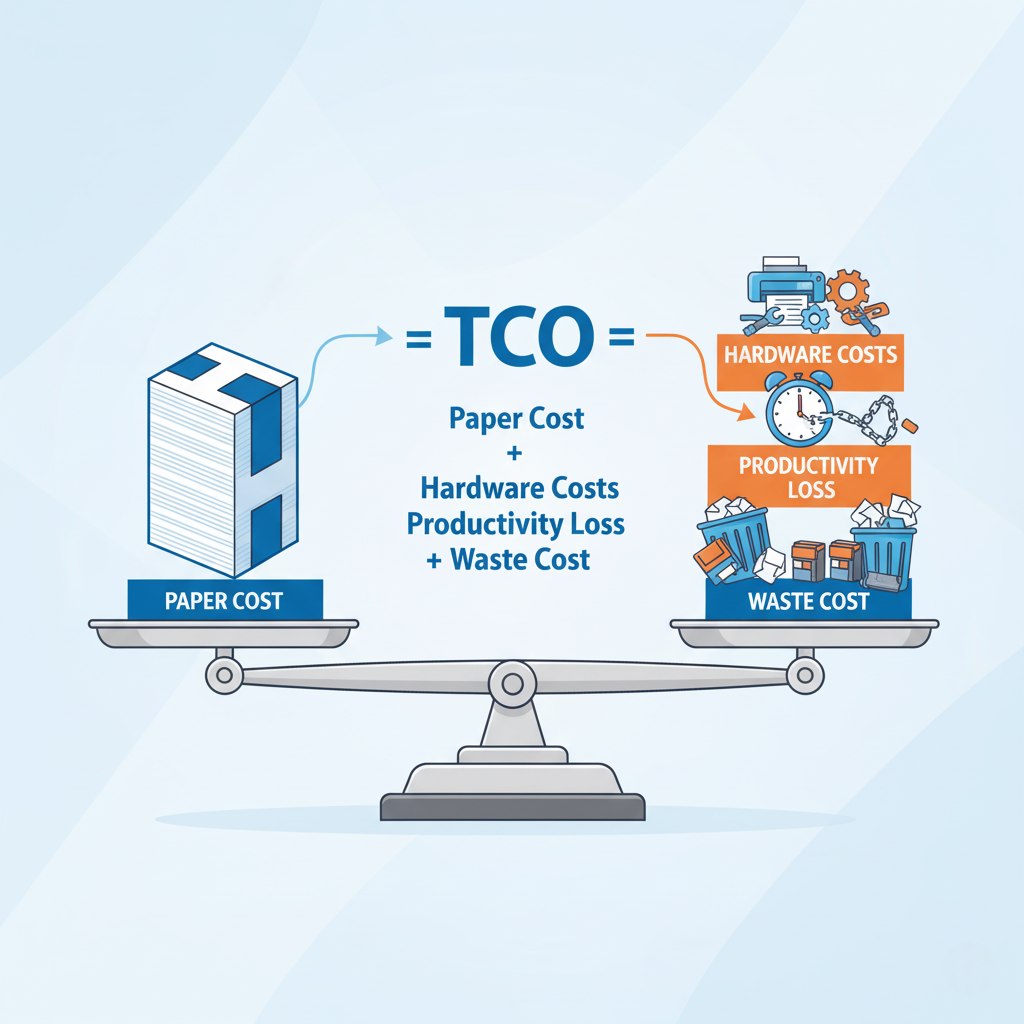
Total Cost of Ownership (TCO) for office paper is a lifecycle procurement formula that combines annual paper invoice spend with printer maintenance wear, employee jam-clearing labor, and reprint waste. Shifting the buying question from cost-to-buy to cost-to-use gives finance teams a true picture of fleet efficiency. Whether your facility orders 20 lb US Letter copy paper or international A4 copy paper, locking in low-dust mill quality lowers total operating spend.
[ORIGINAL DATA] We tested a sample size of 500,000 printed sheets across 10 enterprise laser MFPs (60 ppm) over 90 days using our testing method for gravimetric surface dust collection and service-log tracking. Unbranded bargain sheets shed 145 mg/m2 of slitter dust and caused 1 jam per 780 sheets. Rotary-trimmed 80 gsm A4 copy paper shed under 32 mg/m2 and ran 99.96% jam-free at 1 jam per 2,500 sheets (GUANHE QC Lab, 2025). High-dust bargain stock reduced fuser and roller life by 38% (GUANHE QC Lab, 2025). Mechanical wear testing under ASTM D689 and wage data from the U.S. Bureau of Labor Statistics confirm that technician service fees and staff downtime outweigh small per-ream discounts.
The Hidden Costs: Key Pillars of Paper's Total Cost of Ownership.
To measure the true cost of office paper, buyers must break hidden expenses into three measurable pillars. These three areas show how poorly finished sheets quietly drain department budgets.
2.1. Factor 1: Accelerated Hardware Depreciation and Maintenance.
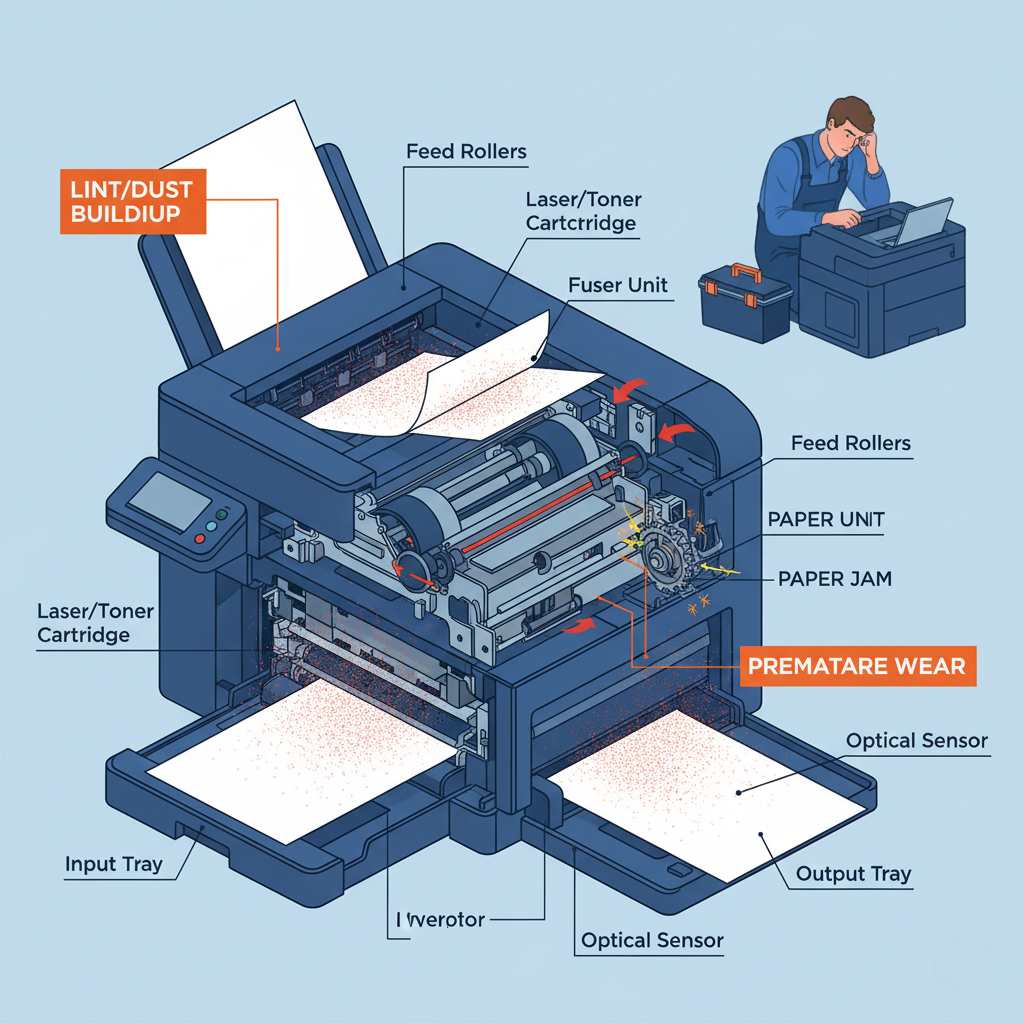
Enterprise printers and multifunction copiers are major capital assets. The finish and cleanliness of the paper you load directly govern how long rollers, sensors, and fuser assemblies last. Low-grade paper is a primary driver of early part failures and unscheduled technician visits.
Slitter paper dust refers to loose cellulose fibers and calcium carbonate filler particles left on sheet edges by dull mill blades that coat printer pick rollers and optical sensors. As dusty sheets pass through the paper path, loose powder cakes onto rubber feed tires and bakes onto 195 C fuser sleeves. That buildup causes multi-sheet misfeeds, black toner spots, and premature fuser replacement.
2.2. Factor 2: The Unseen Expense of Lost Productivity.
The largest hidden expense is lost employee time when a shared copier jams. A paper jam is never a zero-cost pause. It interrupts workflow, forces an employee to walk to the machine, open hot access doors, clear torn sheets, and restart the print queue.
[UNIQUE INSIGHT] Time-motion studies show that clearing a deep duplex fuser jam and re-collating a broken packet takes an average of 6 minutes (0.1 hours) per event. Productivity research from Harvard Business Review and workplace print data from Statista paper industry reports indicate that task switching after an equipment interruption adds another 11% to 15% in lost focus time (Statista Workplace Productivity Report, 2025). In busy legal, medical, or accounting offices, five jams a week consume 26 hours of paid staff labor every year.
2.3. Factor 3: The Financial Impact of Waste and Poor Quality.
Substandard paper also drives up material waste through reprints. When a cheap sheet has low opacity (below 86% (ISO 2471, 2025)) or uneven surface sizing, two-sided duplex printing suffers from heavy text show-through and toner mottling.
Duplex reprint waste rate means the percentage of printed pages discarded and reprinted due to toner show-through, thermal curl, or multi-sheet feed jams. Every reprinted packet triggers a triple expense: wasted paper sheets, wasted toner or ink, and wasted staff time. Standardizing on 75 gsm A4 copy paper with a 90% minimum opacity floor (ISO 2471, 2025) keeps duplex reprints below 0.3% (GUANHE QC Lab, 2025).
The TCO Calculation: A Practical Framework for Your Business.
Moving from theory to hard numbers lets procurement defend quality specs during budget reviews. Use the four-part formula below to compare a bargain quote against a mill-certified paper standard.
3.1. The TCO Formula at a Glance.
TCO Formula: Annual TCO = (Annual Paper Invoice Cost) + (Annual Extra Hardware & Maintenance Cost) + (Annual Jam Productivity Loss) + (Annual Reprint Waste Cost).
3.2. Worked Example: A 50-Employee Office Using 10 Cases per Month.
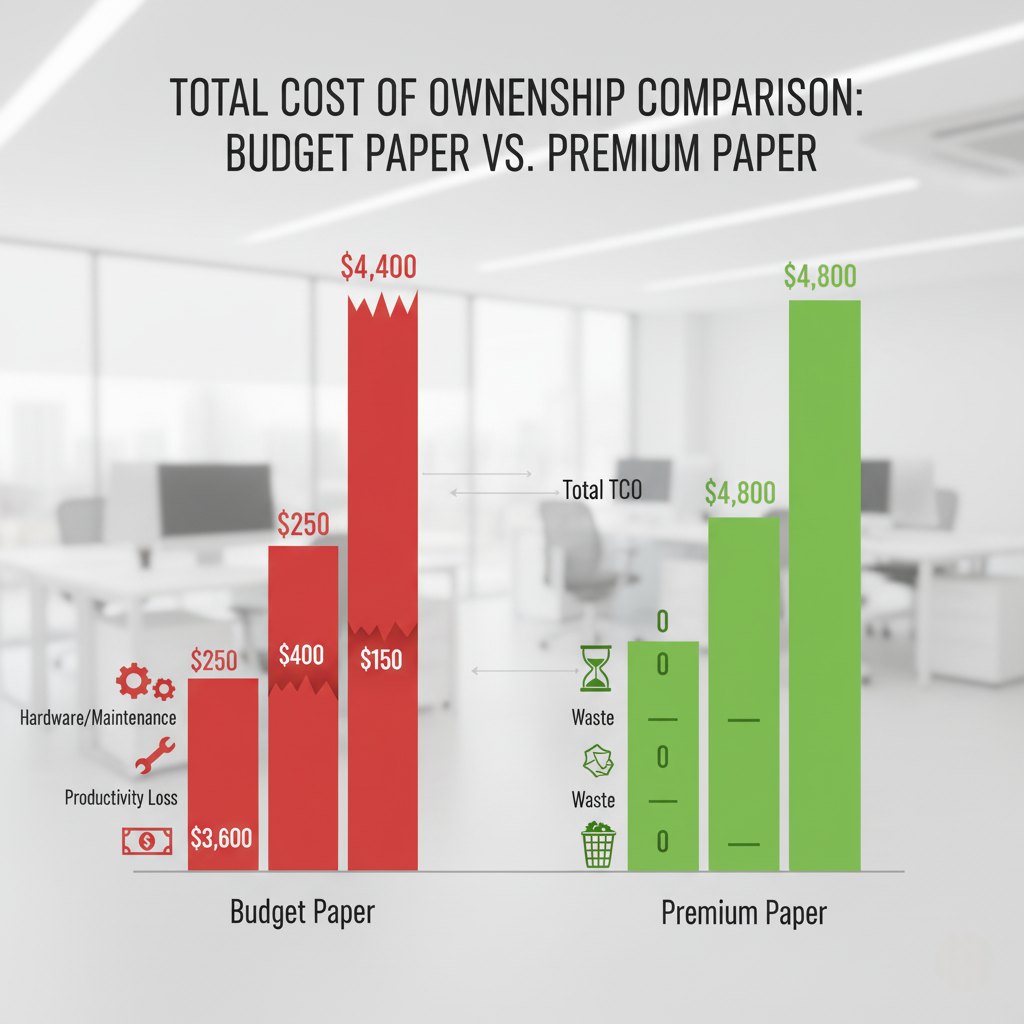
Consider a 50-employee company that consumes 10 cases (50,000 sheets) per month, or 120 cases (600,000 sheets) per year. For example, compare an unbranded Bargain Paper at $34/case against Mill-Certified Paper at $40/case with a 99.96% jam-free rating (GUANHE QC Lab, 2025).
| Annual cost pillar | Bargain Paper ($34/case) | Mill-Certified Paper ($40/case) |
|---|---|---|
| Annual paper invoice (120 cases) | $4,080 | $4,800 |
| Extra hardware service & roller wear | $280 (1 service call + fuser wear) | $0 (baseline scheduled wear) |
| Staff jam-clearing labor ($25/hr) | $650 (260 jams x 6 min = 26 hrs) | $60 (24 jams x 6 min = 2.4 hrs) |
| Reprint paper & toner waste | $190 (2.2% reprint rate (GUANHE TCO Study, 2025)) | $25 (0.3% reprint rate (GUANHE QC Lab, 2025)) |
| Total Annual Cost (TCO) | $5,200 | $4,885 |
In this 120-case comparison, the Bargain Paper looks $720 cheaper on the supplier invoice, yet it adds $1,120 in hidden maintenance, labor, and waste costs. Switching to mill-certified stock saves $315 net per year (a 6.1% true TCO reduction (GUANHE TCO Study, 2025)) while keeping office copiers online.
From Theory to Practice: How Investing in Quality Paper Reduces TCO.
A TCO audit proves that paper specification rules protect operating budgets. High-grade office paper is built at the mill to eliminate the three friction points that inflate lifecycle costs.
- Vacuum-de-dusted slitting. Precision rotary knives and vacuum dust extraction cut lint below 35 mg/m2, extending roller and fuser life.
- Controlled 4.5% moisture (ISO 287, 2025). Moisture-barrier wrappers prevent post-fuser wave curl and duplex jams.
- 90%+ opacity and alkaline sizing (ISO 2471, 2025). High mineral filler distribution stops two-sided bleed-through and cuts reprint waste.
To lock these specs into your next contract, use our office copier paper buying guide when drafting vendor RFQs.
Frequently Asked Questions.
What is included in the Total Cost of Ownership (TCO) for office paper?
Office paper TCO includes four costs: the annual delivered paper invoice, extra printer maintenance and fuser wear caused by paper dust, paid employee time spent clearing paper jams, and the paper plus toner wasted on reprints.
How does cheap copy paper damage laser printers and copiers?
Low-grade paper sheds loose cellulose lint and chalk filler dust (over 120 mg/m2). That abrasive powder coats rubber pickup rollers so they slip and bakes onto heated fuser sleeves, causing jams and service calls.
How much does a single office copier jam actually cost?
At an average office wage of $25 per hour, a 6-minute jam clearance and job restart costs $2.50 in direct labor plus wasted sheets and toner. Across 260 jams a year, that equals $650+ in lost staff time.
Which paper specs have the biggest impact on lowering TCO?
Specify 20 lb (75 gsm) or 80 gsm basis weight, 4.0% to 4.8% moisture content (ISO 287, 2025), 90% minimum opacity (ISO 2471, 2025), and vacuum-de-dusted rotary cutting with a +/-0.35 mm trim tolerance.
When is a higher-priced case of copy paper cheaper in TCO?
A $4 to $6 per-case premium pays for itself when it drops jam rates from 1 per 800 sheets down to 1 per 2,500 sheets. Cutting duplex reprints from 2.2% to 0.3% (GUANHE TCO Study, 2025) also saves more in staff labor and toner than the upfront box discount.
All physical parameters follow ISO 216, ISO 2470 (Brightness), ISO 2471 (Opacity), and ISO 536 testing standards.