
Quick Answer: Standard Copy Paper Measurements
In US offices, standard copy paper usually means Letter size: 8.5 x 11 inches. The same sheet measures 21.59 x 27.94 cm or 215.9 x 279.4 mm. If a requester asks for normal printer paper, everyday copy paper, or office copy paper without another size specified, procurement teams should confirm whether Letter is the intended size before placing a recurring order.
Measurements are only one part of the specification. A purchase request should separate sheet size from paper weight, brightness, opacity, finish, color, and packaging format. This avoids a common ordering problem: approving the correct paper grade but the wrong sheet size, or replacing Letter with A4 because the two look similar in a catalog.
When other sizes replace Letter
Legal paper is 8.5 x 14 inches and is used when documents require the longer sheet length, such as certain contracts, files, forms, or administrative records. Tabloid is 11 x 17 inches and is often used for larger layouts, folded documents, reports, or proofs. A4, at 210 x 297 mm, is the everyday standard in many international markets, so it may appear in global templates, imported manuals, and documents from overseas partners.
For B2B purchasing, the safest approach is to write the complete measurement and standard name on requisitions, printer tray labels, and internal paper catalogs. Before standardizing a size, confirm the devices, document templates, filing requirements, and regional users that will rely on that specification.
Copy Paper Measurements Chart: Inches, CM, and MM
Use the chart below as a practical reference when comparing copy paper measurements across US and ISO paper standards. Dimensions are rounded for purchasing, print setup, and internal order guides. For a closely related reference on copy paper dimensions, compare the same sizes before building a SKU list or office paper catalog.
Common copy and printer paper sizes
| Paper size | Inches | Centimeters | Millimeters |
|---|---|---|---|
| Письмо | 8.5 x 11 | 21.59 x 27.94 | 215.9 x 279.4 |
| Legal | 8.5 x 14 | 21.59 x 35.56 | 215.9 x 355.6 |
| Tabloid or Ledger | 11 x 17 | 27.94 x 43.18 | 279.4 x 431.8 |
| Executive | 7.25 x 10.5 | 18.42 x 26.67 | 184.2 x 266.7 |
| A5 | 5.83 x 8.27 | 14.8 x 21.0 | 148 x 210 |
| A4 | 8.27 x 11.69 | 21.0 x 29.7 | 210 x 297 |
| A3 | 11.69 x 16.54 | 29.7 x 42.0 | 297 x 420 |
US sizes and ISO A-series sizes are not interchangeable even when they appear similar. Letter and A4 are close enough to confuse requesters, but the difference can affect margins, duplex alignment, and preprinted forms. Tabloid and Ledger share the same measurement, but the name may vary by orientation and workflow, so purchasing teams should clarify how the sheet will be loaded or finished.

When creating supplier RFQs or internal order guides, use one consistent naming format: standard name, inch size, metric size, and intended use. This makes it easier to compare quotes, check carton labels, and prevent substitutions that create rework for print rooms or administrative staff.
US Letter vs A4: Which Measurement Should You Use?
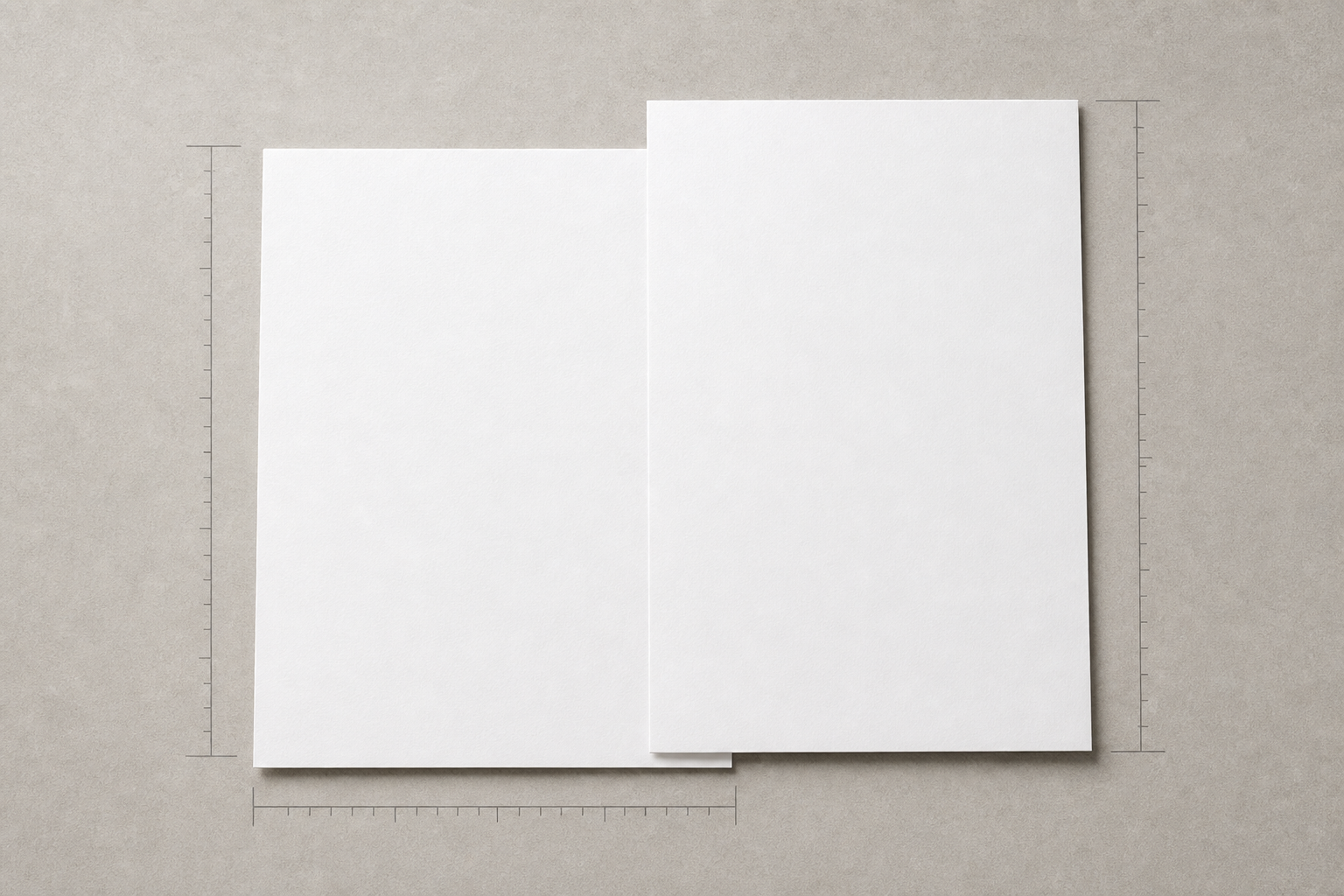
US Letter and A4 are the two sizes most likely to be confused in office printing. Letter measures 8.5 x 11 inches, while A4 measures 210 x 297 mm, or about 8.27 x 11.69 inches. In simple terms, Letter is slightly wider and shorter; A4 is slightly narrower and taller.
Which size is standard for US offices?
For most US business printing, purchasing, and school use, Letter is the default size. A4 is the default everyday office size in many countries outside North America. If your organization works with international branches, overseas suppliers, or global document templates, both sizes may appear in files and purchase requests.
The difference matters most when PDFs, forms, and templates are designed in one size and printed on another. Without the correct print setting, a document can scale down, crop, shift margins, or leave extra white space. This can be inconvenient for routine printing and more serious for forms, branded materials, and documents that require signature blocks, barcodes, or fixed fields.
Procurement and document-control implications
Business buyers should not rely on a generic description such as printer paper when multiple regions or departments order supplies. Define the default sheet size by site, verify printer tray settings, and confirm whether A4 is an approved substitute or a separate item. For recurring orders, the approved paper list should show Letter and A4 as distinct specifications, not interchangeable alternatives.
Common Copy Paper Measurements by Business Use Case
The right copy paper measurement depends on the document, device, and filing workflow. Letter size is the default for everyday office documents, school handouts, reports, memos, spreadsheets, and general copier output in the US. If the request is for high-volume office printing, size should be confirmed together with paper grade, runnability, opacity, and storage expectations. For broader selection factors beyond measurements, see this guide to choosing the right copy paper for office printing.
Contracts, legal files, invoices, and multipart forms
Legal size, 8.5 x 14 inches, provides extra length for documents that need more vertical space or are expected by a department filing process. However, not every contract or legal document requires Legal paper, and many organizations now standardize on Letter unless a workflow specifies otherwise. Invoices, delivery notes, and multipart forms may require a different paper type, preprint layout, or form size, so do not assume standard copy paper is acceptable without checking the form design.
Flyers, booklets, reports, drawings, and larger-format printing
Tabloid or Ledger, 11 x 17 inches, is useful for spreadsheets, booklet spreads, small posters, proofs, and folded inserts. A3 serves a similar role in ISO markets. Procurement teams should confirm whether the job will be copied, printed, folded, bound, or mailed, because finishing requirements can change the required sheet size and packaging quantity. For larger-format work, align the paper request with equipment capability before ordering to avoid excess inventory.
Copy Paper Measurements in Pixels and DPI
Copy paper does not have one fixed pixel measurement. Physical paper is measured in inches, centimeters, or millimeters; pixels depend on the resolution of the digital file. The basic formula is simple: paper width in inches multiplied by DPI equals pixel width, and paper height in inches multiplied by DPI equals pixel height.
Common pixel examples
| Paper size | 72 DPI | 150 DPI | 300 DPI |
|---|---|---|---|
| Letter, 8.5 x 11 in | 612 x 792 px | 1275 x 1650 px | 2550 x 3300 px |
| A4, about 8.27 x 11.69 in | 595 x 842 px | 1241 x 1754 px | 2481 x 3507 px |
A Letter page at 300 DPI is 2550 x 3300 pixels because 8.5 x 300 equals 2550 and 11 x 300 equals 3300. A4 at 300 DPI is commonly approximated as 2481 x 3507 pixels because the inch dimensions are rounded from 210 x 297 mm.

Pixel measurements matter for marketing teams, in-house designers, form creators, and anyone preparing files for print. They do not change the sheet size you order, but they do affect how images, margins, bleed areas, and fixed fields appear on the page. Before producing preprinted forms or high-volume handouts, confirm the physical sheet size, document page size, and output resolution in the same proofing workflow.
Buyer Decision Guide: Choosing the Right Copy Paper Size for Office Procurement
Once the measurement is confirmed, the procurement decision should connect paper size to actual operating conditions. Start with the document format and the printer or copier tray capacity. A device may support Letter, Legal, and A4, but each tray may need guides adjusted correctly, and mixed-size printing can create jams, misfeeds, or user confusion if settings are not controlled.
Before bulk printing, verify the page setup in the document, the selected tray, and the print driver size. If a PDF is set to A4 while the tray contains Letter, the output may scale or crop. If a department needs both sizes, label trays clearly and define which size is the default for routine jobs.
Procurement checklist
- Specify the exact size name and measurement, not only general printer paper.
- Confirm paper weight, brightness, opacity, finish, and color separately from size.
- Check packaging format, including reams, cartons, and larger order units used in your purchasing system.
- Ask suppliers how substitutions are handled and whether nonstandard sizes require separate approval.
- Coordinate reorder points with actual usage by department, location, and device type.
Request clear product descriptions, carton labeling, and consistent communication around acceptable substitutions. For B2B buyers comparing paper options after confirming measurements, a copier paper buying guide can help structure specification reviews, supplier conversations, and internal purchasing standards without relying on vague descriptions.
Printable Copy Paper Measurements Reference
A printable measurements reference is useful for purchasing desks, print rooms, schools, and departments that submit frequent copy paper requests. The reference should include the standard name, inch measurement, centimeter and millimeter conversion, common use case, and any regional note such as US standard or ISO standard. It should also explain that pixel dimensions depend on DPI, not on the paper alone.
How office teams can use the reference
Keep the chart near shared printers or within the internal procurement portal so requesters can check Letter, Legal, Tabloid, A4, A3, and A5 before submitting an order. If a downloadable PDF is not available, the on-page chart can still be printed or saved internally as a reference. Add your organization’s approved sizes, preferred naming conventions, and any sizes that require manager or print-room approval.
Before ordering, compare the measurement on the purchase request with the paper description on the supplier quote, carton label, and printer tray setting. This simple check reduces errors caused by similar names, regional defaults, and accidental substitutions.
If your organization orders paper repeatedly, use the measurements above to standardize paper specifications, plan recurring copy needs, and compare copy or printer paper options before contacting a supplier. A clear size standard makes supplier conversations more precise and helps internal users request the right paper the first time.
Frequently Asked Questions
What is the standard copy paper size in the United States?
The standard copy paper size in the US is Letter, which measures 8.5 x 11 inches. For purchasing records, it is also useful to list it as 21.59 x 27.94 cm or 215.9 x 279.4 mm.
Is A4 the same as 8.5 x 11 copy paper?
No. A4 measures 210 x 297 mm, or about 8.27 x 11.69 inches. It is close to US Letter but slightly narrower and taller, so documents may need print-scaling adjustments.
What are copy paper measurements in pixels at 300 DPI?
At 300 DPI, US Letter is 2550 x 3300 pixels. A4 is commonly 2481 x 3507 pixels. Pixel dimensions change if the file is prepared at a different DPI.
Can I print an A4 PDF on Letter paper?
Usually yes, but you should check the print settings. Using fit-to-page can prevent cropping, while forms, fixed margins, barcodes, and official templates may require the original paper size.
Which copy paper size should procurement teams order in bulk?
For most US offices, Letter is the default bulk size. Legal, Tabloid, A4, or A3 should be ordered separately when required by department workflows, printer trays, document templates, or regional standards.
Why do paper measurements use both inches and millimeters?
US paper sizes are commonly inch-based, while ISO A-series sizes such as A4 and A3 are metric. Including both units in RFQs and internal catalogs helps prevent ordering mistakes.
What should a printable copy paper measurement chart include?
A useful chart should include paper name, inches, centimeters, millimeters, common use case, regional standard, and a note that pixel size depends on DPI rather than the physical sheet alone.
Supply information
Ordering to these measurements?
GUANHE supplies every size listed here, and can confirm exact cut tolerances on request.
| Trial minimum | 5 reams |
| Volume orders | 20GP full container |
| Port of loading | Qingdao, China |
| Lead time | 14 days |
Specifications: A4 copy paper range · Бумага для принтера A3