

Define Cheap Copy Paper as Lowest Usable Cost, Not Lowest Listed Price
For a US office buyer, cheap copy paper should be measured by the sheets the business can actually use, not by the lowest advertised ream price. A low listing can still be expensive if it requires extra pickup time, creates storage problems, arrives with damaged wrapping, or performs poorly in shared printers and copiers.
Core equation: total landed cost ÷ expected usable sheets. Total landed cost includes the product charge, shipping or handling, pickup labor, minimum order requirements, storage effort, damaged or wasted paper, and emergency replenishment caused by running too low. Expected usable sheets start with the stated sheet count, then account for known exclusions such as damaged cartons, failed test purchases, or reams that do not run acceptably in key devices.
Where low price can lose value
- A 500-sheet ream may be convenient but less efficient for repeat purchasing if orders are frequent.
- A 10-ream or 5,000-sheet carton may lower unit math but require space, handling, and inventory discipline.
- A bulk quote may look attractive but needs clear substitute rules, packaging details, and delivery coordination.
This landed-cost method keeps the discussion practical. Procurement can compare offers without relying on current sale claims, brand rankings, or assumptions that the largest package is always the best business choice.
Normalize Every Cheap Copy Paper Offer Into the Same Worksheet
Cheap copy paper offers often use different package language: one listing may show a single 500-sheet ream, another may show a 10-ream carton or 5,000-sheet case, and a larger quote may describe cartons, cases, or bulk units. Before approving a purchase, put every offer into the same worksheet so the buyer is comparing like with like.

| Worksheet field | What to copy from the listing or quote |
|---|---|
| Quantity | Total sheets, reams per carton, cartons per order, and whether 5,000 sheets means ten 500-sheet reams. |
| Paper spec | Size, weight, brightness, color, finish, and copy, printer, or multipurpose labeling. |
| Commercial terms | Quoted product price, shipping or pickup terms, minimum order, and any handling requirements. |
| Control rules | Substitute permissions, backorder handling, and whether the same SKU or approved spec can be repeated. |
Then calculate two figures. Price per usable sheet equals total landed cost divided by expected usable sheets. Price per usable ream equals price per usable sheet multiplied by 500. This prevents a low carton price from hiding a higher sheet cost, and it prevents a single-ream bargain from winning when repeated small orders create more procurement work.
Create a Lowest-Acceptable-Spec Template Before You Chase Discounts
A discount is only useful if the paper still meets the office standard. Before asking suppliers or marketplaces for lower-cost options, define the lowest acceptable cheap-copy-paper specification. This keeps substitutions from drifting below what printers, copiers, and internal users can tolerate.
| Template field | Procurement instruction |
|---|---|
| Größe | US letter 8.5 x 11 in unless another approved size is required. |
| Sheet count and packaging | State 500-sheet reams, 10-ream cartons, 5,000-sheet cases, or the approved bulk unit. |
| Gewicht | Use the office baseline, such as 20 lb copy paper, or document an approved alternative. |
| Brightness and color | Set the acceptable range, such as 92 bright if that is the current standard, and specify white or approved color. |
| Label and compatibility | Require copy, printer, or multipurpose labeling suitable for the office devices in use. |
| Substitutes | List which fields may change and which require buyer approval before shipment or acceptance. |
For everyday office workflows, the minimum spec should be easy for approvers to read and repeat. If your team is still defining the baseline, this guide to office copy paper for everyday printing can support the internal specification discussion without turning the purchase into a brand preference exercise.
Choose Quantity by Reorder Cadence: Occasional, Departmental, or Shared-Device Use
The cheapest quantity is not automatically the largest carton available. Order size should follow monthly print volume, number of devices, available storage, and how reliably the office can reorder before stock runs out.

| Cadence band | Buying logic | Main risk to control |
|---|---|---|
| Occasional purchasing | Use smaller quantities when print volume is irregular or storage is limited. | Overbuying, damaged wrapping, and paper sitting in poor storage conditions. |
| Steady departmental use | Plan reams or 5,000-sheet cartons around actual monthly consumption and department storage space. | Frequent small orders that increase admin work or missed reorder timing. |
| High-volume shared-device use | Coordinate approved cartons or bulk replenishment around busy MFPs, copier rooms, and supply staging. | Downtime, emergency buying, and uncontrolled substitutions during shortages. |
Set reorder triggers by sheets or cartons remaining, not by panic requests from the printer area. The trigger should cover normal approval time, supplier coordination, internal receiving, and a practical safety buffer. If storage is tight, a slightly higher price per sheet may still be the lower-risk choice because it avoids crushed cartons, blocked work areas, or excess handling.
This cadence approach also helps finance approve the method. Instead of asking for the biggest possible order, procurement can show how the quantity supports actual consumption and reduces repeat ordering friction.
Compare Buying Channels With Logistics and Procurement Control Questions
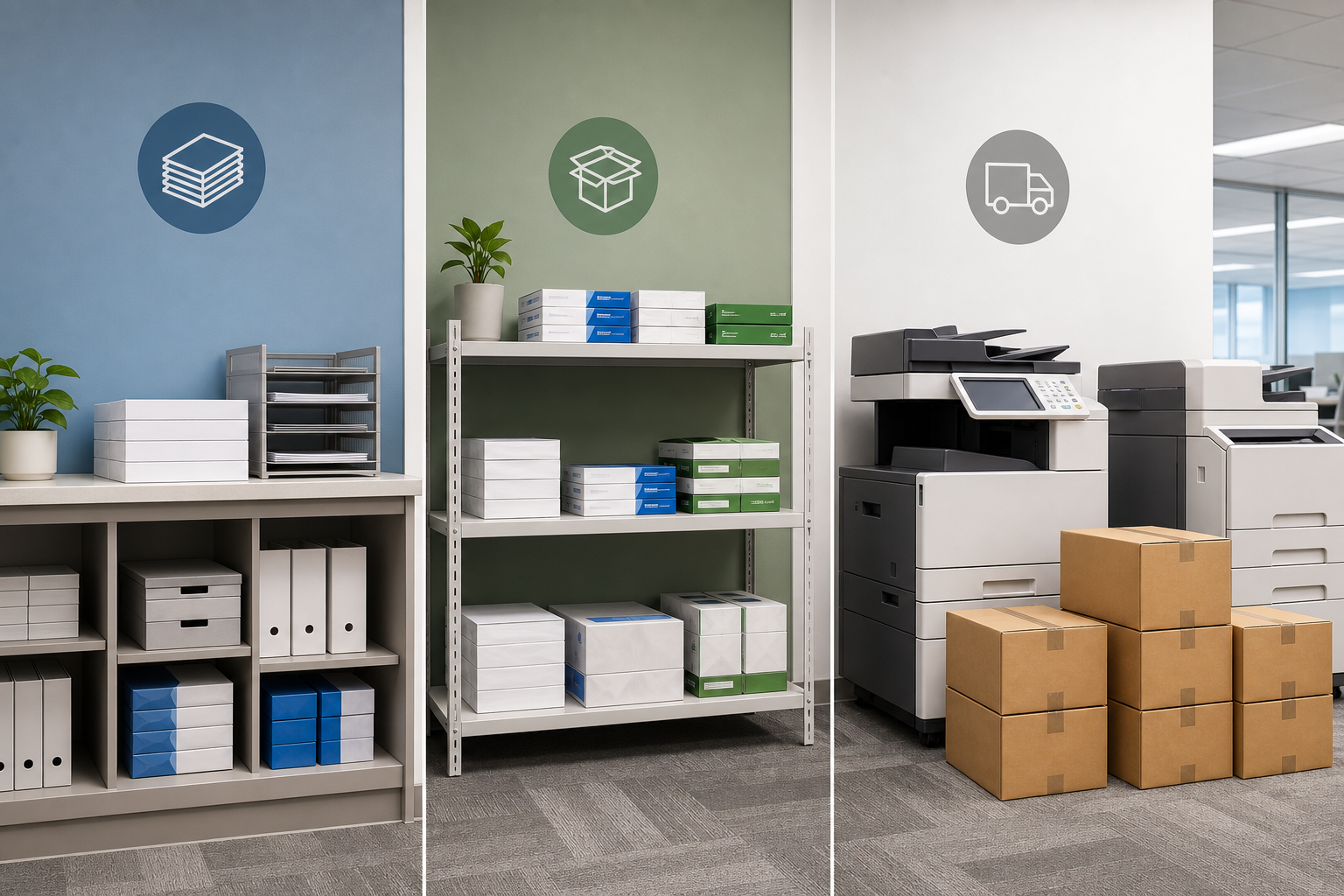
Marketplaces, big-box or club retailers, local pickup options, office-supply sellers, and wholesale or B2B suppliers can all appear in a cheap copy paper search. The right channel depends less on the retailer name and more on how well the purchase can be controlled after the first order.
| Control question | Why it affects landed cost |
|---|---|
| Can the same SKU or approved spec be reordered? | Repeatability reduces surprise substitutions and fresh approval cycles. |
| Will invoices, POs, and internal approvals match the offer? | Mismatch can add administrative time or delay payment processing. |
| How are substitutions and backorders handled? | A cheaper replacement may fall outside the approved spec unless rules are documented. |
| Where will cartons be received and stored? | Delivery point, staging space, and internal handling all affect usable cost. |
Pickup can be useful when it avoids waiting, but it is not free for an office. Staff time, vehicle capacity, loading, and moving cartons to storage are real variables. For a deeper view of local pickup and delivery variables for copy paper, treat location as one input in the landed-cost worksheet rather than the whole buying strategy.
The lowest listed price may not be the cheapest business choice if it creates invoice exceptions, inconsistent packaging, unclear substitutes, or storage problems that the purchasing team has to resolve repeatedly.
Avoid Cheap-Paper False Economy With a Small-Quantity Device Test
Cheap copy paper becomes a false economy when the apparent savings are erased by misfeeds, waste, damaged packaging, curl, repeated user complaints, or emergency reorders. No buyer can confirm performance from price alone, so the safer approval path is a small-quantity test before committing to recurring cartons or bulk supply.
Test where failure would be most visible
- Run the paper in the busiest shared printers, copiers, and MFPs, not only in a lightly used desktop printer.
- Include duplex jobs, multi-page packets, and the routine forms or internal documents that use the most paper.
- Inspect wrapping before loading; torn or poorly protected packaging can expose paper to handling damage.
- Watch for repeated misfeeds, excessive curl, dust, or output issues that users report during normal work.
Document the result as pass, conditional pass, or reject. A conditional pass might mean the paper is acceptable for internal drafts but not for heavy duplex work or client-facing documents. Be more conservative with high-volume shared MFPs, limited storage areas, and offices that must follow recycled, preferred-paper, or other internal purchasing policies.

Testing does not promise jam-free performance. It simply gives procurement a practical record before the low-cost option becomes the default. These copy paper quality, storage, and handling tips can help teams reduce avoidable waste after approval.
Turn the Bargain Hunt Into a Controlled Low-Cost Reorder Plan
Once the office has tested an acceptable low-cost paper, move the decision out of one-time bargain hunting and into a controlled reorder plan. The plan should name the approved minimum spec, the package quantities that fit storage, the devices or workflows tested, and the conditions under which a substitute needs approval.
Supplier-ready request fields
- Monthly estimated print volume and number of shared devices using the paper.
- Approved size, weight, brightness range, color, sheet count, and package quantity.
- Preferred comparison units: 500-sheet ream, 10-ream or 5,000-sheet carton, and larger bulk option if relevant.
- Shipping or pickup requirements, receiving constraints, minimum order rules, and storage limitations.
- Substitute policy, test notes, and approval contact for spec changes.
Set reorder triggers using actual consumption rather than waiting for the last ream. A simple trigger can be based on cartons remaining, expected approval time, and the stock needed to keep core devices supplied while the next order is processed.
To compare options more cleanly, turn monthly print volume and the lowest acceptable paper spec into a supplier-ready request for comparable low-cost ream, carton, and bulk responses. Ask each supplier to answer with the same landed-cost fields instead of choosing the lowest advertised listing on price alone.
Häufig gestellte Fragen
What should a purchasing approver require before accepting a cheaper copy paper substitute?
Require a written match to the fixed fields that matter most: size, weight, brightness or color, sheet count, package format, and suitability for the office devices. Any variance should be approved before the substitute is shipped or stocked.
When does a 5,000-sheet carton stop being the low-cost choice?
A 5,000-sheet carton may stop being economical when the office cannot use, store, or handle it efficiently. If cartons sit too long, get damaged, block storage space, or force extra handling, a smaller approved quantity may have a lower usable cost.
How can finance compare copy paper bids with different minimum order quantities?
Put each bid on the same planning horizon and approved spec, then include delivery or pickup effort, receiving time, storage impact, and unused-stock risk. Bids that exceed realistic consumption should not win on unit price alone.
Should low-cost copy paper be approved for every printer after one quick test?
No. Test the paper in the highest-volume and most sensitive devices first, including duplex and routine multi-page jobs. If it performs acceptably only in lower-risk workflows, approve it for those uses rather than making it the default everywhere.
How should an office set a reorder trigger for cheap copy paper?
Base the trigger on average weekly use, approval and receiving time, plus a practical safety buffer. Track remaining reams or cartons rather than waiting for the last package, so emergency buying does not erase the savings.