
Treat an Amazon Copy Paper Search as a Procurement Request, Not a Product Ranking
When a stakeholder says to buy Amazon copy paper, the task is not to pick the first popular listing. The search is partly navigational: the buyer is using Amazon as a live catalog to check current options, pack sizes, and order conditions. Because product pages, sellers, pack formats, and cart conditions can change, any approval based on an old screenshot, informal review, or remembered price is weak evidence for a business purchase.
Start with a verification record
Before comparing Amazon to another retailer or supplier quote, record the listing URL or product identifier shown on the page, the product title, brand, date checked, quantity placed in the cart, and the visible specification fields. If your organization tracks seller, shipper, or account-purchasing restrictions, capture those fields as well. This creates a defensible snapshot without treating it as a permanent market price.
Keep the decision objective
- Define the paper required before judging value: size, weight, brightness, finish, color, and total sheets.
- Separate user preference from measurable purchasing criteria.
- Compare only offers that can meet the same quantity and delivery location.
- Save the final cart or worksheet notes used for approval.
This approach turns Amazon copy paper results into a benchmark that can be compared against retailer alternatives and supplier quotes on equal terms.
Turn Each Amazon Copy Paper Listing Into Comparable Buying Fields
An Amazon copy paper product card often mixes marketing language with procurement facts. Build a worksheet that strips the listing down to comparable fields. The exact values must come from the live listing, but the column structure should stay the same for every option you review.
Looking for Factory-Direct Copy Paper Prices?
Skip the middlemen. Get FOB/CIF container quotes directly from the mill. OEM private labeling available.

Worksheet fields to capture
| Amazon field | Procurement use |
|---|---|
| Listing URL or product identifier | Creates a traceable reference for approval. |
| Brand and product title | Helps compare Amazon Basics, retailer listings, and supplier quotes. |
| Sheet size | Confirms letter-size or another required format. |
| Paper weight | Separates common 20 lb options from heavier paper such as 24 lb. |
| Brightness, color, and finish | Defines appearance and everyday print suitability. |
| Sheet count and ream count | Prevents confusion between one ream, multi-packs, and cases. |
| Pack format and item or case weight | Supports receiving, storage, and logistics planning where shown. |
Use the worksheet to compare a 20 lb 8.5 x 11 multipurpose paper listing against a 24 lb option or another brand without relying on the title alone. If a field is missing or ambiguous, mark it as unknown and request clarification before approving a substitute. This is especially important when Amazon search results show similar-looking copy paper listings with different sheet counts or package formats.
Normalize Amazon Cart Quantities Before Comparing 500 Sheets, 3 Reams, 5,000 Sheets, or 10 Reams
Amazon cart comparisons can look cheaper or more expensive simply because the unit is different. A 500-sheet single ream, a 3-ream pack, and a case described as 5,000 sheets do not belong in the same comparison until the buyer converts them into total sheets and equivalent reams.
Use one quantity basis
| Listing wording | Normalize as | Buyer check |
|---|---|---|
| 500 Blätter | Usually 1 ream if the listing states 500 sheets per ream | Confirm it is not a sample, specialty pack, or multi-unit cart quantity. |
| 3 reams or 1,500 sheets | 3 equivalent reams | Confirm the order unit is one 3-ream pack, not three separate listings. |
| 5,000 sheets | Often 10 reams when each ream contains 500 sheets | Confirm total sheets and case format on the live listing. |
| 10 reams | Equivalent reams first, then total sheets | Verify whether the search result is a full case, bundle, or different pack. |
Also check cart quantity. Ordering two units of a 3-ream Amazon pack is not the same as ordering two single reams; it becomes 6 reams or 3,000 sheets if each pack is 1,500 sheets. Searches for Amazon copy paper 10 reams may show cases, multi-packs, or mixed sponsored results, so the real unit of measure should be captured from the listing and cart, not from search-result wording alone.
Move Beyond the Visible Amazon Price to the Live Delivered Total
The visible Amazon item price is only the starting point for a business decision. Approvals should use the live delivered total for the exact quantity, account, and delivery location being considered. That final number may be affected by address, taxes or fees where applicable, ordering constraints, ship-to rules, or internal purchasing account controls.
Calculate value on equal terms
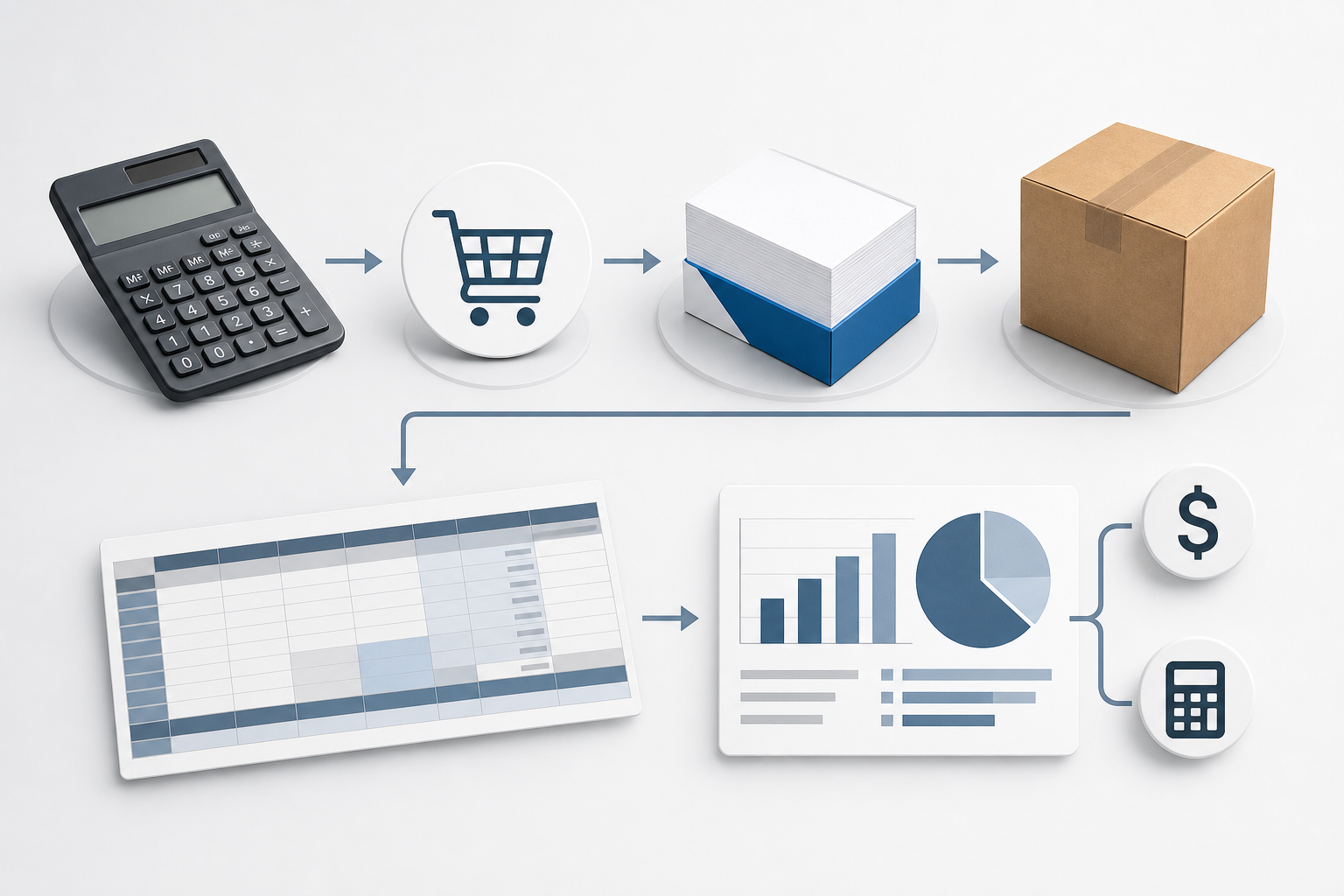
Use formulas after the cart quantity is normalized: cost per sheet = final delivered total divided by total sheets; cost per ream = final delivered total divided by equivalent reams. Do not mix a visible item price from one listing with a delivered total from another. If comparing Amazon with a supplier quote, use the same delivery destination and quantity basis.
Record the approval condition
- Date and time the Amazon cart was checked.
- Quantity ordered, total sheets, and equivalent reams.
- Delivery location used for the calculation.
- Final delivered total and any applicable order constraints.
- Assumptions about substitutions, pack format, or receiving requirements.
This protects the buyer if listings change after approval. It also makes it easier to explain why a higher visible item price might still be acceptable, or why a low visible price did not win once total quantity and delivered cost were normalized.
Set Equivalent Substitution Rules for Amazon Basics, Office Depot, Walmart, and Supplier Quotes
Brand comparisons should start only after the technical and quantity fields match. Amazon Basics, an Office Depot listing on Amazon, a Walmart result, or a supplier quote may all be viable, but none is equivalent unless the buyer can match the requested size, weight, brightness, finish, color, sheet count, pack format, and delivery requirement.
When using Office Depot copy paper listing fields as a secondary benchmark, keep Amazon as the first verified reference and translate both offers into the same worksheet columns. Apply the same method to Walmart searches or supplier responses.
Substitution rules that reduce misorders
- Non-negotiable: exact sheet size, minimum paper weight, required color, and total quantity.
- Controlled flexibility: brand, case configuration, or pack count may change only if total sheets and required specs remain equivalent.
- Not a substitute: photo paper, specialty inkjet paper, colored paper, or form stock when the workflow requires standard white multipurpose copy paper.
Also separate duplicate-form requirements before approving any standard copy paper substitute. If the department needs carbon copy paper and carbonless forms, that is a different purchasing specification, not a variant of Amazon copy paper. Clear substitution rules prevent a brand-led comparison from creating a workflow failure.
Choose the Buying Path: Immediate Amazon Order, Retailer Alternative, or Recurring Supplier Quote
Amazon may be a practical route for an urgent small order, but it should not automatically become the default for every copy paper requirement. Match the channel to the business situation and the evidence available at the time of approval.

When each path tends to fit
- Immediate Amazon order: useful when a department needs a limited quantity, the live cart meets the required specification, and the delivered total is acceptable under your purchasing policy.
- Retailer alternative: useful when another retailer shows a clearer pack format, preferred account terms, pickup option, or documented delivered total for the same specs.
- Supplier quote: stronger for recurring replenishment, bulk case buying, multi-location supply, or standardization across departments.
For another retailer-style benchmark, a Costco copy paper buying decision memo can help buyers think through pack size, delivered cost, and channel fit without assuming one source is always best.
The safest decision is often a two-step path: use Amazon copy paper listings to define the live benchmark, then decide whether the order is a one-time purchase or should move into a repeatable supplier process. If monthly usage is predictable, document preferred specs, acceptable substitutions, reorder points, and delivery locations before the next urgent request appears.
Use a One-Paragraph Handoff to Request a Like-for-Like Copy Paper Quote
A handoff note is more useful than a generic checklist because it carries the actual Amazon fields a buyer verified. It also tells an approver or supplier which parts of the Amazon benchmark are flexible and which are not.
One-paragraph handoff format
Template: We are comparing a verified Amazon copy paper listing checked on [date] for [brand/product identifier or URL]. Required paper is [sheet size], [paper weight], [brightness/color], [finish if required], with [total sheets/equivalent reams] in [pack format]. Deliver to [location]. Acceptable substitutions are [brand or pack flexibility], but do not substitute [non-negotiable specs or specialty paper exclusions]. Please quote or approve on a like-for-like basis, including final delivered total, quantity assumptions, delivery timing, and any ordering constraints.
Use this note near the end of the buying process, after the Amazon cart quantity and delivered cost have been checked. It prevents a quote request from saying only copy paper, which can lead to mismatched ream counts, paper weights, or package formats.
If you have already verified the Amazon listing fields, use them to request a like-for-like copy paper quote that includes sheet count, paper weight, brightness, pack size, delivery location, and acceptable substitutions. The clearer the handoff, the easier it is to compare Amazon, another retailer, and a supplier response without reopening the entire search.
Frequently Asked Questions
How do I check the current Amazon copy paper price for an office order?
Open the live listing and cart for the exact quantity and delivery address, then compare the final delivered total by cost per sheet and cost per ream. Avoid using an old screenshot or a search-result price as the approval number.
How can I tell if an Amazon copy paper listing is 500, 1,500, or 5,000 sheets?
Check the product title, specification fields, package count, and cart unit. Convert reams to sheets only after confirming sheets per ream; one cart unit may be a single ream, a multi-ream pack, or a case.
Does an Amazon copy paper 10 reams result always mean a full 5,000-sheet case?
Not automatically. Search results can mix cases, bundles, and similar paper items. Confirm total sheets, reams per case, paper weight, and whether the cart quantity changes the total before comparing.
Can Amazon Basics copy paper be compared with Office Depot, Walmart, or supplier quotes?
Yes, if each option is normalized to the same size, weight, brightness, finish, color, total sheets, pack format, and delivered total. Do not choose by brand name alone.
What should I verify before using Amazon copy paper in office printers?
Match the printer’s allowed paper size, weight, and finish to the listing. Standard multipurpose paper may work for routine office printing, but photo, colored, form, or specialty inkjet needs should be purchased separately.
What details from an Amazon listing should go into a supplier quote request?
Include the listing URL or product identifier, date checked, sheet size, paper weight, brightness, finish, total sheets, equivalent reams, pack format, delivery location, and allowed substitutions.
Planning Full Container (20GP) Copy Paper Import?
We manufacture and export high-brightness 70 / 75 / 80 GSM A4 copy paper directly to overseas paper importers, commercial stationery distributors, and procurement managers worldwide. Access factory-direct FOB / CIF container pricing with custom OEM brand packaging.